Wolf Cut Guide: How to Choose, Request, and Style the Cut
Learn what defines a wolf cut, how it differs from a shag or mullet, and how to choose, request, style, and maintain your version.
A wolf cut is a heavily layered haircut with shorter crown layers, face-framing pieces, and a longer or tapered perimeter. It combines the movement of a shag with some of the length contrast associated with a mullet, but there is no single template.
The right version depends on your hair density, strand thickness, natural pattern, starting length, and styling routine. The most useful decision is not simply whether to get a wolf cut, but how short to make the crown, how much fullness to keep at the ends, and how strongly the layers should contrast.
What a wolf cut actually looks like
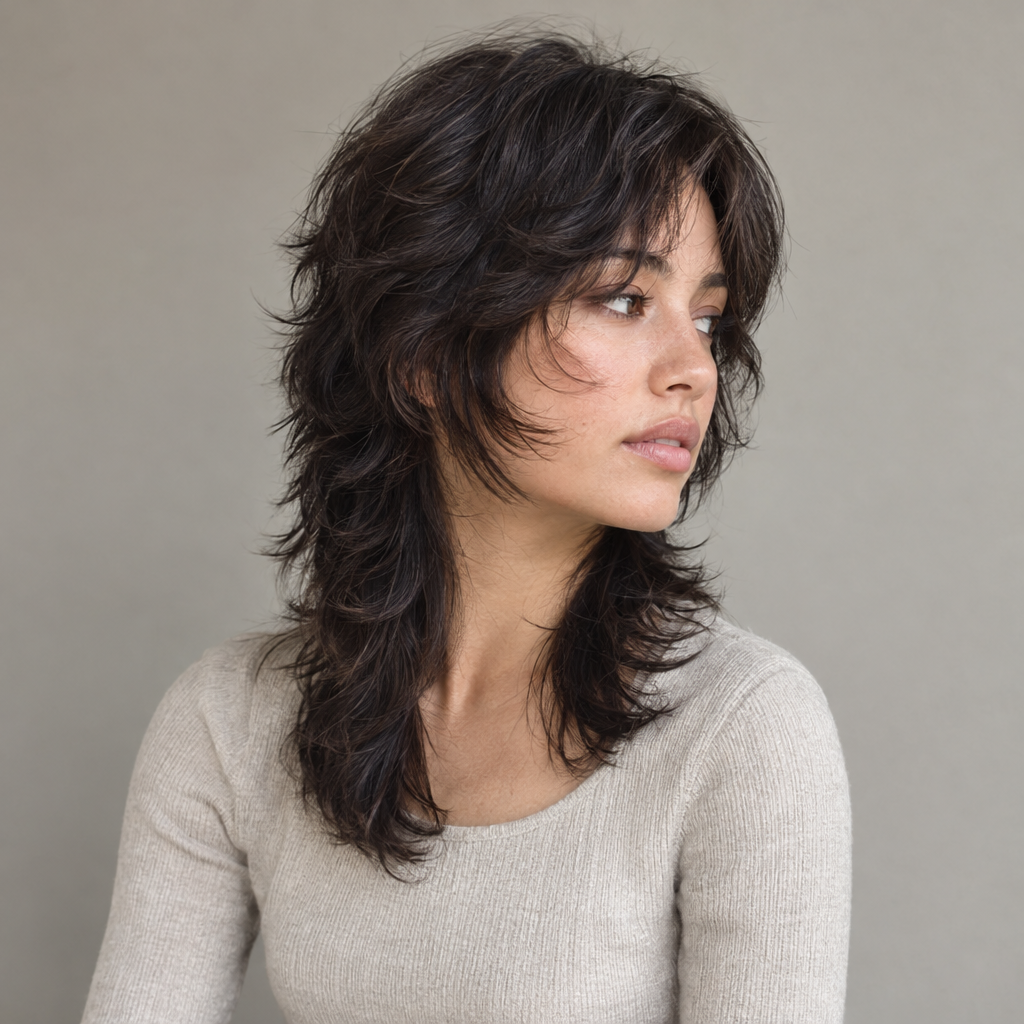
Four structural elements give the cut its recognizable shape:
- Shorter crown layers. Layers around the top and back of the head create separation and can encourage lift. Shorter layers usually make the contrast with the lengths more noticeable, but they do not guarantee volume.
- Face-framing pieces. Shorter sections around the face connect the front to the sides. They can begin near the eyes, cheeks, or chin, depending on the intended shape.
- Visible movement. Layered sections separate, bend, or curl rather than falling as one continuous sheet.
- A longer or tapered perimeter. The perimeter is the haircut’s outer edge. It retains length beneath the shorter layers and may look softly full, feathered, or deliberately wispy.
Layers redistribute existing hair; they do not create additional density. A crown that looks fuller can come at the expense of weight through the lengths, especially when substantial hair is removed.
What to look for from each angle
- Front: Face framing, fullness around the upper sides, and longer pieces beneath it. Bangs are optional.
- Profile: A visible difference between the shorter crown and longer back, with either a gradual or pronounced transition.
- Back: Layered movement above a longer outline. The ends may taper, but they should not automatically look thin.
A generally layered cut can keep most of its weight near the bottom. A wolf cut usually makes the upper layers more prominent.
Wolf cut vs. shag vs. mullet
These names overlap. The useful distinctions are where the shorter sections sit and how they connect to the remaining length.
| Cut | Typical structure | Length relationship |
|---|---|---|
| Wolf cut | Pronounced crown layering | Longer, often tapered perimeter |
| Shag | Layers distributed throughout | More continuous layered movement |
| Mullet | Shorter front and sides | Stronger contrast with longer back |
A shag can have short crown layers, and a wolf cut can lean toward a mullet. Neither label guarantees a particular fringe, length, or finish.
For a clearer salon conversation, describe crown height, perimeter fullness, and disconnection. Disconnection means shorter and longer sections meet with a deliberate contrast rather than a fully graduated transition.
Two cuts called “wolf cuts” can therefore look substantially different. One might have long, blended layers and full ends, while another has a short, rounded top above a narrow, wispy back.
Will a wolf cut work with your hair and routine?
Use this four-factor suitability matrix as a starting point. The behavior column identifies a possible issue, while the customization column gives you a specific option to discuss with your stylist.
| Factor | What to observe | Customization to discuss |
|---|---|---|
| Hair density | Lower density may leave fewer strands at the perimeter; higher density may expand around the crown | Preserve more perimeter weight for lower-density hair; remove internal bulk selectively for higher-density hair |
| Strand thickness | Fine strands may collapse under heavy products; coarse strands may project outward when cut short | If coarse crown sections project outward when dry, retain more crown length instead of assuming heavy thinning is needed |
| Natural pattern | Straight hair exposes layer steps; curls and coils may sit much shorter when dry | Plan the shortest layers around the natural dry outline and the amount of shrinkage observed in each area |
| Styling tolerance | Short layers may need drying or product to hold a particular direction | Choose longer, more blended crown layers if you prefer air-drying or minimal daily shaping |
Density and strand thickness are separate factors
Lower-density hair may show more space between layered sections, especially through the ends. Keeping a fuller perimeter can be more useful than pursuing very short crown layers for apparent volume.
Fine hair and low-density hair are not the same. You can have many fine strands or relatively few coarse strands. The cut should respond to how the hair behaves when dry rather than relying on either label alone.
Natural pattern changes where layers settle
Straight hair makes differences between layer lengths easy to see. Wavy hair may gain movement as weight changes, while curly and coily hair can spring upward after the crown is shortened.
If your curl or coil pattern varies across your head, the same wet cutting length may not produce an even dry outline. Ask the stylist to account for those differences before removing more length.
Your everyday routine matters more than the salon finish
A highly shaped reference created with a blow-dryer or curling tool may not represent an air-dried result. If your routine is wash, apply one product, and leave the hair alone, the layers should be designed around that routine.
Before agreeing to a short crown, ask: “How will these layers sit when I wear my hair naturally?”
How your starting length affects the cut
Your current shape determines how much contrast can be created without sacrificing more length than expected.
If the back is already short
There may not be enough length to create a pronounced tail beneath the crown. A compact wolf cut is still possible, but it may read more like a short shag until the back grows.
If the crown is already short
Avoid automatically cutting it shorter to make the result feel more dramatic. The stylist may be able to reshape the sides and perimeter while allowing the existing crown to grow into a better proportion.
If your hair is long
Long hair offers more room for crown-to-perimeter contrast, but extensive layering can remove considerable fullness from the lower lengths. Decide how much visible weight you want to keep before choosing the shortest crown point.
If your hair is mostly one length
The first wolf cut can feel like a significant change because weight shifts upward. A softer version with longer crown layers gives you movement while preserving more of the original outline and tying-back ability.
Choose a soft, balanced, or high-contrast wolf cut
These categories are consultation descriptions rather than universal salon standards.
| Version | Crown and perimeter | Visual result | Styling and grow-out |
|---|---|---|---|
| Soft | Longer, blended crown with a fuller perimeter | Layered movement without a sharply separated top | Usually easier to tie back and less abrupt as it grows |
| Balanced | Noticeable crown contrast with connected sides | Recognizable wolf-cut outline without an extremely narrow back | May need some root and face-framing direction |
| High-contrast | Short crown with lighter ends or clearer disconnection | Strong separation between the upper shape and longer back | More pieces may escape tied styles, and the crown takes longer to catch up |
If you’re still exploring which wolf cut variation suits your preferences, Facefy’s Hairstyle Finder can help you discover hairstyle ideas and compare different looks. Use those ideas as a starting point, then discuss the layering, length, and styling requirements with your hairstylist.
Soft wolf cut
Choose a soft version if you want to keep substantial length, preserve visible fullness, or minimize daily shaping. Confirm that the shortest layers are long enough for any ponytail, bun, or clip styles you regularly wear.
Balanced wolf cut
A balanced version suits someone who wants visible texture without a strongly disconnected back. It offers more crown definition than the soft version, but enough connection through the sides to avoid an exaggerated top-and-tail effect.
High-contrast wolf cut
Choose this version for the contrast itself, not because more layers sound like an automatic route to volume. Short sections can require deliberate styling, and they may fall out of tied styles until they grow longer.
Important adjustments for low-density, curly, and coily hair
Low-density hair: preserve the outline first
For low-density hair, the key question is how much hair will remain through the bottom edge after layering.
Ask about:
- Keeping the crown layers longer or using fewer short sections.
- Retaining a fuller perimeter instead of making every end wispy.
- Limiting aggressive thinning through already-light lengths.
- Checking how the ends look with your usual part and natural finish.
Sparse-looking ends can occur even when individual strands are coarse. The issue is how much hair reaches the perimeter, not just strand thickness.
Curly and coily hair: plan for the dry shape
Wet or stretched length does not show exactly where a curl or coil will sit after drying. Shortening the crown can produce more apparent lift than expected, especially if that area has a tighter pattern than the sides.
Discuss the shape you want in its usual dry state. Before removing more length, have the stylist check where the crown and face-framing sections settle without being pulled straight. Sections with different curl patterns may need different treatment.
Also distinguish between your natural and stretched routines. A shape planned for a stretched finish may look quite different when worn unstretched.
Cutting techniques are choices, not guarantees
Razor cutting, thinning shears, point cutting, and slide cutting can all change weight and edge texture. None is universally right or wrong for every wolf cut.
Ask what the technique is intended to accomplish: soften a heavy edge, remove internal bulk, or create visible separation. If your ends are already light, further weight removal may work against the outline you want.
Five details to give your hairstylist
A useful request defines these five choices before cutting begins.
- The shortest acceptable crown layer. Ask the stylist to show where that section is expected to sit when dry. This affects lift, styling behavior, and contrast with the longer hair. Mention if you need the upper sections to stay in a ponytail.
- The face-framing endpoint. Identify whether the shortest front pieces should finish near the cheekbone, chin, or collarbone. This changes the front outline and whether those pieces can tuck behind the ears.
- The perimeter weight to retain. Specify full, softly tapered, or deliberately wispy ends. This determines how substantial the bottom of the cut looks.
- Blended or disconnected sides. Blending creates a more continuous transition. Disconnection makes the shorter and longer sections more distinct.
- Whether fringe is included. State full bangs, parted fringe, side fringe, or no fringe. This affects how the front joins the crown and how often it may need reshaping.
When deciding where your face-framing layers should fall, you can also consider your overall facial outline. Facefy’s Face Shape Detector provides an estimated face-shape classification from a photo, which you can use as an additional styling reference. Face shape is not a rule for choosing a wolf cut, and your hair texture, density, and personal preferences remain important.
A detailed request might sound like:
“My hair is lower-density with fine strands and a loose wave, and I usually air-dry it. I want a balanced wolf cut, but I need most of my hair to tie back. Keep the crown layers on the longer side, retain a fairly full perimeter, start the face framing around my chin, blend the sides, and leave out a short fringe.”
In this example, the longer crown reduces the chance of short sections collapsing or escaping tied styles. The fuller perimeter keeps more visible weight through lower-density ends. The trade-off is a softer crown-to-length contrast than a short, heavily layered reference would show.
There is no universally correct crown measurement. The same cut length can sit differently on straight hair, loose waves, or tightly coiled hair.
Use reference photos without asking for an exact copy
Bring enough information to show the whole shape, not just the most flattering angle.
Reference-photo self-check
- Include at least a front, side, and back view of the intended cut.
- Include one image with a similar natural pattern or hair density.
- Identify one feature you want from each reference.
- Identify one feature you do not want from each reference.
- Separate the haircut from the styling finish.
For example: “I like this crown height, but not the thin ends,” or “I want this face framing without the disconnected sides.”
Look at crown height, front pieces, side connection, perimeter fullness, fringe, and finish separately. If the images show different people, explain which details belong together in your preferred version.
Photos cannot fully reveal density, movement, or daily styling effort. Lighting, camera angle, crop, and image quality can obscure the outline. Editing, extensions, and heavy styling may also make a reference look fuller or more structured than the haircut alone would produce.
How to style a wolf cut by natural pattern and finish
Choose the finish before choosing extremely short layers. An air-dried cut and a smooth, rounded blowout may need different structural compromises.
Straight hair: choose separation or a smoother outline
For an air-dried finish, arrange the part while damp and guide the front pieces into place. A small amount of lightweight styling product can encourage separation, but it will not reliably create a wave pattern that is not there.
For a tousled finish, use loose heat-free bends or selectively shape a few sections with a heat tool. Use heat protection and avoid repeatedly passing over the same pieces.
For a smoother finish, dry the roots in the intended direction, then guide the lengths with a brush. Excessive rounding at the crown can create more height than you wanted.
Wavy hair: guide the crown before it dries
Apply your preferred lightweight mousse or gel to damp hair, then scrunch gently. Arrange the part and any crown sections that tend to split or flatten before leaving them to dry.
Air-drying is an option. If diffusing, use gentle airflow and minimize disturbance while the waves set. Avoid continually touching the crown, which can break up the wave groups.
Curly hair: define without flattening the shape
Distribute styling product through damp sections, then group or define curls in their natural direction. Pay particular attention to the shorter crown pieces so they do not dry pressed flat beneath longer sections.
Air-dry or diffuse according to your routine. Once fully dry, separate only where needed rather than pulling every curl apart.
Coily hair: style for the intended dry outline
Use your usual sectioning and defining method, accounting for areas that shrink differently. Decide whether the target finish is naturally defined, picked out, twisted, or stretched.
Those finishes can produce different silhouettes from the same cut. Tell your stylist which one you wear most often so the crown is not planned around an occasional finish.
Root direction changes the result
Drying roots upward or briefly against their usual fall can encourage lift. Guiding them closer to the head produces a more controlled outline. A different part may also redistribute crown fullness.
More lift is not always the goal. If the crown already expands readily, focus on direction and definition rather than adding volume.
Maintenance and grow-out expectations
Use these as planning ranges, not fixed appointments:
- Fringe reshaping: Around 3 to 6 weeks, if you want to maintain a specific length or opening.
- Overall layered silhouette: Reassess around 8 to 12 weeks, depending on how the shape settles.
Slower growth, longer versions, and deliberately undone finishes may allow longer intervals. A short, precise fringe may need attention before the rest of the cut.
The sections also change visually in different ways. Fringe can begin obstructing vision, the crown may lose lift, and the perimeter may need tidying while the overall length still feels right.
A softer, blended cut generally grows out less abruptly than a highly disconnected version. If your goal is to grow it out, say so at every appointment. Repeatedly shortening the crown maintains the contrast rather than helping those layers catch up.
Troubleshooting a wolf cut that is not sitting as expected
Flat crown
First, try changing the part or drying the roots in a different direction. Use less heavy product near the roots and avoid letting damp crown sections dry pressed against the head.
If the issue persists, ask whether the crown layers are too long or heavy for the intended finish. Do not assume making them much shorter will solve it. Some hair still settles flat after cutting.
Overly puffy crown
Try more controlled drying, less lifting at the roots, and more consistent curl or wave grouping. Avoid separating the upper sections excessively once dry.
If the outline remains wider than intended, discuss conservative blending with your stylist. Further shortening can sometimes increase expansion rather than reduce it.
Sparse-looking ends
Avoid further aggressive thinning. Style the ends with less separation so they read as a more connected edge.
If too much weight has been removed, allowing the shorter layers to grow can help rebuild fullness at the perimeter. A modest perimeter trim may make the edge look fuller, but it trades some overall length for that effect.
Awkward grow-out
Changing the part or switching between a tousled and smoother finish may make the transition easier. A stylist can sometimes soften disconnected areas without substantially shortening the whole cut.
Otherwise, letting the shorter layers catch up may be the most practical option. Cutting an already-short crown at home can prolong the grow-out and leave fewer options for reshaping.
If several sections seem difficult at once, bring photos of both the freshly styled and everyday result to a consultation rather than repeatedly trimming individual pieces.
Wolf cut questions people often ask
Does a wolf cut need bangs?
No. Face-framing layers can connect the front to the sides without a separate fringe. Bangs change the front outline and add another section to style and maintain, but they are not required.
Can you style a wolf cut without heat?
Yes, especially when the layers are planned around your natural pattern. Air-drying, gentle scrunching, curl definition, and heat-free shaping can all be options. A smooth blowout reference, however, may not represent the result you will get without heat.
Can fine hair have a wolf cut?
Yes. Fine strands do not automatically rule it out. Assess density separately, preserve enough perimeter weight, and avoid assuming that extensive thinning will create lasting fullness.
Is a wolf cut low-maintenance?
It can be, but the name alone does not tell you. Longer blended layers with no short fringe may fit a simple routine. A short crown, strong disconnection, or carefully shaped fringe can require more attention.
The most manageable version is the one designed around how your hair naturally settles and how you prefer to wear it on an ordinary day.
What a digital wolf cut preview can and cannot show
A digital preview can help you compare broad outlines: a fuller perimeter versus lighter ends, softer layering versus a pronounced crown, or a fringe versus an open front.
Facefy’s Hair Style Try-On offers a way to explore a different look from a photo and bring a visual starting point to a salon conversation.
Treat the result as an estimated visualization, not a haircut guarantee. Lighting, angle, crop, hair visibility, and image quality can influence the preview. It cannot reliably predict your actual density, movement, shrinkage, strand behavior, or a stylist’s precise execution.
The useful question is, “Do I like this overall outline?” Your stylist can then assess how to approach it with your hair.