Long Layers: How to Choose and Request the Right Haircut
Learn what long layers are, how they work across hair textures, what to request at the salon, and how to avoid common styling surprises.
Long layers are sections of hair cut at different lengths while the overall haircut stays long. The result depends on three choices: where the shortest layer begins, how much separation appears between lengths, and how much fullness remains along the bottom edge, also called the perimeter.
Those choices determine whether you get subtle movement, clearly visible layering, redistributed volume, or lighter ends. Asking for “long layers” alone leaves room for very different results, so it helps to describe both the shape you want and how you wear your hair day to day.
What long layers actually change
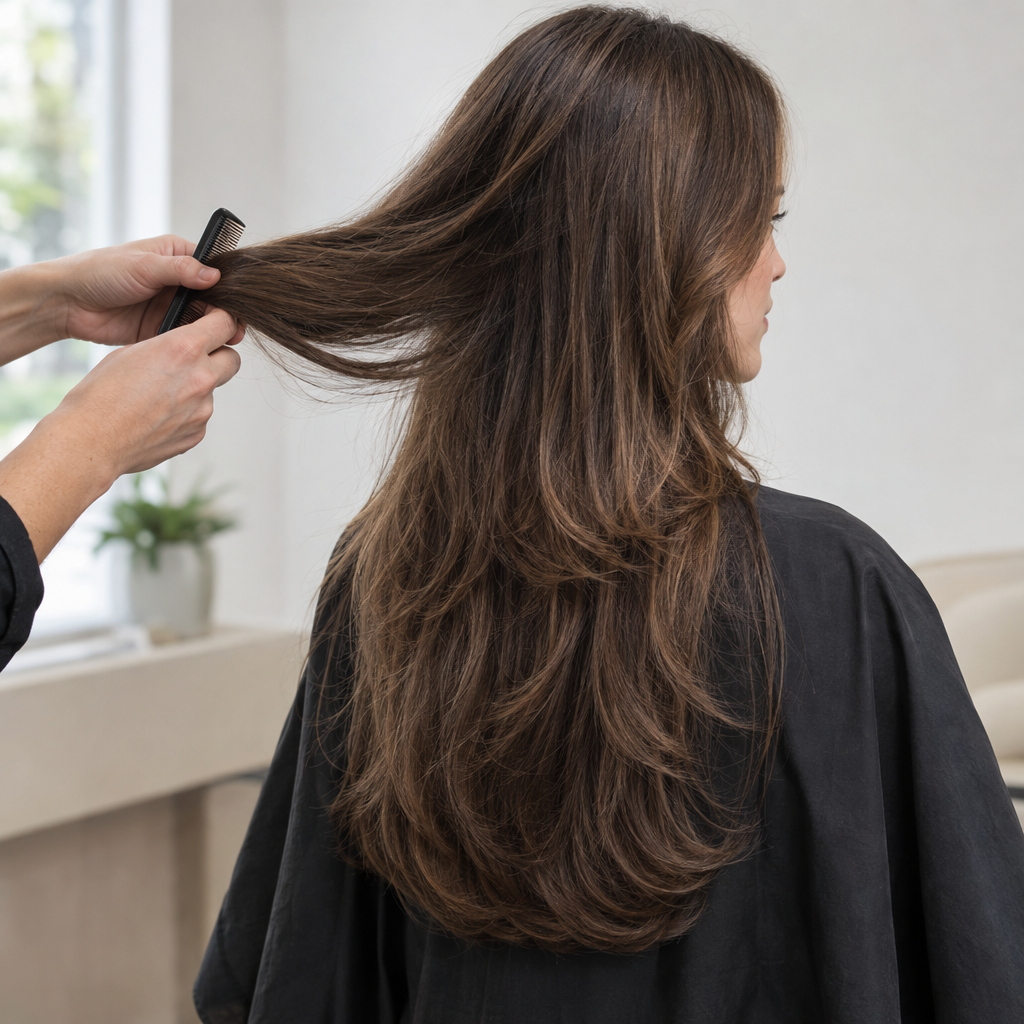
A one-length haircut brings much of the hair down to a shared perimeter. Layering creates shorter lengths within that outline, changing where the hair’s weight sits without necessarily taking much length off the bottom.
Three design decisions make the biggest difference.
1. Where the shortest layer starts. A higher starting point introduces shorter pieces farther up the haircut, which can make movement more noticeable around the upper lengths. Layers beginning closer to the bottom concentrate the change near the ends. A shoulder-level shortest layer and a chest-level shortest layer will behave differently on waist-length hair, even though both cuts might be described as long layers.
2. How much separation appears between lengths. Closely blended transitions create a quieter effect, especially on straight hair. More distinct differences between lengths make individual sections easier to see, particularly when curled or blow-dried. Greater separation can also leave less hair reaching the lowest edge.
3. How much fullness stays at the perimeter. A substantial bottom edge gives the haircut a solid outline. A lighter perimeter looks more tapered or airy. Neither is inherently better, but someone who wants movement and thick-looking ends needs both priorities included in the consultation.
Layers can remove weight in one area while allowing more visible volume elsewhere. For example, reducing weight through wavy mid-lengths may let those sections bend more readily, even though the haircut contains less hair overall.
They do not guarantee root lift or easier styling. Cutting can remove split portions where they are trimmed, but layering does not repair damaged hair or necessarily remove every split end.
Four layering terms that describe different results
These terms can overlap within one haircut. The useful distinction is where the change happens and what you can see afterward.
- All-over long layers: Shorter lengths run through the back and sides. You may notice movement across the whole haircut rather than only around the face, with sections falling at different points through the mid-lengths and ends.
- Face-framing pieces: The cutting effect is concentrated near the front. Pieces may curve or fall around the cheeks, jaw, or collarbone while the back remains relatively one-length.
- Internal or invisible layers: Shorter sections sit beneath a longer surface. The hair may feel less heavy or move more freely while the outer outline stays comparatively smooth. “Invisible” is a descriptive salon term, not a guarantee that no shorter sections will show.
- Perimeter graduation: Lengths build weight near the outer edge, creating a compact or softly stacked effect in that area. This differs from distributing layers throughout the interior of the haircut.
A front-view photo may show face framing without revealing whether the back is layered. Likewise, subtle internal work may be difficult to identify in a still image.
How stylists create movement and preserve length
Three cutting concepts help explain why similar starting lengths can produce different finishes.
Elevation means lifting the hair away from its natural fall while cutting. When hair is cut with little lift, more strands tend to finish near the same lower outline, which retains weight at the perimeter. Lifting sections farther from their natural fall generally creates a larger difference between the shorter interior pieces and the longest edge. That produces more layering through the interior and leaves fewer strands reaching the bottom. Sectioning, guides, overdirection, and cutting angles also affect the result, so elevation alone does not define the finished haircut.
Overdirection means moving a section away from where it naturally falls before cutting it. When released, that section travels back to its own position. This can help preserve length or concentrate weight in selected areas rather than removing the same amount everywhere.
Internal weight removal reduces selected bulk beneath the surface. It can create room for sections to move without leaving a strongly stepped outline. Too much removal, however, can make some textures look wispy, separate unevenly, or become harder to manage.
You do not need to request a particular angle, tool, or cutting method. Describe the result you want, then let the stylist choose an approach suited to your texture, density, growth patterns, and condition.
How long layers behave across textures and densities
Fine hair describes the thickness of individual strands. Density describes how much hair grows across the scalp. They are separate characteristics, which is why fine hair does not necessarily mean low-density hair.
Use this comparison to identify the benefit you want, the tradeoff you want to avoid, and the point to raise at the salon.
| Hair characteristics | Potential benefit | Tradeoff | Consultation point |
|---|---|---|---|
| Fine, straight hair | Subtle layering can add movement through otherwise uniform lengths. | Removing too much hair from the lower lengths can make the perimeter look sparse. | Ask how much fullness will remain at the bottom and whether restrained layering can provide enough movement. |
| Dense, straight hair | Redistributing internal weight can make heavy sections move more freely. | Layers concentrated near the ends may leave heaviness higher up unchanged. | Show exactly where the hair feels bulky, such as behind the ears or through the back, rather than asking for thinning everywhere. |
| Fine, wavy hair | Reduced weight can help waves separate and become more visible. | Very short or widely separated sections may leave gaps between waves or thin-looking ends. | Show your usual air-dried finish and discuss keeping enough hair together for the waves to form cohesive sections. |
| Dense, wavy hair | Well-placed layers can interrupt a heavy, solid shape and improve movement through the sides. | Excessive removal can let some sections expand while others remain heavy, creating an uneven outline. | Discuss side fullness and end density separately, including where you want to retain width. |
| Loose curls | Different lengths can allow curls to sit at several heights instead of gathering mainly at the bottom. | Shrinkage changes where the shortest sections land, and curl patterns may vary across the head. | Agree on the shortest acceptable length in its dry, naturally curled state, not only when stretched. |
| Tighter curls | Shaping can redistribute curl volume from the lower outline toward selected areas through the sides or upper lengths. | Stretched reference photos may misrepresent dry length, and different sections may shrink by different amounts. | Identify where you want more or less width, then discuss dry length, shrinkage, detangling, and your usual styling routine. |
If your characteristics overlap, combine the relevant guidance rather than choosing only one row. Someone with fine strands and high-density straight hair, for example, may benefit from targeted internal weight removal while still needing a strong perimeter to keep the ends from looking delicate.
Very long hair adds another consideration: closely blended layers may be difficult to see across a large expanse of length. More separation can make them clearer, but preserving both maximum length and a full perimeter may limit how dramatic the result can be.
Who may prefer long layers, and who may want fewer
Long layers are worth considering if you want to keep substantial length but change how the hair moves. They may also suit a routine that already includes waves, curls, or a blowout, since those finishes make differences in length easier to see.
Use your main priority to guide the decision:
- Movement matters most: Discuss where you want the movement to begin, not simply how many layers you want.
- Full-looking ends matter most: Favor a stronger perimeter and ask how much layering it can support.
- Ponytails and braids are everyday styles: Keep front and upper sections long enough to stay secured. Shorter pieces may escape or protrude from a braid.
- You prefer a solid, smooth outline: Fewer layers or restrained internal shaping may better match that preference.
- Your ends are fragile or already sparse: Discuss establishing a fuller edge before adding extensive layering.
- You mostly air-dry: Choose the design around your natural texture rather than a finish that depends on round-brush styling.
Minimal styling does not automatically rule out layers. A cut that follows your natural wave or curl pattern may work well with little intervention. The important question is whether you like its everyday finish, not only its salon finish.
Face shape can inform preferences around the front, but texture, density, current length, and routine usually provide more practical constraints.
How to judge a long-layer reference photo
A useful reference shows enough of the haircut to explain what you like. Before saving one, check these five things:
- Comparable starting length: Is the pictured hair close to your current length, or would the result require growing it first?
- Similar density: Look through the mid-lengths and ends, not just at fullness near the crown.
- Similar natural texture: A curled finish on naturally straight hair is not the same reference as naturally curly hair.
- An unstyled or minimally styled view: Look for another photo showing the cut without a polished blowout.
- A clearly visible perimeter: The bottom edge should not be hidden behind clothing, brought entirely over one shoulder, or cropped out.
A polished blowout can exaggerate movement by bending each layer away from the next. It can also obscure how the haircut lies when air-dried. Ask yourself: “Do I like the actual outline, or mainly the styling?”
Camera angle, lighting, extensions, and hair placement can change apparent fullness. A back view and a side view usually reveal more than a single posed front image.
If you want to explore a different overall shape before your appointment, Facefy’s Hair Style Try-On can help you preview hairstyles on a photo. Use it to compare broad silhouettes, not to predict exact layer placement, density, shrinkage, or how your own hair will respond to cutting.
What to say during your salon consultation
Clear boundaries are more useful than a haircut name alone. You can adapt this script:
“I want to keep my overall length around this point. I don’t want the shortest layer to begin above this point when my hair is dry. I want the bottom edge to stay full, and these front pieces need to reach my ponytail. I usually air-dry my hair, with occasional heat styling. I’d like movement through the mid-lengths without very wispy ends.”
Point to those locations on your own hair. A fixed measurement is less useful if you and your stylist are imagining different starting points, especially when curls shrink as they dry.
Then cover the practical details:
- Tied styles: Explain whether you rely on ponytails, braids, clips, or updos. Bring your usual tie or clip if reach is important.
- Parting: Show where you normally part your hair and mention if you switch sides.
- Natural texture: Describe what happens after washing, including uneven waves or different curl patterns.
- Styling frequency: Be specific about how often you blow-dry, straighten, curl, or air-dry.
- Everyday appearance: Ask, “What will these layers look like without the salon styling?”
Use reference photos to name individual features: a full bottom edge, movement below the shoulders, or front pieces that remain long. That gives the stylist something actionable without expecting an exact copy of someone else’s hair.
Styling and maintaining long layers
Work with your usual texture
Straight hair: Air-drying will usually show a smoother, subtler version of the cut. A round brush can curve the ends, while a few gentle bends through the mid-lengths can reveal the separation between layers.
Wavy hair: Style around the wave pattern rather than brushing it into a different shape as it dries. An optional lightweight mousse can provide hold for fine waves. Scrunching damp sections and limiting disturbance during drying may help the waves stay grouped.
Curly hair: Distribute your preferred styling product evenly through sections so the upper layers and lower lengths are not treated differently by accident. An optional gel can provide hold and help curl groups remain defined as the hair dries. Judge where the layers land once the hair is dry and has reached its usual shrinkage.
Heat styling can make layering more obvious, but it is not a requirement. If you use heat, follow your tool’s guidance and apply a heat-protectant product.
Reshape according to the outline, not a rigid calendar
There is no single maintenance interval for long layers. Growth, texture, end condition, and the amount of visible separation you prefer all affect when reshaping becomes useful.
Watch for practical changes: the lower section starts feeling heavy again, previously distinct layers blend together, or the front pieces no longer sit where you like them. These are more useful cues than assuming everyone needs the same schedule.
Dry or split ends can make layered sections look less cohesive. Trimming removes the affected portions that are cut off. It does not repair the remaining hair fiber.
Some people also notice more tangling where shorter ends meet longer lengths, particularly on very long or textured hair. Detangle gently in sections using a method appropriate for your texture, working from the ends upward rather than pulling through a knot.
Why long layers sometimes disappoint
The ends look too sparse
Too much hair may have been removed from the lower lengths, leaving too few strands reaching the perimeter.
Show the stylist where the edge becomes see-through and discuss preserving a stronger outline. Depending on the cut, that may mean letting shorter sections grow, trimming the longest edge, or combining both. Further thinning will not restore missing fullness.
The layers disappear without styling
The transitions may be deliberately subtle, or the reference photo may have relied on a blowout to separate them.
Look at the cut in your normal finish before requesting more layering. If you want a clearer effect, discuss whether greater separation is compatible with the end density you want to retain.
The upper section remains bulky
Layers may begin below the area that feels heavy, or internal weight may remain concentrated in that spot.
Point out the specific section rather than asking for the entire haircut to be lighter. Targeted shaping may be more appropriate than removing weight everywhere, particularly if you already like the ends.
Shorter pieces fall out of tied styles
The highest layers or front pieces may be shorter than your ponytail, braid, or clip requires. The consultation may not have established that practical minimum.
Bring your usual accessory to a follow-up appointment and show which pieces escape. Those sections may need time to grow. Cutting them shorter cannot make them reach farther.
The result looks unlike the reference
Differences in texture, density, length, styling, extensions, or camera presentation may explain the mismatch.
Identify the visible difference: too much width at the sides, less fullness at the bottom, or movement beginning higher than expected. A follow-up conversation built around those observations gives your stylist a clearer problem to address than simply asking for “better layers.”