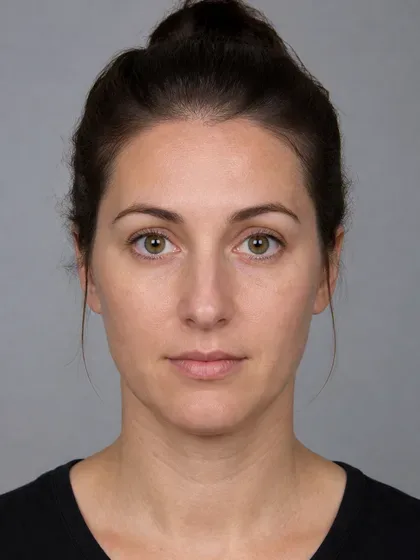
ANALYZE YOUR FACIAL PROPORTIONS
Facial Ratios
Upload one selfie to explore your facial proportions. Analyze the relationships between facial width, height, feature spacing, and key facial regions.


Use a clear, front-facing selfie with good lighting and your face fully visible.
How it works
How it works
- 01
Upload Your Selfie
Choose a clear, front-facing photo where your entire face is visible. Keep your head straight and avoid strong filters or extreme camera angles.
- 02
Explore Your Facial Proportions
Facefy examines visible relationships between different facial areas, including overall dimensions, feature spacing and relative proportions.
- 03
Discover Your Facial Ratios
Explore how different parts of your face relate to one another and learn more about the proportions that make your facial structure unique.
Guide
Discover Your Facial Ratios
Faces are not defined by individual features alone.
The way those features relate to one another plays an important role in overall facial structure.
Your eyes can be large or small relative to your face. Your jaw can be broad compared with your cheekbones. Your lower face can appear longer or shorter relative to the rest of your facial height.
These relationships are what we mean by facial ratios.
Facefy's Facial Ratios tool lets you explore these proportions from your own photo.
Instead of manually measuring your face and calculating multiple relationships yourself, upload a clear selfie and explore the proportions between different visible facial regions.
The purpose is not to determine whether your face has “perfect” proportions.
There is no single universal set of measurements that every face should match.
Facial ratio analysis is much more useful as a way to understand how your own features work together.
What Are Facial Ratios?
A facial ratio compares one facial measurement with another.
Imagine measuring two distances on a face.
Looking at either distance individually tells you relatively little. When you compare them, however, you begin to understand the proportional relationship between those features.
For example, facial width can be considered relative to facial height.
Jaw width can be considered relative to cheekbone width.
Distances within the eye area can be considered relative to the overall width of the face.
These relationships help describe facial structure without relying only on absolute measurements.
This matters because two people can have similarly sized features but very different overall appearances.
The surrounding proportions change how those features are perceived.
Why Facial Proportions Matter
Think about a single feature such as the jaw.
Calling a jaw “wide” does not mean much without context.
Wide compared with what?
If the cheekbones and forehead are similarly broad, the jaw may create a relatively straight facial outline.
If the cheekbones are considerably wider than the jaw, the same jaw measurement could contribute to a more tapered appearance.
The same principle applies throughout the face.
Feature size is always perceived in context.
That is why facial proportion analysis focuses on relationships rather than isolated measurements.
It provides a more complete picture of facial structure.
Face Length-to-Width Ratio
One of the broadest facial relationships is the ratio between overall face length and width.
Some faces appear relatively long and narrow.
Others appear shorter and wider.
These differences contribute to overall facial shape.
For example, an oblong face generally has greater visible length relative to width, while a rounder face tends to have a more similar relationship between those dimensions.
However, the length-to-width ratio alone does not determine face shape.
The forehead, cheekbones and jaw also influence the outline.
If identifying your overall facial shape is your primary goal, Facefy's Face Shape Detector provides a dedicated analysis.
Understanding Vertical Facial Proportions
Your face can also be examined vertically.
Different regions contribute to the total visible height of the face.
The upper, middle and lower facial areas can vary in relative length from one person to another.
One person may have a relatively longer lower face.
Another may have more visible height through the forehead.
A third may have proportions that appear more evenly distributed.
These differences can change the overall impression of facial structure even when two people have similar face shapes.
Vertical proportions are therefore useful when looking beyond simple categories such as oval, square or round.
Horizontal Facial Proportions
Horizontal proportions describe relationships across the width of the face.
This can include the width of different facial regions and the spacing between features.
The forehead, cheekbones and jaw do not necessarily have the same width.
Their relationship contributes heavily to the facial outline.
For example, prominent cheekbone width combined with a narrower forehead and jaw can contribute to a diamond-shaped appearance.
A broader jaw with similar forehead width can contribute to a squarer outline.
These proportional relationships are one reason Facefy's Face Shape Detector and Facial Ratios tools complement each other.
One identifies an overall shape category, while the other explores the relationships behind that structure.
Eye Spacing and Facial Ratios
Eye spacing is frequently discussed in facial proportion analysis.
But simply measuring the distance between the eyes does not provide enough information.
That distance needs context.
The width of each eye and the overall dimensions of the face influence how the spacing appears.
This illustrates an important principle of facial ratios: relative measurements are often more informative than absolute measurements.
Two people can have the same physical distance between their eyes but appear very different because the surrounding facial dimensions differ.
If you are interested in the eyes beyond spacing and proportions, Facefy's Eye Shape tool explores visible eye characteristics separately.
Eye Orientation vs. Eye Proportions
Another distinction worth understanding is the difference between eye proportions and eye orientation.
Facial ratios may examine how eye-related measurements compare with surrounding facial dimensions.
Canthal tilt asks a different question.
It describes the visible angle between the inner and outer corners of the eye.
A positive, neutral or negative canthal tilt is therefore not itself a facial ratio in the same sense as comparing two distances.
If eye orientation is what interests you, use Facefy's Canthal Tilt tool.
Keeping these measurements separate makes it easier to understand what each characteristic actually describes.
Jaw-to-Cheekbone Proportions
The relationship between the jaw and cheekbones has a strong influence on the visible shape of the lower face.
When the jaw is relatively broad compared with the cheekbones, the sides of the face may appear straighter.
When the jaw is considerably narrower, the face can appear more tapered toward the chin.
Neither proportion is inherently better.
They simply create different facial structures.
The chin adds another dimension because its width, projection and shape can affect how the lower face is perceived.
If you want to explore this region in more detail, Facefy's Jawline Rating focuses specifically on the visible characteristics of the jaw and lower face.
Facial Ratios and Face Shape
Facial ratios and face shape are closely connected, but they are not the same thing.
Face shape places the overall outline into a recognizable category.
Facial ratios examine the underlying proportional relationships.
For example, two people may both be categorized as having oval faces while still having noticeably different facial proportions.
One might have a relatively longer lower face.
Another might have different eye spacing or jaw-to-cheekbone relationships.
Face-shape categories are useful simplifications.
Facial ratios allow you to look beyond the label and explore more of the structure underneath it.
Facial Ratios vs. Facial Symmetry
These two concepts are often confused.
Facial ratios compare the relative dimensions of different parts of the face.
Facial symmetry compares corresponding features on the left and right sides.
A face can have balanced proportions while still containing natural left-to-right differences.
Likewise, a highly symmetrical face can have a wide range of proportional relationships.
They describe different aspects of facial geometry.
If you specifically want to compare both sides of your face, use Facefy's Symmetry Checker.
For a more complete understanding, you can explore both analyses rather than expecting one to substitute for the other.
Facial Ratios vs. the Golden Ratio
This distinction is particularly important.
Every golden-ratio facial measurement involves a ratio, but not every facial ratio is the golden ratio.
Facial ratios can have many different numerical relationships.
The golden ratio refers specifically to approximately 1.618.
Some facial-aesthetics systems compare selected facial measurements with that number, but general facial proportion analysis does not require every measurement to approach 1.618.
If you specifically want to explore that mathematical concept, Facefy's Golden Ratio Face tool compares selected facial relationships with golden-ratio-based references.
Facial Ratios gives you the broader view.
Is There a Perfect Facial Ratio?
There is no single scientifically established collection of ratios that defines a universally perfect human face.
This is an important point because facial analysis online can sometimes make mathematical measurements appear more definitive than they are.
Human faces vary enormously.
People from different populations have different average facial characteristics, and individual variation within any population is substantial.
Beauty preferences vary as well.
A proportional relationship can describe facial geometry.
It cannot establish whether everyone will consider that geometry attractive.
Facefy's Facial Ratios tool should therefore be used to explore your facial structure rather than determine whether your face meets an imaginary universal standard.
Do Facial Ratios Determine Attractiveness?
Not by themselves.
Proportions contribute to the overall appearance of a face, but attractiveness involves far more than a collection of measurements.
Facial expression matters.
Styling matters.
Individual preferences matter.
Even the same face can create a different impression depending on hairstyle, lighting and expression.
This is why Facefy separates facial proportion analysis from its Attractiveness Test.
Facial Ratios answers:
How do the dimensions of my facial features relate to one another?
The Attractiveness Test addresses the broader appearance-based question:
How attractive do I look according to this analysis?
They should not be treated as the same result.
Why Camera Distance Matters for Facial Measurements
A photograph converts a three-dimensional face into a two-dimensional image.
Perspective can therefore affect visible proportions.
This is particularly noticeable with very close smartphone selfies.
Features closer to the lens can appear relatively larger, while areas farther from the camera can appear smaller.
The result can change the apparent relationship between the center and outer parts of the face.
Camera distance is therefore important when analyzing proportions.
You do not need professional photography equipment, but avoid holding the camera extremely close to your face if you want a more neutral representation.
Head Position Can Change Apparent Facial Ratios
Head rotation also changes visible measurements.
If your face is turned slightly toward one side, the opposite side becomes partially compressed by perspective.
Widths and distances in the photograph may no longer represent the same relationships you would see in a straight-on portrait.
Tilting the head can create similar problems for vertical measurements.
For facial ratio analysis, the simplest photograph is usually the best:
straight toward the camera, head level, natural expression.
This reduces the number of variables created by the image itself.
What Photo Should You Use for Facial Ratio Analysis?
Choose a clear and recent front-facing photograph.
Your full facial outline should be visible whenever possible.
Avoid strong filters that reshape the face or modify individual features.
For a cleaner analysis:
- Face the camera directly.
- Keep your head level.
- Keep your full face visible.
- Use even lighting.
- Choose a natural camera distance.
- Use a relaxed expression.
- Avoid extreme wide-angle selfies.
- Avoid face-reshaping filters.
- Avoid heavily edited images.
The purpose is not to choose your most flattering photograph.
It is to provide a relatively neutral view of your facial structure.
Can Hairstyle Change Your Facial Proportions?
A hairstyle cannot change the underlying measurements of your face, but it can significantly change how those proportions are perceived.
Bangs can reduce the visible height of the forehead.
Volume around the cheeks can change the apparent width surrounding the midface.
Hair that exposes the jaw creates a different frame from hair that covers the sides of the lower face.
This is one reason certain hairstyles can feel particularly harmonious with certain facial structures.
If you want to use your facial analysis practically, Facefy's Hairstyle Finder can help you explore styles based on your overall look.
You can then visualize different options with the AI Hairstyle Try-On.
Facial Ratios Are One Part of Your Face
Numbers can help describe a face, but they cannot completely represent one.
A ratio can describe the relationship between two measurements.
It cannot describe the way your expression changes when you smile.
It cannot fully capture the interaction between your hair, eyes, skin, movement and personality.
And it cannot determine whether someone will find you attractive.
Use facial ratios for what they do well: describing proportional relationships.
If you want to explore other aspects of your appearance, analyze them separately rather than trying to force every characteristic into a single numerical result.
Build a Complete Picture of Your Facial Structure
Your Facial Ratios result can become a starting point for exploring the rest of your face.
Use the Face Shape Detector to understand your overall facial outline.
Explore your lower-face structure with the Jawline Rating.
Compare left-to-right balance using the Symmetry Checker, or examine golden-ratio-based relationships through Golden Ratio Face.
If you prefer one broader analysis rather than several individual tools, continue to Facefy's Face Report.
Each tool answers a different question.
Together, they provide a much richer picture than any single facial measurement.
FAQ
Frequently asked questions
What are facial ratios?
Facial ratios are proportional relationships between different facial measurements. They help describe how features and facial regions relate to one another rather than looking only at their absolute size.
How can I calculate my facial ratios?
Upload a clear, front-facing photo to Facefy's Facial Ratios tool to explore proportional relationships between visible areas of your face.
What are ideal facial proportions?
There is no universally accepted set of ideal facial proportions. Human faces naturally vary, and facial ratios should not be treated as a universal beauty standard.
Are facial ratios the same as the golden ratio?
No. Facial ratios can describe many different proportional relationships. The golden ratio specifically refers to approximately 1.618. You can explore it with Facefy's Golden Ratio Face tool.
Are facial ratios the same as facial symmetry?
No. Ratios compare dimensions between different facial areas, while symmetry compares corresponding features on the left and right sides. Use the Symmetry Checker to explore symmetry separately.
Can facial ratios determine my face shape?
Facial proportions contribute to face shape, but the overall outline also matters. Facefy's Face Shape Detector is specifically designed for identifying face shape.
Do facial proportions determine attractiveness?
No. Proportions are one aspect of facial appearance, but attractiveness is subjective and cannot be objectively determined from measurements alone.
Why do my facial proportions look different in selfies?
Close camera distances, lens perspective, head rotation and angle can alter the apparent dimensions of facial features in photographs.
What photo should I use for a facial ratio test?
Use a clear, recent, front-facing photo with your head level, even lighting, a natural camera distance and no face-reshaping filters.
Can my hairstyle change my facial ratios?
It does not change your underlying facial measurements, but hairstyle can change how those proportions appear by framing different parts of the face. You can explore suitable styles with Facefy's Hairstyle Finder.
Where can I analyze all my facial features together?
Facefy's Face Report provides a broader facial overview, while individual tools let you examine specific characteristics in greater detail.
Map the proportions that shape your face
Upload one selfie to analyze width, height, spacing, and relationships between facial regions.
Analyze my ratiosNo signup required · Your photo stays private