Edgar Cut Guide: Variations, Barber Requests, and Upkeep
Learn what defines an Edgar cut, compare fringe and fade options, check hair compatibility, and ask your barber for the result you want.
An Edgar cut is a short haircut with a deliberately shaped forehead fringe, a compact top, and visibly shorter sides, usually finished with a taper or fade. Its signature outline can look sharp and high contrast, or softer and more textured.
The right version depends on how your hair falls, its density and strand texture, and how much upkeep you want. Choose the fringe finish and side treatment separately instead of assuming every Edgar needs a ruler-straight front and a high skin fade.
What makes a haircut an Edgar cut?
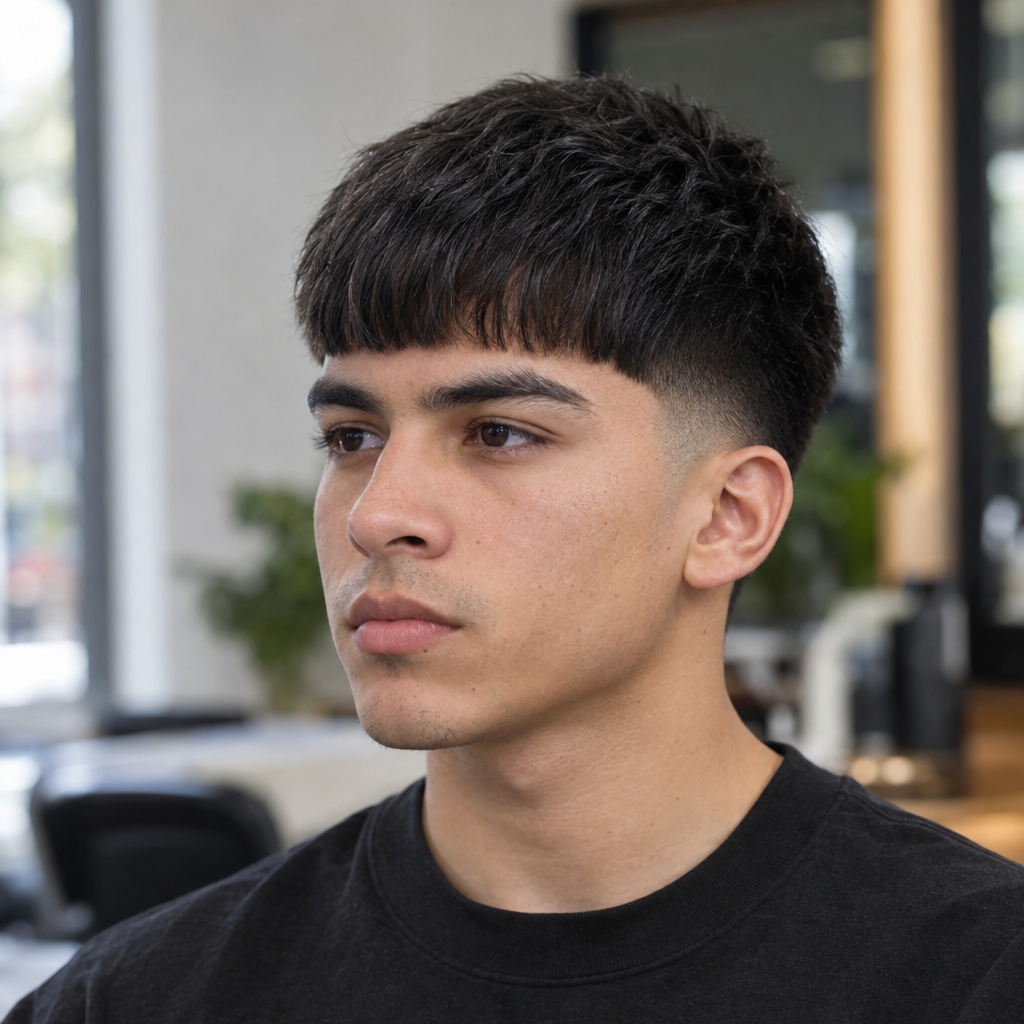
Look for these four features together:
- A shaped forehead fringe. The front forms an intentional edge, often blunt but sometimes softened or adapted to natural texture.
- A compact top. The upper section creates a contained silhouette, even when it has lift or separation.
- Visibly shorter sides. These distinguish the upper shape from the hair around the ears.
- A deliberate transition. A taper or fade connects the longer and shorter areas.
A short haircut does not automatically become an Edgar because some hair falls over the forehead. The combination of the front outline, compact silhouette, and side contrast matters.
The front view shows fringe shape and width. The side view reveals fade height and weight above the ears. A three-quarter view shows whether the front and sides feel connected. Names vary among barbers, so these visible details are more useful than a label alone.
Edgar cut vs. French crop and Caesar cut
These styles overlap, particularly when the fringe is short. Compare the front and top first:
| Style | Fringe shape | Top finish |
|---|---|---|
| Edgar | Deliberately shaped, often blunt | Compact, sometimes lifted or textured |
| French crop | Often broken or softly textured | Forward-directed and usually textured |
| Caesar cut | Short and generally horizontal | Short and relatively uniform |
Then compare the sides and overall contrast:
| Style | Side treatment | Typical contrast |
|---|---|---|
| Edgar | Taper or fade | Often clearly defined |
| French crop | Scissored, tapered, or faded | Variable |
| Caesar cut | Traditionally short, blended sides | Traditionally lower contrast |
A modern Caesar can have faded sides, and a French crop can have a blunt fringe. These are tendencies, not fixed boundaries. If a reference combines elements, describe the individual features instead of debating which name fits.
Choose the fringe finish and side treatment separately
Decision one: What should the front edge look like?
| Fringe finish | Visual effect | Upkeep tradeoff |
|---|---|---|
| Sharp | Strong, straight front outline | Small irregularities become visible quickly |
| Softened | Defined shape with gentler edges | Growth is less obvious between trims |
| Textured | Visible separation and movement | Separation may need restoring with damp fingers and a small amount of product after sleep |
| Curly | Edge follows natural curl grouping | The front may need damp reshaping after sleep and should be checked after drying in your usual routine |
A classic Edgar usually emphasizes the sharp fringe. A textured Edgar breaks up that solid edge, while a softened version keeps its general shape without such a strict line.
A fluffy Edgar describes the top finish, not a separate fade type. It needs enough length to lift and hair that supports that volume. Adding more product cannot reliably make a very short, flat top look fluffy.
For a curly Edgar, the fringe should be judged in its natural, dry pattern. Cutting a stretched section to the desired finished length can leave it shorter than expected once it springs back.
Decision two: How much contrast do you want at the sides?
| Side treatment | Shape and scalp exposure | Upkeep tradeoff |
|---|---|---|
| Taper | Fuller sides with localized short edges | Produces a subtler change as the edges grow |
| Low fade | Short area stays relatively low | Low skin edges still reveal regrowth |
| Mid fade | Blend rises through the middle of the sides | Contrast gradually becomes less crisp |
| High fade | Short area extends higher | Regrowth is often more noticeable |
| Burst fade | Rounded blend around each ear | Curved outline needs careful maintenance |
Fade height describes where the transition sits, not necessarily how short it goes. A low fade can reach skin, while a higher fade can retain visible stubble. Agree on both variables with your barber.
These choices create familiar variations:
- Low-taper Edgar: Preserves more fullness through the sides.
- Mid-fade Edgar: Creates clearer separation between the top and sides.
- High-fade Edgar: Exposes more of the head’s contour and produces stronger contrast.
- Rounded ear-fade Edgar: Concentrates the fade around the ears while potentially retaining more length behind them.
Any suitable fringe finish can pair with these treatments. A sharp front does not require a high fade, and a textured top does not require a soft taper.
Curly and coily Edgar cuts
For curly and coily textures, compare references with similar shrinkage, density, and curl grouping rather than copying the outline alone. A reference with looser curls may not show how a tighter pattern will sit at the same stretched length.
Ask your barber to assess the fringe dry or close to its normal resting state. Decide whether you want the curl groups to form a continuous front outline or create a more irregular, separated edge.
- Visual reference: Facefy’s Hairstyle Finder can help you compare shorter, softer, and higher-contrast directions before your appointment. A visual preview cannot guarantee how your hair will shrink or respond to styling.
Check your hair before choosing the cut
Look at clean, dry hair without forcing it into position. Use these five observations to guide the consultation.
-
Natural fringe direction. Brush the front forward, then release it. Does it stay forward, split sideways, or lift upward? Ask whether the cut can follow that direction or will need regular blow-drying.
-
Front growth pattern. A cowlick near the fringe can interrupt a straight edge. Ask about leaving extra length, shifting the fringe slightly, or softening the outline instead of cutting that section shorter to make it cooperate.
-
Density at the front. Notice whether the front looks solid or naturally separates. Lower density may produce a less continuous blunt line, especially when the fringe is cut very short. Preserving weight can be more useful than trying to force a solid block-like edge.
-
Curl shrinkage. Compare the resting dry fringe with a gently extended section. Agree on where the fringe should land when dry, not only when wet or stretched.
-
Willingness to refresh the outline. Decide whether a slightly softened edge will bother you. If frequent appointments do not fit your routine, request a less rigid fringe and lower-contrast sides.
Density and strand diameter are different variables. Density describes how closely the hairs are packed, while strand diameter describes whether individual strands are fine, medium, or coarse.
Fine but densely packed hair can still create considerable bulk, so selective removal may help the top sit closer without making the fringe thin. Coarse but sparse hair can behave very differently: the individual strands may feel substantial, but removing too much weight can expose gaps at the front. Bulk removal should follow the way the hair is distributed, not strand thickness alone.
Naturally wavy texture may produce a broken fringe even without much texturizing. Straight hair can also separate if the front is fine, sparse, or directed by a strong growth pattern.
Balance fringe length, fade height, and contrast
A shorter fringe exposes more forehead and keeps the outline compact. A longer fringe allows more movement, but it may split, bend, or feel heavier as it grows. Use a visible landmark, such as “clearly above my eyebrows,” rather than relying on “short.”
Choose which feature you want to emphasize:
- Compact and controlled: A contained top with limited separation.
- Soft and textured: A broken edge with some side fullness.
- Lifted and fluffy: Enough top length for root lift.
- Curl-defined: Natural grouping with room for shrinkage.
- Silhouette-led: Fade height and side fullness influence how the forehead, temples, and lower face are visually framed.
If you are deciding how strongly the fringe should alter the upper outline, a broader guide to visual balance can help you describe what you want without treating any single measurement as a rule.
Avoid stacking changes you are unsure about. A very short blunt fringe plus a high skin fade makes two strong changes at once. Keeping more side fullness or softening the fringe offers a less dramatic starting point.
A high fade also exposes more of the side profile, including the temple area and jawline outline. That does not make it better or worse than a low fade. It simply changes which parts of the overall silhouette are most visible.
Also distinguish removing bulk from thinning the edge. Excessive texturizing can make the front look more separated than intended, and cutting an upward-growing section shorter may make it stand up more. Product cannot replace weight that has been removed.
What to ask your barber for
Bring a front reference and a side reference. Identify what you like in each, such as the fringe length, amount of side fullness, shortest fade length, or point where the fade stops.
Photos have limits. Lighting can exaggerate scalp contrast, styling can hide the hair’s natural fall, and a close crop may look different once it begins growing. Choose references with reasonably similar texture and density where possible.
Here is a complete request you can adapt:
“I want an Edgar with a low fade that stays below the temple, with visible stubble at the shortest part rather than bare skin. Please keep most of the top length and remove about half an inch, if that still lets the front sit forward. I want the dry fringe clearly above my eyebrows, softly straight rather than ruler-sharp, with light separation but no heavy thinning. Keep the temple hairline natural and taper the neckline. Please show me where the fade and fringe will sit before cutting.”
For a sharper version, replace the softened fringe request with “a blunt front edge and a defined finish, without pushing the natural hairline back.”
If your reference includes a dramatically lighter or darker shade, judge the cut separately from the color. Contrast can make texture and scalp exposure look stronger than they would with your current shade.
- Separate decision: Review hair color ideas independently so the fringe shape and fade height do not get confused with the visual effect of a different color.
Fringe cutting and lineups are separate requests
Shaping the free ends of a hanging fringe means cutting the hair that falls over the forehead. A lineup means defining an exposed perimeter, such as the temple edge or visible natural hairline.
A crisp fringe does not automatically require the barber to reshape your natural hairline. Tell the barber whether you want only the hanging fringe sharpened, the exposed perimeter lined up, or both.
| Technique | Main purpose | Important limitation |
|---|---|---|
| Blunt cutting | Creates a solid edge through the hanging fringe ends | Natural separation may remain |
| Point cutting | Softens the ends of the fringe | Too much can reduce fullness |
| Controlled texturizing | Adds separation or reduces selected bulk | Useful weight must be preserved |
| Lineup | Defines the exposed hairline or temple perimeter | It is separate from trimming the hanging fringe and should respect the natural hairline |
The appropriate technique depends on density, strand diameter, growth direction, and the intended finish. A technique name is not a guarantee of a particular result.
Avoid prescribing one universal clipper guard. Guard systems, equipment, and terminology vary. “Visible stubble, not skin” gives the barber a useful starting point that can be translated into the available tools.
How to style an Edgar cut by hair type
Start with a small amount of product. Add more only if the hair needs it.
Straight texture
Direct the damp fringe forward with your fingers or a brush. Keep the airflow controlled, then add separation where wanted instead of flattening the entire top.
Naturally wavy texture
Encourage the existing bend by gently scrunching or directing sections forward. Repeated brushing can remove the movement you wanted and make the top sit flatter.
Curly or coily texture
Shape the fringe in its natural groups, then air-dry or diffuse with gentle airflow. Judge the length and front outline after the hair is fully dry.
Choose the product according to the finish rather than assuming one formula works for everyone. A light gel may help hold defined curl groups and keep the fringe arrangement in place. A cream may suit someone seeking softer definition and less visible hold.
Product weight and amount depend on density, strand diameter, shrinkage, and the intended finish. Fine, densely packed hair may need only a small amount spread evenly. Coarser but less dense sections may benefit from targeted application so the product does not separate the fringe into sparse-looking pieces.
Dense hair
Style the top in sections so the surface and underneath move together. If it remains bulky, ask about selective removal at the next appointment rather than adding more heavy product.
Fine strands
Favor modest product amounts, especially if the front is not densely packed. Heavy waxes can collapse lift or divide the fringe into narrow sections.
For a fluffy finish, lift the roots while drying and guide the top slightly upward before settling the fringe forward. Natural growth and retained length determine how much lift is realistic.
Styling can change direction, separation, and volume. It cannot lower a fade, restore an overly short fringe, or replace missing density.
Maintenance and what happens as the cut grows
Use visible changes to decide when to book a refresh. There is no mandatory schedule.
Stage one: The fade loses crisp contrast
Stubble fills in the shortest areas, and the transition looks less distinct.
Options: Clean up the sides and perimeter while leaving the top alone, or allow the contrast to soften. A grown fade will not necessarily become a taper without reshaping.
Stage two: The fringe becomes heavier or less even
The front may bend, separate differently, or become harder to direct.
Options: Request a fringe-only cleanup, add controlled texture if the density allows it, or let the edge become looser. Small irregularities are normal and do not require constant correction.
Stage three: The top begins to merge with the sides
The compact upper shape becomes less distinct as the side hair gains length.
Options: Restore the original fade, reshape toward a softer textured crop, or continue growing while trimming only the areas that interfere with the next shape.
A sharp edge and strong fade contrast usually make growth more noticeable than a softened fringe and fuller sides. That is a maintenance difference, not a quality difference.
Cultural context and the cut’s name
The Edgar is strongly associated with Mexican and Mexican-American youth style. Online, related looks are sometimes described as a “Mexican Edgar” or “takuache” cut, although those labels are not always used interchangeably.
Stories about the name and origin vary. A single viral anecdote should not be treated as settled history.
The cut does not indicate someone’s behavior, intelligence, or social class. It is also not restricted to one ethnicity or gender.
Common questions about the Edgar cut
Can it work with an upward-growing fringe?
Yes, but extra length or a softer, slightly shifted edge may be necessary. Ask the barber to assess the front at rest before choosing a strict horizontal line.
Can the fringe look less block-like?
Yes. Point cutting, limited texturizing, and a less rigid perimeter can soften it. Preserve enough weight for the hair to sit forward.
Does a sharp Edgar fringe require a lineup?
No. The barber can sharpen the free ends of the hanging fringe without altering the exposed natural hairline. If you also want the temples or forehead perimeter lined up, request that separately and clarify how natural you want the result to remain.
How long should the top be?
Long enough to create your chosen finish. Compact versions need less movement, fluffy versions need lifting room, and curly versions need allowance for shrinkage. A dry-length landmark is more useful than one universal measurement.
Which fade is best?
A taper preserves the most side fullness. A low fade keeps the short area lower, while mid and high fades move it upward. A rounded ear fade emphasizes the area around the ears. Choose the height and shortest length separately.
How often should it be trimmed?
Refresh it when the loss of fringe definition or side contrast starts to bother you. If you regularly want a softer result between appointments, ask for that softer finish from the beginning.
Can a barber reproduce a reference exactly?
Not necessarily. Hairline, density, strand texture, growth direction, head contour, previous cuts, and daily styling all affect the result. Use the reference to agree on the details that matter most, then let the barber adapt those details to your hair.