How to Identify Your Eye Shape: A Five-Part Visual Guide
Learn how to identify your eye shape by checking outline, eyelids, corner tilt, socket depth, and spacing with clear visual comparisons.
Identify your eye shape by assessing five traits separately: eye-opening outline, eyelid structure, corner tilt, socket depth, and spacing. These dimensions overlap, so your eyes might be almond-shaped, hooded, and slightly upturned rather than fitting one exclusive label.
The most useful result is a description of what you can see, not a category you have to fit perfectly. Start with relaxed eyes and consistent lighting, then work through each observation below.
Set up a clear two-photo eye-shape check
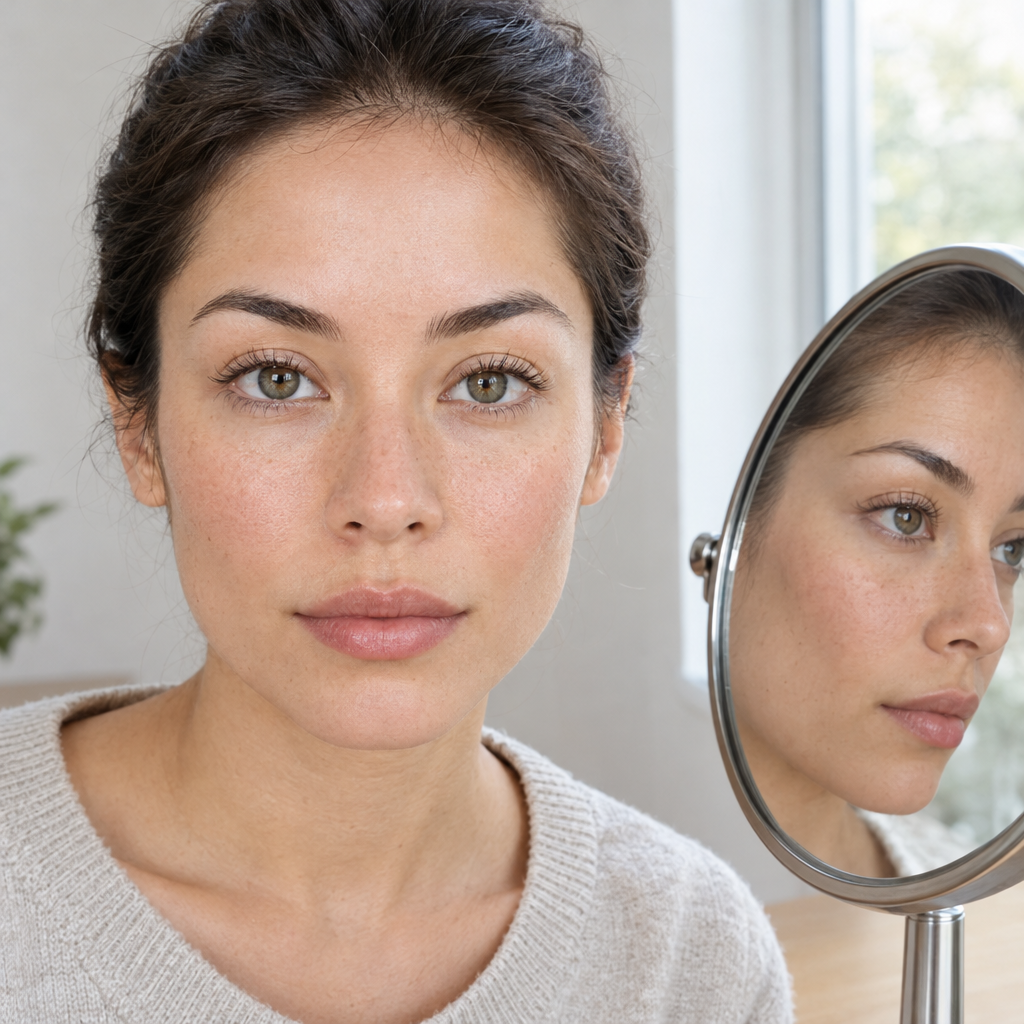
Use a mirror for a quick look, or take two photos so you can compare features without changing your expression.
- Take one straight-on photo. Keep the camera at eye level and your head upright, without tilting your chin or leaning to either side.
- Take one slight side view. Turn your head slightly while keeping your eyes comfortably open. Use similar lighting and camera distance.
- Relax your expression. Let your eyebrows settle naturally. Avoid widening your eyes, squinting, or smiling strongly.
- Keep the eye area visible. Move hair aside. If practical, remove heavy eyeliner, dramatic lashes, and eyeshadow that obscures the crease or corners.
- Avoid an extreme close-up. Move the camera farther away and crop afterward if necessary. Close camera distance can exaggerate apparent differences in proportions.
The front view is most useful for outline, corner tilt, and spacing. It also shows how much upper eyelid is visible. The slight side view helps with socket depth and prominence, which can be difficult to judge straight-on.
Skip beauty filters. Wide-angle lenses, head position, expression, and uneven lighting can all change the apparent result.
The five traits that make up an eye-shape description
Common eye-shape labels answer different questions. “Almond” describes an opening; “hooded” describes the skin above it. They are not competing categories.
| Dimension | What to inspect | Common terms |
|---|---|---|
| Eye-opening outline | Taper, height, iris visibility | Almond, round |
| Eyelid structure | Crease and visible lid space | Visible crease, hooded, monolid |
| Corner tilt | Outer versus inner corner height | Upturned, level, downturned |
| Socket depth | Placement relative to brow and socket | Deep-set, intermediate, prominent |
| Spacing | Gap compared with one eye’s width | Close-set, average-spaced, wide-set |
Several terms can apply at once. These are descriptive labels, not measures of attractiveness, health, personality, ancestry, or ethnicity.
1. Check the outline of the eye opening
Look straight ahead with a neutral gaze. Focus on the opening between the eyelids rather than the surrounding skin or makeup.
Use this iris-and-lid check:
- Does the iris, the colored part of the eye, appear to meet both the upper and lower lids?
- Is any sclera, the white of the eye, visible directly above or below the iris?
- Does the opening taper noticeably toward the corners, or look more rounded through its center?
An almond-shaped outline typically looks elongated, with tapered corners. The iris often appears to meet or be partly covered by both lids, with little white showing above or below it.
A round outline has more visible vertical openness relative to its width. White may be visible below the iris, and sometimes above it, although this varies.
White visible beside the iris is not the key distinction. Look specifically above and below it, then consider the overall outline.
Round does not mean large, and almond does not mean small. Size and outline are different observations. You might also find that your opening falls between these descriptions.
Treat iris contact and visible white as clues, not rigid diagnostic rules. Looking upward, widening your eyes, or squinting changes the relationship between the iris and lids.
2. Identify your eyelid structure
Next, look at the upper eyelid while keeping your eyebrows relaxed.
The mobile lid is the part of the upper eyelid immediately above the lashes that moves as you blink. When there is a distinct crease, this area sits between the lash line and the crease.
- Visible crease with exposed lid space: You can see a fold above the lash line and some mobile lid while looking straight ahead.
- Hooded lids: Upper-lid skin partly covers the mobile lid or crease area. Coverage may extend across the lid or be more noticeable toward the outer portion.
- Monolid: There is no distinct upper-eyelid crease. Natural folds may still be present, including a fold near the inner corner.
A crease can exist even when it is partly hidden with the eyes open. If needed, briefly lower your gaze to observe the fold, then return to a neutral gaze to assess how much lid remains visible.
Monolids and hooded lids are not interchangeable. A monolid describes the absence of a distinct crease; hooding describes skin covering lid or crease space. Neither should be inferred from ethnicity.
Raising your eyebrows can temporarily expose more lid space. If you notice yourself doing that, relax your forehead before deciding.
3. Compare the inner and outer corners
This step describes corner tilt, also called canthal tilt, by comparing the height of the inner and outer corners. Use your straight-on view with your head level, gaze neutral, and eyebrows relaxed.
Imagine a horizontal reference line starting at the inner corner and extending outward toward the outer corner. Compare the actual outer corner with that line:
- Upturned: The outer corner sits above the line.
- Approximately level: The outer corner sits near the line.
- Downturned: The outer corner sits below the line.
Use the points where the upper and lower lids meet. An eyeliner wing, a cluster of lifted lashes, or an outer skin fold is not the corner itself.
Check each eye separately. Small left-to-right differences are common, and a slight head tilt can make one outer corner appear higher than it is. If the difference is subtle, “approximately level” is a useful description.
4. Assess socket depth from the front and side
Compare your two photos, using the brow area and surrounding socket as reference points. Do not judge depth by how large the eyes appear.
Deep-set eyes appear positioned farther beneath a more prominent brow area. Prominent eyes project more noticeably relative to the surrounding socket. A slight side view often makes this relationship easier to see.
Some eyes look neither especially deep-set nor prominent. You can describe that as intermediate depth or simply leave depth unspecified.
Ask yourself:
- Does the impression of depth remain in both views?
- Can I see recessed or projecting placement, rather than just a lighting effect?
- Am I confusing covered lid space with depth?
Hooded eyes and deep-set eyes are different traits
Hooding concerns the upper eyelid. Deep-set placement concerns where the eyes sit relative to the brow area and surrounding socket.
| Comparison | Hooded eyes | Deep-set eyes |
|---|---|---|
| Main feature | Upper-lid skin covers lid space | Eyes sit farther beneath the brow area |
| Useful view | Front, with eyebrows relaxed | Front plus slight side view |
| Main clue | Reduced visible lid or crease | Recessed placement relative to the brow |
| Can coexist? | Yes, with deep-set placement | Yes, with hooded lids |
A person can have both hooded and deep-set eyes. Others have hooded lids without noticeably recessed placement, or deep-set eyes with a clearly visible crease and mobile lid.
Do not use a dark upper-lid shadow alone to judge depth. Overhead lighting can create that shadow regardless of eye placement.
Longstanding placement is an appearance trait, not a health assessment. A new change in prominence or position should not be treated as a new eye-shape category.
5. Estimate eye spacing separately
Spacing describes the relationship between the eyes, not the shape of either individual opening.
In your straight-on photo:
- Find the visible gap between the two inner corners.
- Compare that gap with the apparent width of one eye, measured from inner to outer corner.
- Use the comparison as a rough description.
| Gap compared with one eye | Approximate description |
|---|---|
| Smaller | Close-set |
| Similar | Average-spaced |
| Larger | Wide-set |
This is an approximate styling descriptor, not a precise anatomical measurement or an ideal to aim for. Overall facial proportions, camera perspective, and head angle affect the comparison.
If one eye appears wider because your head is turned, the estimate becomes less useful. Return to the straight-on view rather than forcing a result.
You can have close-set round eyes, wide-set almond eyes, or any combination of spacing and eyelid structure.
Combine the five observations into one description
Use this order:
Outline → eyelid structure → corner tilt → socket depth → spacing
For example:
- Round, hooded, approximately level, intermediate depth, average-spaced.
- Almond, monolid, slightly upturned, intermediate depth, wide-set.
- Almond, visible crease, downturned, deep-set, close-set.
- Almond, hooded, upturned, deep-set, average-spaced.
These combinations describe different features without implying that one arrangement is better.
Your own description can include qualifiers such as “slightly,” “partly,” or “between almond and round.” You do not need to assign every trait confidently.
A simple stopping point is to record one observation for each dimension, noting anything unclear. One careful assessment is more useful than repeatedly checking for a perfectly fixed label.
Why your result may look different in photos
A changed photo does not necessarily mean a changed feature. Several everyday variables affect what you see:
- Expression: Squinting narrows the opening. Raised eyebrows can expose more mobile lid.
- Makeup and lashes: Eyeliner, shadow, curled lashes, and false lashes can alter the apparent outline or corner direction.
- Camera distance and angle: A close or off-center image can change apparent spacing and make the nearer eye look larger.
- Lighting: Overhead light can deepen brow shadows. Flat frontal light can make socket depth less obvious.
- Natural left-to-right differences: The two eyes may have slightly different creases, openings, or corner positions.
Assess each eye first, then note the overall pattern. There is no need to make both descriptions identical. If you’re curious about natural differences between your eyes, Facefy’s Symmetry Checker offers a photo-based way to explore facial symmetry. Keep in mind that camera angle, lighting, and expression can influence the result, and small differences between the two sides are normal.
Eyelid appearance can also change gradually with age as skin and surrounding soft tissue change. That is different from a sudden change. New drooping, swelling, pain, double vision, or other vision changes need medical advice rather than appearance classification. The UK National Health Service recommends urgent assessment for sudden double vision and emergency care for sudden vision loss. Facial drooping accompanied by arm weakness or speech difficulty can be a stroke warning sign and requires emergency help.
Use your eye-shape description as a styling guide, not a rule
The description is useful when it helps you make a practical choice.
Let visible lid space guide placement
If little mobile lid shows with your eyes open, a thick liner may cover most of that visible space. For a more visible eyeshadow effect, start with a thinner line and check placement while looking straight ahead with relaxed brows.
For hooded lids or monolids, place shadow according to what remains visible with the eyes open rather than relying on an assumed crease position. You can build color gradually where you want it to show.
Experiment with outline and corner direction
To echo your natural outline, keep liner close to the lash line and follow its curve. To create a different visual effect, adjust the outer extension or concentrate mascara toward the center or outer lashes.
These are optional styling choices. Upturned, level, and downturned corners do not need correction.
Check depth and spacing in context
Brow shadows can change how eyeshadow looks on deep-set eyes. More prominent placement can make shimmer catch light differently. Check the finished look in ordinary daylight as well as your makeup lighting.
Spacing may help you compare how eyewear frames sit around the eyes, but it does not determine a specific bridge size. Nose fit, frame width, lens position, and comfort matter more than the spacing label.
If you would like another reference after your manual check, Facefy’s Eye Shape Detector offers an estimated visual classification from a photo. Treat it as a supplementary description, not an objective judgment or a replacement for the five observations. Lighting, expression, angle, and image quality can affect the estimate.
Eye-shape terms cannot establish attractiveness, personality, ancestry, ethnicity, or health. Their value is in helping you describe features and make choices that suit your preferences.
Eye-shape questions people often ask
Can you have more than one eye shape?
Yes. The five dimensions describe different features, so several labels can apply together. “Round, hooded, and level” is a coherent description, not a contradiction.
Are monolids and hooded eyes the same?
No. A monolid lacks a distinct upper-eyelid crease. Hooding means upper-lid skin reduces visible mobile-lid or crease space. Look at both crease structure and what remains visible with relaxed, open eyes.
Can almond eyes also be hooded or upturned?
Yes. Almond describes the opening’s outline, hooded describes the upper eyelid, and upturned describes corner direction. All three can apply at once.
Are close-set and wide-set considered eye shapes?
They are spacing descriptions rather than descriptions of an individual eye opening. Keep spacing separate from outline, lids, tilt, and depth.
Why can the two eyes look different?
Small natural differences are common. Expression, makeup, lighting, and camera perspective can also exaggerate them. A new or sudden difference, especially with symptoms, deserves medical attention rather than a new appearance label.
Does eye shape change with age?
The eye opening and surrounding eyelid appearance can change gradually as skin and soft tissue change. Crease visibility and hooding may look different over time, so a description that fitted years ago may not capture what you see now. Use these terms as flexible descriptions of your current features, not permanent categories.