How to Determine Your Face Shape: A Practical Identification Guide
Learn how to identify your face shape using four simple comparisons, a seven-shape chart, and practical checks for mixed or unclear results.
Your face shape is the outer outline created by the relative widths of your forehead, cheekbones, and jaw, together with your face length. To estimate it, pull your hair away, look straight ahead with a relaxed expression, and compare those four dimensions.
The closest category is a useful styling reference—not an exact classification. If your features sit between two families, a blended description such as oval–round is completely reasonable.
What face shape describes—and what it does not
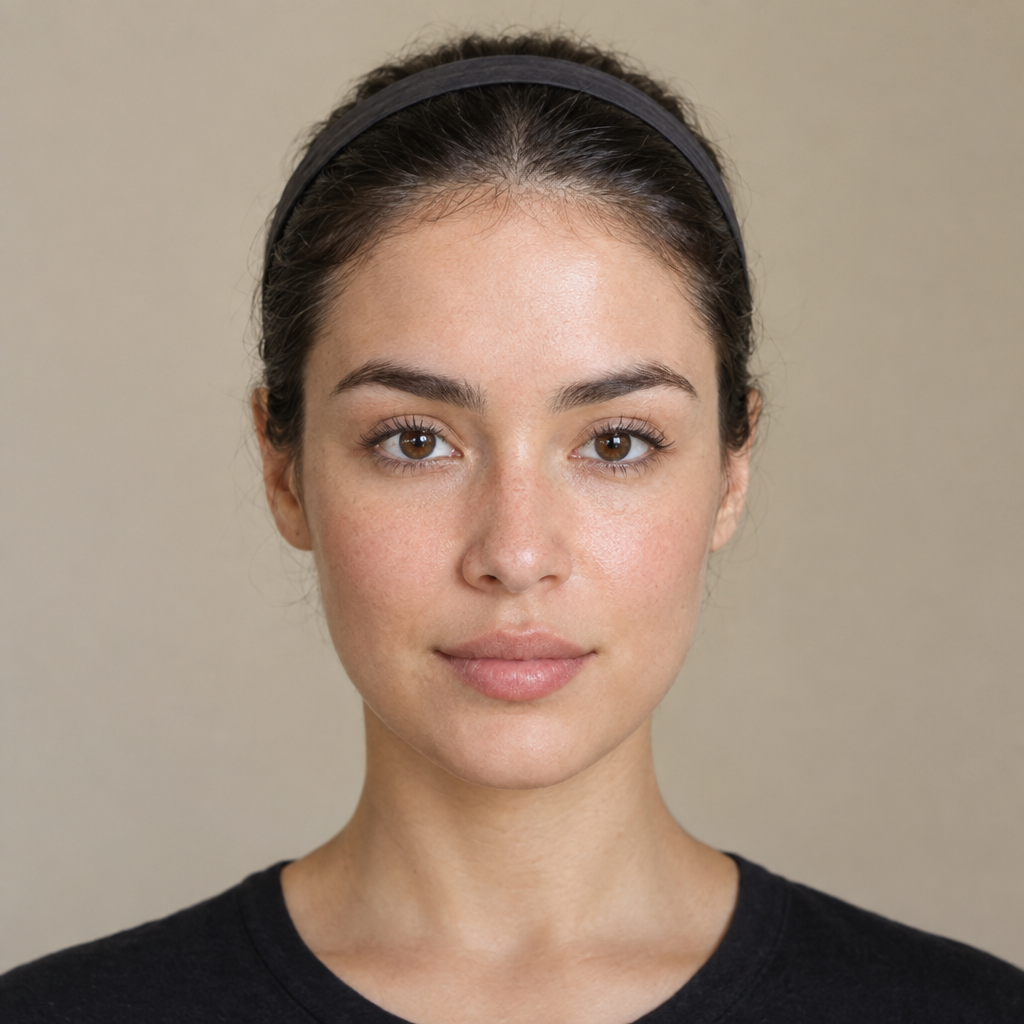
The size or shape of your eyes, nose, and lips contributes to your appearance, but does not determine your outer face-shape category. Neither does one striking feature, such as prominent cheekbones.
These categories have overlapping boundaries. No shape is inherently more attractive, balanced, feminine, or masculine than another.
Start with the outline reset
Before comparing categories, use this outline reset to separate your facial boundary from its framing:
- Pull hair away from your forehead and the sides of your face.
- Remove glasses if comfortable so frames do not interrupt the outline.
- Relax your jaw, with your teeth unclenched and lips at rest.
- Face forward without lifting, lowering, or turning your chin.
- Visually follow only the skin boundary from your forehead, down your temples and jaw, to your chin.
Use the visible hairline as the upper boundary, excluding hair volume. Irregular or receding sections can make that boundary less clear; do not let one small hairline detail decide the whole result.
Use four dimensions to compare your face
Compare these spans on a straight-on photo, or hold a soft measuring tape lightly across each span without wrapping it around facial contours. If you use a picture, follow the same basic principles described in this guide to taking a clear face-analysis photo: keep your head level, your outline visible, and the lighting even.
Photo-based comparisons and straight-span tape measurements are approximate styling references, not clinical measurements.
Use this worksheet:
| Dimension | Start | End |
|---|---|---|
| Face length | Visible hairline midpoint | Lowest point of chin |
| Forehead width | One outer forehead edge | Opposite edge at widest span |
| Cheekbone width | Widest point of one cheekbone | Matching point on other side |
| Jaw width | One jaw angle | Opposite jaw angle |
For forehead width, look across the upper forehead around the temples, without including hair. For cheekbone width, locate the widest midface points, generally beneath the outer eye corners. For jaw width, compare the lower-face corners—not just the chin.
Record which width is greatest, which is smallest, and whether face length clearly exceeds the widest span. Relative order matters more than tiny numerical differences.
Face shape comparison chart
Use the same four fields for each family. The descriptions below are reference patterns, not requirements that every face must meet.
Oval
- Length impression: Longer than wide.
- Widest area: Cheekbones, with a relatively similar forehead width.
- Jaw outline: Smooth, gradual taper.
- Chin shape: Softly rounded.
Round
- Length impression: Length and width relatively close.
- Widest area: Cheeks, or broadly balanced widths.
- Jaw outline: Curved rather than strongly angular.
- Chin shape: Rounded.
Square
- Length impression: Length and width relatively close.
- Widest area: Forehead, cheekbones, and jaw broadly similar.
- Jaw outline: Broad, with noticeable corners.
- Chin shape: Broad rather than strongly tapered.
Oblong or rectangular
- Length impression: Clearly longer than wide.
- Widest area: No strongly dominant region; comparatively straight sides.
- Jaw outline: Softer in oblong descriptions; angular in rectangular ones.
- Chin shape: Rounded or broad.
Heart or inverted triangle
- Length impression: Variable; often longer than wide.
- Widest area: Forehead or upper face.
- Jaw outline: Noticeably narrowing toward the chin.
- Chin shape: Narrow or tapered.
Triangle or pear
- Length impression: Variable; width distribution matters more.
- Widest area: Jaw.
- Jaw outline: Broad below a narrower upper face.
- Chin shape: Rounded or squared.
Diamond
- Length impression: Usually longer than wide.
- Widest area: Cheekbones, distinctly wider than forehead and jaw.
- Jaw outline: Tapered below the cheekbones.
- Chin shape: Narrow or pointed.
Prominent cheekbones are not necessarily wide cheekbones: projection and lighting can make them stand out. The diamond and oval comparison explores why width distribution and gradual versus sharper side transitions matter more than prominence alone.
Follow the three-stage decision path
1. Compare length with overall width
If length and width look relatively close, begin with round and square as possibilities. If length clearly exceeds width, consider oval or oblong.
This only narrows the starting point. Strong differences between forehead, cheekbone, and jaw width may point elsewhere.
2. Identify the widest region
- Forehead or upper face widest: Consider heart.
- Jaw widest: Consider triangle.
- Cheekbones distinctly widest: Consider diamond.
- All three relatively balanced: Use length and lower-face contour to distinguish oval, round, square, or rectangular.
3. Assess the jaw and chin
A curved jaw and rounded chin support round when length and width are close, or oval when the face is longer with a gradual taper.
A broad, angular jaw supports square when dimensions are close, or rectangular when length clearly dominates.
A narrow or pointed chin supports heart when the forehead or upper face dominates, or diamond when the cheekbones are distinctly wider than both the forehead and jaw.
Mixed face shapes are normal
If two widths are very close, or the visual evidence splits between categories, use a blended label rather than forcing a match. No rigid numerical cutoff is necessary for ordinary styling decisions.
Two common edge cases show why:
- Long face, broad angular jaw: The jaw may suggest square, while the length suggests rectangular. “Square–rectangular” communicates both traits.
- Tapered jaw, nearly equal forehead and cheekbones: Heart and oval can be easy to confuse. More noticeable upper-face dominance and sharper narrowing support heart; a gradual, rounded transition supports oval. Heart–oval may be the most useful description.
One careful assessment is enough. Repeated measuring is unlikely to make a borderline category more useful. Facefy Face Report provides estimated visual observations that are best treated as descriptive clues.
Check the result against one suitable photo
Use just two references: a relaxed mirror view and one neutral, straight-on photo.
Choose a photo with your head level and your entire forehead, both jaw edges, and chin visible. Keep the camera at face height, avoid an arm’s-length close-up, and use even lighting without strong side shadows.
If the references disagree, prioritize the minimally distorted straight-on view—not whichever image makes a category look most obvious. Hairstyle, facial hair, makeup, expression, pose, lighting, and crop can all alter the apparent outline.
For an optional second estimate, Facefy’s Face Shape Detector can help estimate your category from a photo. Treat its AI-generated result as a comparison with your observations, not an objectively correct label; image conditions affect that estimate too.
Different names can describe the same family
Oblong and rectangular both describe a distinctly longer outline. “Rectangular” usually emphasizes straighter sides or a more angular jaw.
Heart and inverted triangle both describe an upper-face-dominant outline narrowing toward the chin. Some guides reserve “heart” for a central point in the hairline, but that convention is not universal.
Triangle and pear both describe a jaw wider than the upper face. Across guides and stylists, observed traits are more useful than exact naming.
Use face shape to choose a visual effect, not obey a rule
Decide what you want to emphasize before choosing a haircut:
- Height at the crown and longer vertical lines can create an impression of length.
- Side volume can add apparent width where it sits.
- Curved layers can soften an angular impression; cleaner lines can emphasize definition.
Layer placement often matters more than the haircut’s name. For example, a butterfly cut can place movement around the cheeks or lower down, depending on the shortest layers and styling. Hair texture, density, and growth direction influence whether that effect is practical.
A useful stylist request is: “I’d like movement below my cheekbones, less volume at the crown, and enough length to tie my hair back.” That communicates more than “Give me something for an oval face.”
Fringe, facial hair, and makeup can change the frame you see without replacing the underlying outline.
Common questions about face shape
Should I include my hairline?
Yes, as the visible upper boundary—not the volume of your hairstyle. Assess the full outline rather than classifying yourself from a widow’s peak or uneven section alone.
Do bangs change face shape?
They change how much forehead is visible and where the eye notices a horizontal boundary. If you are considering them, the guide to deciding whether to get bangs covers practical factors beyond face shape, including styling commitment and hair behavior.
Can I have two face shapes?
Yes. A blended label is often more descriptive when length, width, and jaw contour do not align with one category.
Do I need an exact label to choose a hairstyle?
No. Knowing that your face is relatively long, your jaw is broad, or your upper outline tapers may be enough. Use those observations alongside your texture, daily routine, and preferences—the label is a starting point, not a rule.