What Face Shape Do I Have? A Practical Guide to 7 Shapes
Compare face length, width, jawline, and chin taper to identify your likely face shape while allowing for mixed or uncertain features.
To estimate your face shape, compare four visible traits: length versus width, the widest area, jaw contour, and chin taper. Most faces broadly resemble oval, round, square, oblong, heart, diamond, or triangle shapes. Start with the strongest width or length pattern, then use the other traits to narrow your choice.
Mixed features are common. A likely primary shape, with a secondary possibility if needed, is more useful than forcing a perfect match. These categories are descriptive styling guides, not exact biological classifications.
Start with a reliable view of your facial outline
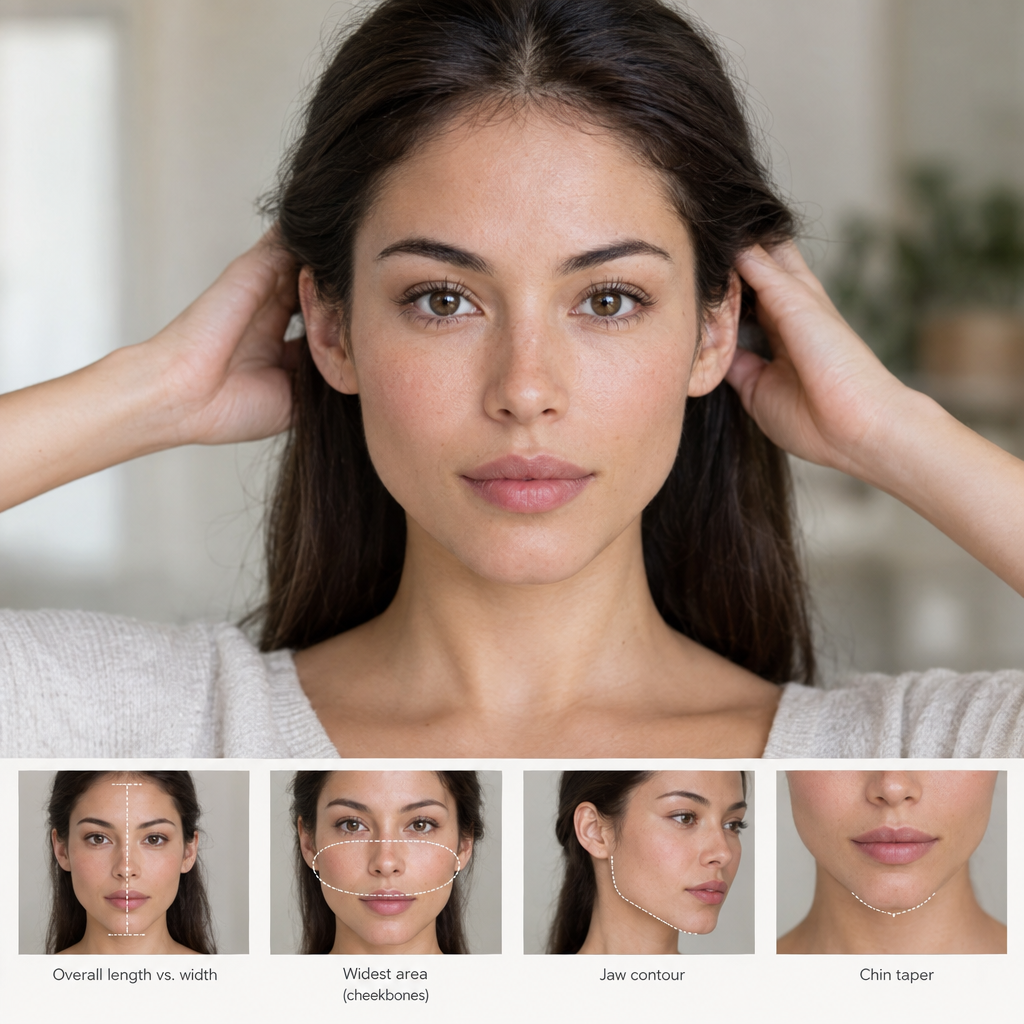
Use a mirror or a clear photo that shows your whole face. For a photo, check the following:
- Position: Face the camera straight on, with the camera at eye level and your head level.
- Distance: Avoid an arm’s-length close-up. Set the camera farther away, such as across a small room, and crop afterward while keeping the full forehead and chin visible.
- Expression: Relax your face. Smiling, clenching your jaw, or raising your eyebrows can change its apparent outline.
- Lighting: Use even front lighting rather than strong side shadows.
- Visibility: Move hair away from your forehead, temples, and jaw. Remove glasses if the frames obscure the sides of your face.
Camera distance, head tilt, makeup, shadows, and hair volume can change the outline you see without changing the underlying structure.
If bangs cover your forehead: Move them aside if possible. Otherwise, use length versus width, cheekbone width, and jaw contour, but leave upper-face width undecided. A widow’s peak is a central point in the hairline, not evidence of a heart-shaped face. Compare the overall breadth of the forehead instead.
If facial hair covers your jaw: Do not trace the beard’s outer edge. Use forehead and cheekbone width, visible jaw corners, and the chin’s position. Leave jaw contour uncertain if it is hidden.
If the two sides look different: Consider the overall outline, then look at each side separately. Length and upper-to-lower width distribution remain useful. Avoid letting one sharper jaw corner determine the category.
One or two suitable views are enough for an informal styling reference. If they suggest different shapes, keep the result uncertain or mixed.
Use four signals to narrow down your face shape
Record these four observations before choosing a label:
- Length versus width: Does your face look noticeably longer than its widest point, or are the two dimensions relatively similar? Compare the visible hairline-to-chin span with the broadest horizontal span.
- Widest area: Is the forehead, cheekbone area, or jaw widest? If none clearly dominates, record “no clear dominant area.”
- Jaw contour: Is the lower outline mainly curved, or does it have straighter sections and visible corners?
- Chin taper: Do the sides narrow gradually, narrow strongly, or remain relatively broad toward the chin?
Face shape describes the overall outline and distribution of width. It is related to, but not the same as, detailed facial ratios between individual features.
Do not treat the four signals as equal votes. First narrow the candidates using the defining width or length pattern. A clearly jaw-dominant outline keeps triangle in consideration, while a clearly elongated outline points toward oblong. Then compare jaw contour and taper within those plausible candidates.
Less-distinctive matches should not override the defining pattern. For example, a curved jaw occurs in several categories and cannot, by itself, make an outline oval.
In the comparison below, “variable” means that the trait does not reliably distinguish that category. It does not mean the trait contradicts the category.
Compare the seven main face shapes
Each entry uses the same four signals, so you can compare like with like without relying on rigid measurement thresholds.
Oval
- Length versus width: Moderately longer than wide.
- Widest area: Often cheekbones, without sharp width contrast.
- Jaw contour: Mainly curved.
- Chin taper: Gradual narrowing.
Round
- Length versus width: Relatively similar.
- Widest area: Cheeks often give the broadest impression.
- Jaw contour: Curved, with less distinct corners.
- Chin taper: Gentle, usually rounded.
Square
- Length versus width: Relatively similar.
- Widest area: Forehead and jaw broadly comparable.
- Jaw contour: Straighter sections and clearer corners.
- Chin taper: Limited; the lower face stays relatively broad.
Oblong or rectangular
- Length versus width: Noticeably longer than wide.
- Widest area: No sharply dominant zone; the sides often appear straighter.
- Jaw contour: Softer in oblong faces and more angular in rectangular faces.
- Chin taper: Usually limited or gradual.
Heart
- Length versus width: Variable.
- Widest area: Forehead or upper face.
- Jaw contour: Variable, within a narrowing lower face.
- Chin taper: Noticeable.
Diamond
- Length versus width: Usually longer than wide.
- Widest area: Cheekbones, extending beyond both the forehead and jaw.
- Jaw contour: Narrows inward below the cheekbones.
- Chin taper: Noticeable.
Triangle or pear
- Length versus width: Variable.
- Widest area: Jaw, clearly wider than the forehead.
- Jaw contour: Can be curved or angular.
- Chin taper: Variable within a broader lower face.
For example, a jaw clearly wider than the forehead supports triangle even if moderate facial length and a curved jaw also resemble oval. Triangle remains a strong candidate because the defining lower-face width matters more than the number of matching descriptions.
Choose a provisional primary shape from the strongest overall pattern, then check its closest alternative below.
Resolve the face shapes that are easiest to confuse
Oval versus oblong: Both are longer than wide. Oblong looks more noticeably elongated and often has straighter side transitions. Oval usually has a more gradual, continuous curve from the upper face toward the chin.
Round versus square: Length and width may look similar in both. Focus on the jaw: a continuous curve supports round, while straighter sections and clearer corners support square. Cheek fullness alone does not settle the distinction.
If jaw contour is difficult to interpret, a separate jawline analysis may help you examine the lower face more closely. Treat it as a supplementary estimate, since the jaw alone cannot establish your overall face shape.
Heart versus diamond: Compare forehead width with cheekbone width. Heart is broadest through the forehead or upper face. Diamond has cheekbones that extend farther outward than both the forehead and jaw.
Square versus triangle: Compare the forehead directly with the jaw. Broadly comparable widths support square; a visibly wider jaw supports triangle. Angularity alone cannot distinguish them because either can have defined jaw corners.
Remember that prominence and width are different. Cheekbones may project forward or catch the light without creating the widest part of the front-facing outline.
Use a primary and secondary shape for mixed features
Among categories consistent with your defining width or length pattern, choose the one supported by most of the remaining visible signals. Use the closest alternative as a secondary label, and name the specific feature behind it.
For example, a moderately longer-than-wide face with gradual taper and no strongly dominant width zone may look mainly oval. If the jaw has clear corners, “oval with square influence” describes the result better than switching entirely to square. The angular jaw is the feature creating the ambiguity.
A secondary label is optional, not something every face needs. If the defining pattern itself is unclear, or two suitable photos disagree, “mixed” or “uncertain” is a reasonable outcome. More repeated checking is unlikely to make a styling category exact.
Natural left-to-right differences can also affect the outline you see. A symmetry check can provide another estimated visual reference, but asymmetry is compatible with every face shape and does not require correction.
Use face shape as one styling input, not a rule
Your result can help organize hairstyle suggestions, but it should not dictate them. Compare details you actually like, such as cheekbone-length framing, fullness at the sides, height at the crown, or an exposed forehead.
Hair texture, density, growth direction, and daily styling effort affect how a haircut behaves. A style that appeals to you is worth considering even if it falls outside common face-shape advice.
For glasses, prioritize bridge fit, temple comfort, and correct optical positioning before frame-shape guidelines. Makeup placement can emphasize different areas, but no category creates an obligation to hide or correct a feature.
Soft-tissue fullness, including changes associated with weight, can alter the visible outline without necessarily changing underlying bone structure. Left-to-right asymmetry can also make labels less obvious.
Common questions about identifying face shape
Can I have a combination of two face shapes?
Yes. A primary label plus one secondary influence can capture mixed traits. Name the feature responsible, such as an oval outline with a more angular jaw, rather than collecting several labels.
Why do I look like a different shape in selfies?
Close camera distance changes perspective and can exaggerate nearer features relative to the sides of the face. Head angle, expression, and cropping also change apparent proportions. Use the consistent photo setup above rather than comparing unrelated selfies.
Are face-shape detectors accurate?
They provide estimated visual classifications, not objective determinations. Lighting, angle, hair coverage, and image quality influence the result, and borderline outlines may reasonably fit more than one category.
Should I choose a hairstyle based only on face shape?
No. Use face shape to explore visual effects, then consider your hair’s texture, density, maintenance needs, and your personal taste. The same face shape can suit many different cuts.
If you are comparing a few options, a hairstyle try-on can help you preview differences in length, fringe, volume, or parting. Generated results are visual estimates, not guarantees of how a cut will behave on your hair.
Write down your result
Complete this short summary using your strongest observations. If no area clearly dominates, write that instead of selecting one.
My face appears [longer than / similar in length to] its width, is widest at the [forehead / cheekbones / jaw], has a [curved / angular] jaw, and [does / does not] taper at the chin; my likely shape is ___, with ___ as a secondary possibility.
If useful, compare your completed summary with an estimated category from Facefy’s Face Shape Detector. Treat the output as another visual reference rather than proof that one label is correct.
Add a brief uncertainty note if something was obscured, such as “jaw partly hidden by facial hair.” The goal is a usable description of your outline, not a perfect geometric label.