What Is My Face Shape? A Practical Guide to Finding Out
Identify your face shape using reliable proportions, a better photo setup, and clear comparisons for oval, round, square, heart, and more.
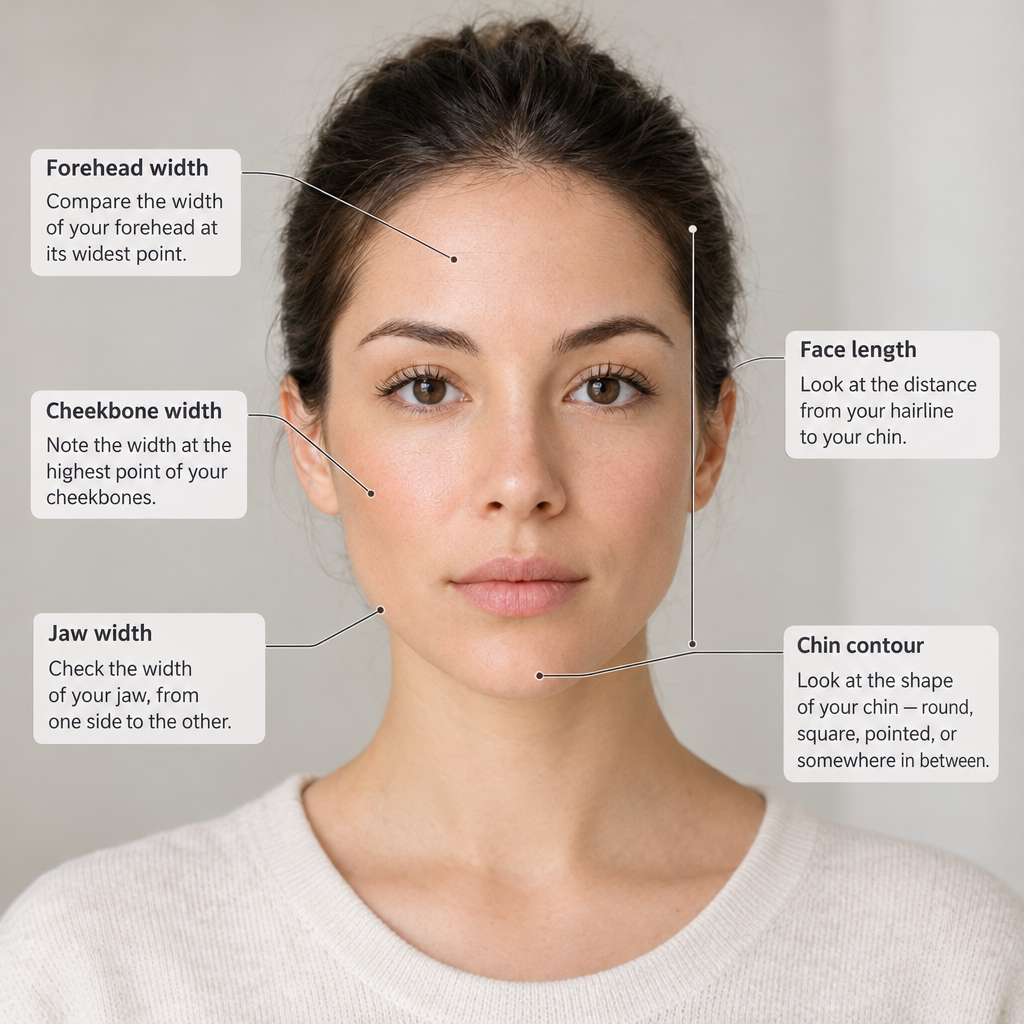
Your face shape is best estimated by comparing five cues: face length, forehead width, cheekbone width, jaw width, and chin contour. Start with a straight-on photo taken at eye level, with a neutral expression and your hair away from your face. Then look for the overall pattern rather than letting one measurement decide the result.
Most faces do not match a category perfectly. You might have an oval outline with a heart-shaped taper, for example. A description such as oval-heart or square-oblong can be more useful than forcing your features into one rigid label.
Start With a Photo That Shows Your Natural Face Outline
A close selfie is convenient, but it can change how your facial proportions appear. Use this setup for a clearer reference:
- Move hair away from the outline. Reveal your forehead, temples, cheeks, and jaw. Keep a fringe or loose strands from covering the boundaries.
- Keep your expression relaxed. Look straight ahead, rest your lips naturally, and avoid smiling broadly or clenching your jaw.
- Place the camera at eye level. Keep your head upright without lifting, lowering, or turning your chin.
- Step back roughly 1.5 metres or more when practical. Use a timer or ask someone to take the photo. Zoom or crop afterward to frame your face rather than bringing the camera closer.
- Disable beauty filters and portrait effects. Turn off reshaping, smoothing, and background blur, which can obscure or alter edges.
- Use soft, even light. Face a window with indirect daylight, avoiding strong shadows on one cheek or beneath the jaw.
A mirror is useful for observing your outline as you move hair aside. A consistent photo is easier to revisit and measure. Neither reveals every detail of a three-dimensional face, so treat the result as a visual estimate.
Use This Five-Point Face Shape Self-Check
Use one photo for all five observations. You can compare distances visually, draw lines on a copy, or use a ruler against the displayed image. The units do not matter as long as the image stays at the same size.
Measure straight across the image rather than following the curves of your skin. Leave ears, hair volume, and beard edges out of width comparisons.
1. Face length
Compare the distance from the central upper hairline to the bottom of your chin with the widest part of your face.
Record one of these descriptions:
- Length and width look relatively similar.
- Length is moderately greater than width.
- Length is noticeably greater than width.
Avoid assigning a category from this observation alone. A longer outline can have either a curved or an angular jaw.
2. Forehead width
Look across the broadest visible part of your forehead, around the temple area. Compare it with your cheekbones and jaw.
Record: broader than, similar to, or narrower than the cheekbones and jaw.
Do not count hair at the temples as part of your forehead width.
3. Cheekbone width
Compare the widest visible span across your upper cheeks, beneath the outer eye area, with the forehead and jaw.
Record whether the cheekbone area is:
- Clearly the widest area.
- Similar in width to the forehead.
- Similar in width to the jaw.
- Narrower than the jaw.
You are observing a surface outline, not locating bone precisely through a photograph.
4. Jaw width
Look at the lower-face width near the jaw corners, before the outline turns toward your chin.
Record whether the jaw stays broad, narrows gently, or narrows strongly compared with the forehead and cheekbones. Also note whether its corners look curved or angular.
5. Chin contour
Describe the bottom of the face as rounded, tapered, pointed, broad, or angular. More than one word can apply, such as “broad and rounded.”
A pointed chin does not automatically mean a heart shape. The forehead and cheekbone relationship still matters.
Write down all five observations before choosing a category. For example:
Moderately longer than wide; forehead slightly narrower than cheekbones; cheekbones widest; jaw narrows gently; chin rounded.
Together, those cues suggest an oval pattern. The same length with a broader forehead and a more tapered lower face might suggest an oval-heart blend.
If you prefer to measure the displayed image, a hypothetical record for that first example might look like this:
- Face length: 720 pixels
- Forehead width: 480 pixels
- Cheekbone width: 520 pixels
- Jaw width: 450 pixels
- Chin contour: rounded
Because all measurements come from the same unchanged image, the pixel values support the verbal observations: the face is longer than it is wide, the cheekbones are slightly wider than the forehead, and the jaw is narrower than both. These numbers are only an example of how to record relative distances. They are not classification thresholds, and the same measurements should not be applied to a different image size.
Compare the Seven Main Face Shape Patterns
These are common descriptive categories, not standardized anatomical classifications. Different guides may use “oblong,” “long,” and “rectangular” somewhat differently.
Start with width and length:
| Pattern | Typical widest area | Relative length |
|---|---|---|
| Oval | Cheekbones, often slightly | Moderately longer than wide |
| Round | Cheek area | Length and width relatively similar |
| Square | Forehead, cheekbones, and jaw similar | Length relatively close to width |
| Heart | Forehead or upper face | Variable, often longer than wide |
| Diamond | Cheekbones | Often longer than wide |
| Oblong or rectangular | Variable, with widths often similar | Clearly longer than wide |
| Triangle or pear | Jaw | Variable |
Then compare the lower outline and the nearest alternative:
| Pattern | Jawline or chin | Commonly confused with |
|---|---|---|
| Oval | Gently narrowing jaw; curved chin | Oblong |
| Round | Curved jaw; rounded chin | Square |
| Square | Broad jaw; distinct corners | Round or rectangular |
| Heart | Jaw tapers toward a narrower chin | Diamond |
| Diamond | Narrower jaw; often tapered chin | Heart |
| Oblong or rectangular | Oblong: curved; rectangular: angular | Oval or square |
| Triangle or pear | Broad jaw; narrower upper face | Square |
For heart, diamond, and triangle patterns, where the width sits is usually more informative than length alone. A widow’s peak is not required for a heart-shaped outline.
How to Tell Similar Face Shapes Apart
Oval versus oblong: compare relative length
Both can have softly curved contours. The distinction is how elongated the whole outline appears.
- Oval: Longer than wide, with a relatively balanced length-to-width impression.
- Oblong: Noticeably elongated, even though the jaw may remain softly rounded.
Do not use a tall forehead by itself as the deciding feature. Consider the full outline.
Round versus square: inspect the jaw angles
Both may have relatively similar length and width.
- Round: The cheeks and lower face form a more continuous curve.
- Square: The lower face remains broad, with clearer corners where the jaw turns toward the chin.
Keep your jaw relaxed. Clenching or strong side lighting can make the corners look more pronounced.
Heart versus diamond: compare forehead and cheekbones
Both may narrow toward the chin.
- Heart: The forehead or upper face is broad relative to the jaw.
- Diamond: The cheekbones stand out as the widest area, with narrowing toward both the forehead and jaw.
If the forehead and cheekbones look nearly equal, a blended description may fit better than either label alone.
Square versus rectangular: compare length first
Both can have a broad, angular jaw.
- Square: Length is relatively close to width.
- Rectangular: The outline is distinctly longer than wide.
Mixed Face Shapes Are Normal
Use a two-part description when your width pattern suggests one category but your jaw or length suggests another. Put the dominant overall outline first, followed by the secondary influence:
- Oval-heart: An oval outline with a broader upper face and tapered chin.
- Square-oblong: A broad, angular outline with extra length.
- Round-oval: Curved contours with more length than a typical round pattern.
Explore styling suggestions for both categories. You do not need to settle on one permanent label.
If your hairline is unclear or receding
Do not guess where an earlier hairline would have been. Record hairline-based length as uncertain and give more weight to visible temple width, cheekbone width, jaw width, and jaw contour.
You can still describe the overall impression as relatively compact or elongated, but avoid treating a larger visible forehead as proof of an oblong outline.
If fuller cheeks obscure your jaw
Start with forehead and cheekbone width, then observe the lower-face contour in even light. Keep your jaw relaxed rather than sucking in your cheeks or clenching.
A softly visible jaw does not necessarily mean a round outline. Look at relative length and whether the lower face stays broad or narrows.
If a beard changes the lower-face outline
Use a clean-shaven reference photo if one is available and reasonably recent. Otherwise, prioritize forehead width, cheekbone width, and any visible natural jaw boundary.
A long beard can create an elongated silhouette; fuller beard sides can create a broader one. If the underlying chin is hidden, mark its contour as uncertain rather than measuring the beard as your jaw.
Why Your Face Shape Can Look Different Between Photos
Camera distance changes perspective. In a close selfie, features nearer the lens can appear larger relative to features farther away. A wide-angle camera often encourages this close shooting distance, but distance is the key issue, not simply the lens label.
Compare a close selfie with a distant photo
Use an existing close selfie and take one reference photo from roughly 1.5 metres or more away:
- Keep the expression, lighting, and head position as similar as possible.
- Crop the distant photo so the face occupies a comparable amount of the frame.
- Compare forehead width, cheekbone prominence, jaw taper, and overall length.
- If the images suggest different categories, give more weight to the distant, eye-level image because its perspective is less exaggerated.
Cropping a close selfie cannot undo its perspective distortion.
Other presentation choices matter too:
- Head angle: Turning changes visible width; tilting changes the apparent balance of forehead and chin.
- Expression: Smiling raises and broadens the cheeks and changes the lower outline.
- Uneven lighting: Shadows can emphasize or obscure jaw corners.
- Crop: Cutting off the hairline or chin removes useful reference points.
- Styling: Hair, facial hair, makeup, and glasses frame or emphasize areas without necessarily changing the underlying proportions.
Changes in soft-tissue fullness can genuinely alter the visible contour. A photo alone cannot establish why that change occurred.
Glossary: Face Shape, Ratios, Symmetry, and Attractiveness
Face shape describes one broad aspect of facial appearance. It can be included within a wider facial analysis, but it does not capture every feature or establish attractiveness.
- Face shape: The overall outline created by relative length, width, jaw contour, and chin shape. Common labels include oval, round, square, heart, diamond, oblong, and triangle.
- Facial ratios: Comparisons between particular facial distances or regions. Ratios provide more detail than a broad outline category, but they do not determine attractiveness.
- Facial symmetry: A comparison of corresponding features across the two sides of a face. Symmetry and face shape describe different visual characteristics, and natural asymmetry is common.
- Attractiveness: A subjective perception influenced by personal preference, culture, expression, familiarity, styling, and context. It cannot be established by a face-shape category, ratio, or AI result.
These descriptions are not diagnoses. They should not be used to infer health, personality, ethnicity, age, or personal worth.
An AI Face Shape Estimate Can Be a Second Opinion
After the manual comparison, Facefy’s Face Shape Detector can estimate a likely category from a photo. It is an optional second interpretation, particularly if you are deciding between two overlapping patterns.
Use the same clear, front-facing reference image: even lighting, relaxed expression, eye-level camera, and hair away from the boundaries.
Treat the output as AI-generated styling guidance, not a definitive or clinical classification. A different result from your own assessment may reflect overlapping categories, a partly hidden hairline, pose, lighting, or image quality. Compare the descriptive cues rather than assuming either answer must be exact.
Before uploading a personal photo, review the service’s privacy information, including how images are handled and retained. Only upload someone else’s photo with their permission.
What to Do With Your Face Shape Result
Use your likely category to narrow ideas, not to create rules about what you can wear.
For a mixed result, compare recommendations for both patterns and focus on the effect you actually want. For example, someone with a square-oblong description might like a cut that keeps the jaw visible without adding much height at the crown.
Before choosing a hairstyle, ask:
- Where do I want volume? At the crown, around the temples, or near the jaw?
- Will my texture support it? Straight, wavy, curly, and coily hair can produce different silhouettes with similar cuts.
- Does it suit my density and routine? A style that needs daily blow-drying may not suit an air-dry routine.
- How does facial hair affect the finished outline? Consider the haircut and beard together.
- Do I enjoy the look? Personal preference matters more than a category recommendation.
For glasses, outline-based suggestions are only a starting point. Frame width, bridge fit, prescription requirements, comfort, and personal taste also matter. Angular frames do not automatically suit every rounded face, and rounded frames are not compulsory for an angular one.
No hairstyle, makeup technique, or accessory is necessary to correct an outline. Choose two or three realistic options to compare, then move from measuring to making a practical styling decision.
Common Questions About Finding Your Face Shape
Why does my face look different in selfies and mirrors?
Camera distance, angle, lighting, and crop affect photographs. Mirrors also show a reversed view that may feel more familiar. Neither a close selfie nor one mirror impression should be your only reference.
Does gaining or losing weight change face shape?
Changes in soft-tissue fullness may affect the cheeks, jaw visibility, and overall outline. That does not necessarily mean the underlying structural proportions have changed. Weight alone is not a reliable way to predict a particular category.
Are face-shape apps accurate?
They can offer a useful estimate, but results depend on the image and how the tool defines its categories. Agreement with one label is not proof of accuracy, especially when a face sits between patterns.
Do I need exact measurements?
No. Consistent observations and relative comparisons are usually enough for styling purposes. Stop once you have a useful description, such as “longer than wide, broad cheekbones, gently tapered jaw,” that helps you compare practical styling options.