What Is a Golden Ratio Face? Phi and Facial Proportions Explained
Learn what a golden ratio face means, how 1.618 applies to facial measurements, and why photo-based scores need careful context.
A golden ratio face is one whose selected facial measurements are compared with phi, a mathematical ratio of approximately 1.618 to 1. It describes relationships between particular distances, not the face as a whole, and it is not an objective measure of beauty, health, or personal worth.
The term can sound like a single, clearly defined facial type. In practice, different calculators and geometric overlays may compare different measurements. Understanding what was measured matters more than the score itself.
What does 1.618 mean?

A ratio describes how large one measurement is relative to another. To compare a longer distance with a shorter one, divide the longer measurement by the shorter measurement.
For a ratio of 1.618 to 1, the longer distance is approximately 1.618 times the shorter distance. If the shorter distance were 100 units, the longer one would be about 161.8 units.
Phi has a specific mathematical property: when a line is divided into a longer and a shorter part, the whole line divided by the longer part equals the longer part divided by the shorter part. Both ratios equal approximately 1.618.
In facial analysis, that number becomes a reference for selected measurements. It is not a required facial proportion or a universal aesthetic target.
How is the golden ratio calculated on a face?
Consider a hypothetical example using two defined measurements:
- Face length: 180 mm
- Face width: 112 mm
- Calculation: 180 ÷ 112 = 1.607, or approximately 1.61
That result is close to 1.618 for this particular length-to-width comparison. It demonstrates the calculation, not an ideal face.
The endpoints are important. Does “face length” start at the hairline or somewhere lower? Does “width” mean the widest visible part of the face or the distance between two specific points? Changing either definition changes the result.
Photo-based calculations can use pixel distances rather than millimetres, provided both measurements come from the same image at the same scale. The units cancel when divided. However, that does not remove perspective distortion or turn a photograph into an exact physical measurement.
Other methods compare distances involving the eyes, nose, mouth, or chin. A result from one pair cannot tell you whether other pairs also approach phi.
Which facial measurements are commonly compared?
Golden ratio analyses may compare overall length with width, or smaller distances between visible features. Some examine vertical relationships separately from horizontal ones.
The reference points used to define those distances are called facial landmarks. There is no single universally accepted set of points or formula for a golden ratio face.
Examples of measurements a method might use include:
- Overall length and width: A defined upper-to-lower distance compared with a defined side-to-side distance.
- Feature widths: The width of the mouth compared with the width of the nose.
- Vertical feature spacing: Distances between specified points near the eyes, nose, mouth, and chin.
These are examples of possible comparisons, not a list of proportions that should all equal 1.618.
Why endpoints can be ambiguous
Some boundaries are easier to locate than others:
- Hairline: Hair can obscure it, and its outline may be irregular or receded. A hidden hairline makes a hairline-to-chin measurement uncertain.
- Lower facial edge: Pose, shadows, hair, and facial hair can soften the visible boundary, changing where its endpoint is placed.
- Lip corners: Smiling or opening the mouth moves them. Makeup, shadows, and image softness may also make their boundaries less distinct.
Two measurements can therefore disagree even when both use the label “face length” or “mouth width.” They may not be measuring exactly the same thing.
Ratios, left-to-right balance, masks, and AI analysis are different
These approaches are often grouped together, but they answer different questions.
| Method | What it examines | What the result means |
|---|---|---|
| Golden ratio calculation | One selected distance pair | Closeness to 1.618 |
| Bilateral symmetry | Left-right correspondence around a midline | Degree of side-to-side agreement |
| Geometric mask | Features against a template | Fit to that overlay |
| AI appearance analysis | System-selected visual measurements | Image-dependent estimated assessment |
A single ratio calculation is narrow: it compares two distances. It says nothing automatically about whether the left and right sides match.
A left-to-right comparison examines corresponding positions or shapes on either side of a chosen midline. A face could have closely matching sides while its length-to-width ratio is 1.4 rather than 1.618. Equally, a selected ratio could approach phi while the two sides differ naturally.
A golden ratio mask places a geometric template over a photograph. The template’s design, scale, rotation, and alignment affect how closely it appears to fit. An overlay is not independent proof of an ideal facial structure.
An AI-generated appearance analysis may estimate reference points and combine several observations. Its output depends on the input image and the system’s method. A combined score is not interchangeable with a directly calculated ratio.
Why can photos and calculators give different results?
A photograph projects three-dimensional facial structure onto a flat image. Apparent distances can change even when the person’s underlying features do not.
Camera distance and lens choice
A close camera exaggerates depth differences. Features nearer the camera, especially around the centre of the face, may appear larger relative to its outer edges.
Wide-angle lenses are often used at close distances, which contributes to the familiar close-selfie effect. Some lenses also introduce optical distortion, particularly near the frame edges.
Camera position determines perspective, not focal length alone. A longer lens used from farther away often produces a flatter-looking portrait because of that increased distance. Changing lenses without moving the camera does not, by itself, change perspective.
Head rotation and tilt
Turning the head changes visible feature spacing and can shorten the apparent width of the farther side. Looking up or down also changes how vertical distances project into the image.
A three-quarter portrait does not preserve the same frontal width relationships as a straight-on photograph. It may be a useful portrait, but it is a poor substitute for a frontal measurement.
Facial expression
Smiling moves the mouth corners and cheeks. Squinting changes the visible eye opening. Raised brows and an open mouth also shift reference points.
A relaxed expression reduces some of these changes, but no photograph captures a perfectly fixed facial configuration.
Visibility, lighting, and crop
Hair, facial hair, makeup, and shadows can obscure or redefine visible boundaries. Directional lighting may sharpen one edge while making another difficult to locate.
A tight crop may remove a necessary endpoint entirely. A calculator then has less information, regardless of how clear the remaining image looks.
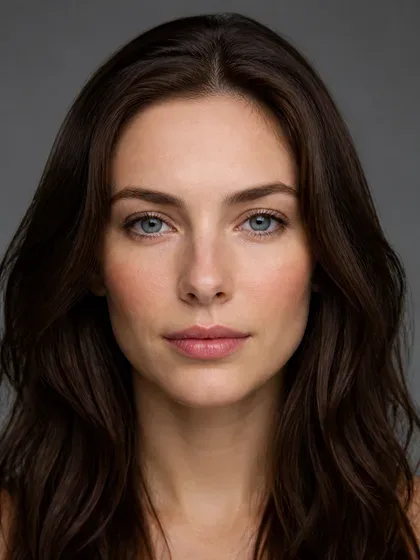
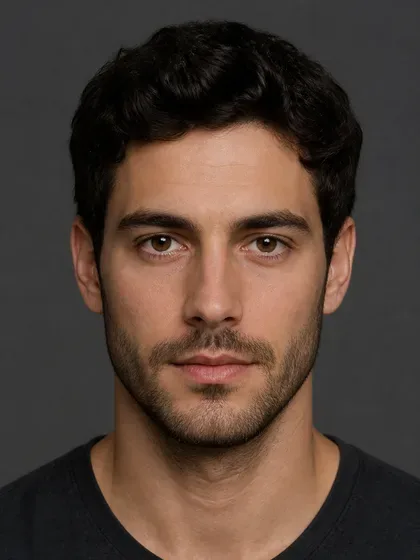
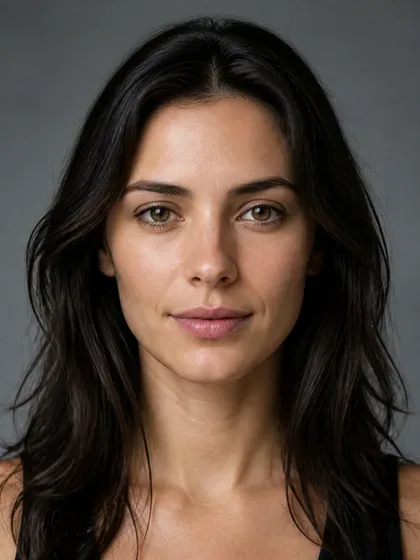
For a more interpretable comparison, use a frontal image taken at eye level from a comfortable portrait distance, with even lighting, a relaxed expression, and the relevant boundaries visible. This reduces avoidable ambiguity without making the result exact.
How to interpret a golden ratio score
First, distinguish a ratio from a score. A value such as 1.61 is a mathematical relationship between two distances. A percentage or rating may combine several measurements using the calculator’s own formula. There is no universal conversion between the two.
Before assigning meaning to a result, ask three questions:
-
Which two distances were compared? A named measurement is more useful than an unexplained overall rating.
-
Were the endpoints clearly defined and visible? An obscured hairline or uncertain mouth corner weakens the comparison.
-
Was the photograph suitable for that measurement? A close selfie, turned head, or stretched image can alter apparent proportions.
If all three answers are clear, the result may be useful as a description of that selected relationship in that photograph. If any answer is unknown, avoid treating small differences between scores as meaningful.
For readers curious about a photo-based comparison, Facefy’s Golden Ratio Face Test offers an estimated analysis of the concept. The same limits around image conditions and measurement choices still apply.
Interpretation rule: A ratio describes the selected pair of measurements, not the whole face, attractiveness, health, identity, or personal value. An AI-generated result is informational or entertainment-oriented, not a clinical finding.
Natural faces do not need to match a template
Facial proportions vary naturally. Visual harmony is not limited to one numerical relationship, and matching one ratio does not mean every other relationship will match it.
Expression, feature shape, hair styling, makeup, and facial hair can all influence overall appearance without changing underlying bone structure. A numerical comparison captures only a small part of that appearance.
It also helps to separate two different statements:
- Measurement: “These two distances have a ratio of approximately 1.61.”
- Interpretation: “Those proportions look appealing to me.”
The first can be calculated once the endpoints are defined. The second is a subjective response, not something the calculation proves.
A score is not a useful basis for ranking people. Repeatedly adjusting photos to chase minor score changes is more likely to reveal differences in pose, lighting, or point placement than a meaningful change in your face.
Common questions about golden ratio faces
Is matching the golden ratio the same as having matching left and right sides?
No. A proportion compares selected distances, while a bilateral comparison examines how the two sides correspond. Either can vary independently of the other.
Can a selfie accurately measure facial proportions?
A selfie can provide an estimate, but a close camera may enlarge central features relative to the sides. Head angle, crop, filters, and image stretching can introduce further differences.
A more distant, straight-on photograph is generally easier to interpret, though it remains a two-dimensional representation.
Do facial expressions affect the result?
Yes. Smiling, squinting, raising the brows, and opening the mouth move visible reference points. Measurements involving the mouth corners or eye openings may be particularly sensitive to expression.
Can hair, makeup, or facial hair change the analysis?
They can change visible boundaries or hide the points being measured. For example, hair may conceal the upper endpoint of a face-length measurement, while facial hair may obscure the lower facial outline. That can change the analysis without changing the underlying structure.
Why do two calculators disagree?
They may use different reference points, formulas, templates, image crops, or ways of combining measurements. Even the same label can refer to different calculations.
The useful question is not which score is more flattering, but whether the result clearly explains what it measured. A defined proportion can be informative; an unexplained number tells you much less.