Golden Ratio Face vs Facial Symmetry: What Each Analysis Measures
Compare golden-ratio facial proportions with facial symmetry, learn why results differ, and understand why neither defines attractiveness.
The golden ratio and facial symmetry measure different visual relationships. Golden-ratio analysis compares selected facial distances with proportional targets such as 1.618. Facial symmetry analysis compares how closely corresponding features align across the left and right sides of the face.
A face can have close left-right alignment without matching selected golden-ratio comparisons, or match some of those comparisons while showing asymmetry. Neither result defines attractiveness, health, or personal worth.
Golden ratio and facial symmetry at a glance
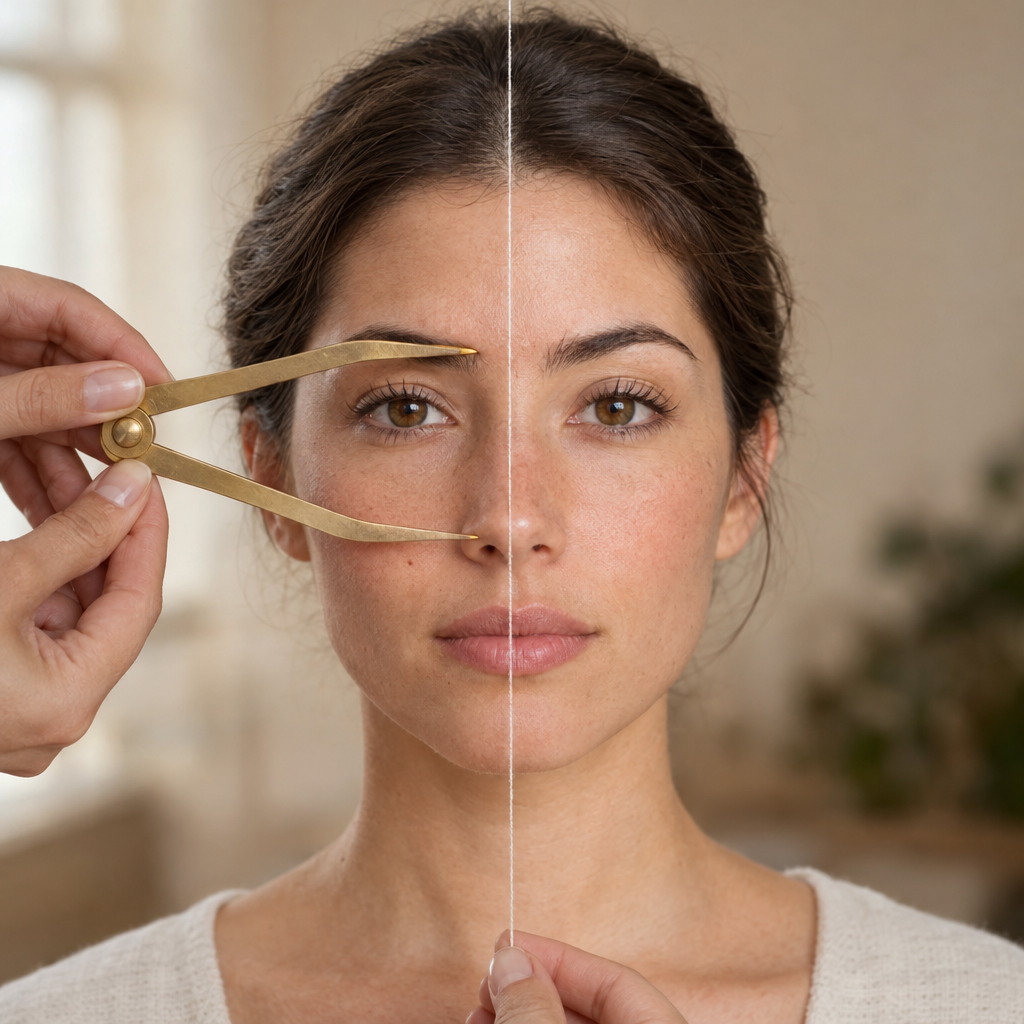
The key distinction is relationships between distances versus correspondence between sides.
| Criterion | Golden-ratio analysis | Facial symmetry analysis |
|---|---|---|
| Core question | How close are selected ratios to targets? | How closely do corresponding features align? |
| Measurement direction | Compares two lengths, which may be vertical, horizontal, or local; it need not compare opposite sides. | Compares the left and right sides across a midline. |
| Typical inputs | Distances between selected facial landmarks | Paired landmarks and a facial midline |
| Possible output | Ratios, target differences, or composite scores | Positional differences or composite scores |
| Primary photo sensitivity | Perspective changes apparent distances | Head rotation changes apparent alignment |
| Cannot establish | Attractiveness, health, personality, genetics, or personal worth | Attractiveness, health, personality, genetics, or personal worth |
A facial landmark is a reference point, such as an eye corner or mouth corner. Both approaches depend on which points are selected and how accurately their positions can be estimated from the photograph.
What the golden ratio means in facial analysis
The golden ratio is a mathematical constant, usually written as phi, with a value of approximately 1.618. In facial analysis, it can serve as a reference for comparing selected distances.
Depending on the method, measurements might involve face length, face width, spacing between the eyes, nose width, mouth width, or other landmark distances. These measurements are not all expected to equal one another or independently equal 1.618. A ratio comes from dividing one selected distance by another.
A simple illustrative calculation
Imagine two fictional distances measured in the same image:
- Distance A: 160 units
- Distance B: 100 units
- Ratio: 160 ÷ 100 = 1.60
The result is close to 1.618, with a numerical difference of 0.018.
This is an arithmetic illustration, not a standardized facial formula. It does not establish which distances should be compared or how much difference matters.
There is no single universally accepted set of facial landmarks or golden-ratio calculations. Different approaches may choose different:
- Landmarks: where each measurement starts and ends.
- Comparisons: which distance is divided by which.
- Weights: how much each comparison contributes to a combined result.
- Scales: how numerical differences become a displayed score.
Consequently, two tools can produce different results from the same photograph. A displayed score is not the ratio itself, and matching one selected ratio says nothing about every other facial relationship.
What facial symmetry analysis compares
Bilateral symmetry means correspondence between features on opposite sides of a chosen midline. For facial analysis, that midline represents the estimated center of the face, not necessarily the center of the photograph.
One landmark-based approach works like this:
- Establish a facial midline. The method estimates a central reference through the face.
- Identify corresponding points. These might include matching eye corners, brow points, or mouth corners.
- Compare positions across the midline. It examines whether paired points sit at similar heights and similar distances from the center.
- Summarize the differences. Those deviations may be reported individually or combined into an estimated result.
For example, two mouth corners could be equally far from the midline but sit at different heights. That would represent one kind of positional asymmetry.
This approach describes selected points, not necessarily the entire three-dimensional face. Landmark choice, head pose, expression, and image quality all affect the result.
Ordinary facial asymmetry is common. Perfect mirror symmetry is not typical, and small left-right differences are a normal part of facial variation.
Why the two results can disagree
The two analyses ask different questions, so disagreement is not automatically an error.
Example one: close alignment, a different selected ratio
Imagine a fictional face whose corresponding eyes, brows, cheek landmarks, and mouth corners align closely across the midline.
Two distances selected for a proportional comparison measure 142 units and 100 units:
142 ÷ 100 = 1.42
The selected ratio is not near 1.618, even though the left and right landmarks align closely. Symmetry does not require those distances to have a golden-ratio relationship.
Example two: a close selected ratio, visible asymmetry
Now imagine another fictional face with two selected distances of 162 units and 100 units:
162 ÷ 100 = 1.62
That comparison is near 1.618. Yet one brow sits slightly higher than the other, and the mouth corners are not quite level.
The selected proportional relationship can remain close to its target despite those left-right differences.
These examples demonstrate conceptual independence, not beauty rankings. A face can be highly symmetrical without matching selected golden-ratio comparisons, or match some selected comparisons while retaining visible asymmetry.
How to read combinations of proportion and symmetry
Here, “closer proportions” means nearer the selected mathematical targets, not better proportions. Likewise, “higher symmetry” means closer alignment under the chosen method, not a better appearance.
| Selected proportions | Higher symmetry | Lower symmetry |
|---|---|---|
| Closer to targets | Nearer ratios; closer alignment. Not attractiveness. | Nearer ratios; greater asymmetry. Not attractiveness. |
| Farther from targets | Farther ratios; closer alignment. Not attractiveness. | Farther ratios; greater asymmetry. Not attractiveness. |
Each combination describes only the chosen measurements:
- Closer proportions and higher symmetry: selected ratios approach their targets, and paired landmarks align closely.
- Closer proportions and lower symmetry: selected ratios approach their targets despite left-right positional differences.
- Farther proportions and higher symmetry: the sides align closely, but the selected ratios are farther from their targets.
- Farther proportions and lower symmetry: selected ratios are farther from their targets, and the measured landmarks show greater left-right variation.
There are no universal cutoffs for these categories. They are useful for understanding what a result describes, not for assigning an appearance grade.
Why photo conditions can change either result
A photograph turns a three-dimensional face into a two-dimensional image. Visible distances and positions can change before an analysis method even begins.
Four photo conditions explain many shifts in image-based results.
1. Frontal head position
Check: Face the camera directly, with it around eye level, rather than turning toward one shoulder or tilting the head.
Why it matters: Rotation makes the farther side appear narrower and shifts features relative to the apparent midline. Tilting can also make paired landmarks appear uneven in height.
2. Neutral expression
Check: Relax the brows and mouth rather than smiling, squinting, or raising one eyebrow.
Why it matters: A smile changes mouth width and cheek position. Squinting changes the visible eye region. These movements can affect both distance ratios and left-right comparisons.
A neutral expression provides a more consistent reference. It is not a more accurate representation of how someone looks during everyday interaction.
3. Even illumination
Check: Use soft light reaching both sides of the face, avoiding a strong light source from only one side.
Why it matters: Shadows can obscure the jaw outline, eye corners, or nose edges. They can also make one side look more prominent without any structural change.
4. Limited close-up perspective distortion
Check: Avoid holding a wide-angle camera very close to the face. Move the camera farther away while keeping enough image detail.
Why it matters: Close camera distance can make central features, particularly the nose, appear larger relative to features farther away. Wide-angle framing often encourages this close distance. Cropping a close-up afterward does not remove its perspective distortion.
Other details matter too. A tight crop may remove useful landmarks. Hair crossing the face, facial hair, glasses, and makeup can obscure or alter visible boundaries. Blur, low resolution, filters, and heavy image processing can further complicate landmark placement.
These checks help explain variation, but they cannot turn a photograph into a definitive measurement of facial structure. Treat comparisons across different photographs cautiously rather than repeatedly seeking a preferred score.
What neither metric captures about appearance
A ratio and a set of landmark positions leave out much of what people notice in a face.
- Expression: a smile, attentive gaze, or relaxed expression changes the impression of a face.
- Individual feature shape: eye contours, lip curves, and nose shape are not fully described by distances between a few points.
- Skin and color contrast: the visible relationships among skin, brows, eyes, and lips contribute to appearance.
- Hairstyle and facial hair: framing, volume, and visible outlines affect how features relate visually.
- Cultural and personal preference: people differ in which features and styles they find appealing.
- Movement: everyday interaction includes changing expressions and viewing angles, not one frozen frame.
- Overall feature relationships: a selected ratio cannot capture every interaction among features.
- Styling, lighting, and context: clothing, makeup, surroundings, and illumination influence visual impression.
How to interpret AI-generated facial analysis
Treat an AI-generated result as an estimate based on a particular image and method. It describes what that system inferred from the photograph, not an objective verdict about your appearance.
A useful interpretation framework is:
- Identify the question being answered. Is the result about selected distance ratios, left-right alignment, or a combined assessment?
- Separate measurements from labels. A numerical ratio, a positional difference, and an overall score are different outputs.
- Keep comparisons like-for-like. Two similarly numbered scores may use different landmarks, targets, and scales.
- Consider the image conditions. A changed pose or expression may explain a changed result.
- Use the result for limited curiosity. It should not become proof of attractiveness or a reason for repeated appearance checking.
As an optional next step, the Golden Ratio Face Test lets you explore selected facial proportions from a photo. Its estimated result should be understood in that narrow context, rather than treated as a symmetry assessment or beauty verdict.
Common questions about golden ratio and facial symmetry
Is the golden ratio the same as facial symmetry?
No. Golden-ratio analysis compares selected distances with proportional targets. Facial symmetry analysis compares corresponding features across the left and right sides of a facial midline.
Which matters more visually, symmetry or proportion?
There is no universal ranking that applies to every face and viewer. Both can contribute to visual impression, but their influence depends on the features involved, expression, styling, context, and individual preference. Neither metric captures the complete way a face looks.