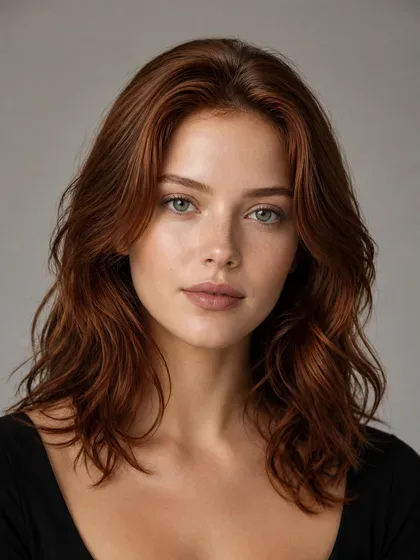
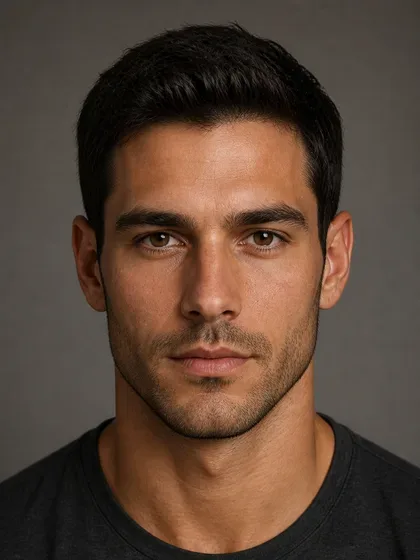
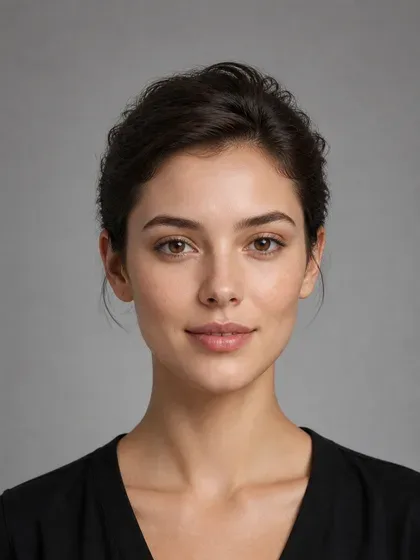
How Hairline Affects Face Shape and the Way Your Face Looks
Learn how high, low, rounded, peaked, and receding hairlines affect perceived face shape without changing your underlying facial structure.
Your hairline affects how your face shape looks, but it does not change the underlying structure of your cheekbones, jaw, or chin. It forms the visible upper boundary of your face, so its height, contour, and temple coverage can make the same face appear longer, shorter, broader, narrower, softer, or more angular.
For a clearer assessment, look at your facial contours with your hair pulled back, then consider how your usual hairstyle changes the overall silhouette. No single hairline reliably identifies a face-shape category. A widow’s peak, for example, can appear on both rounded-jaw and angular-jaw faces.
Structural face shape and perceived face shape are different
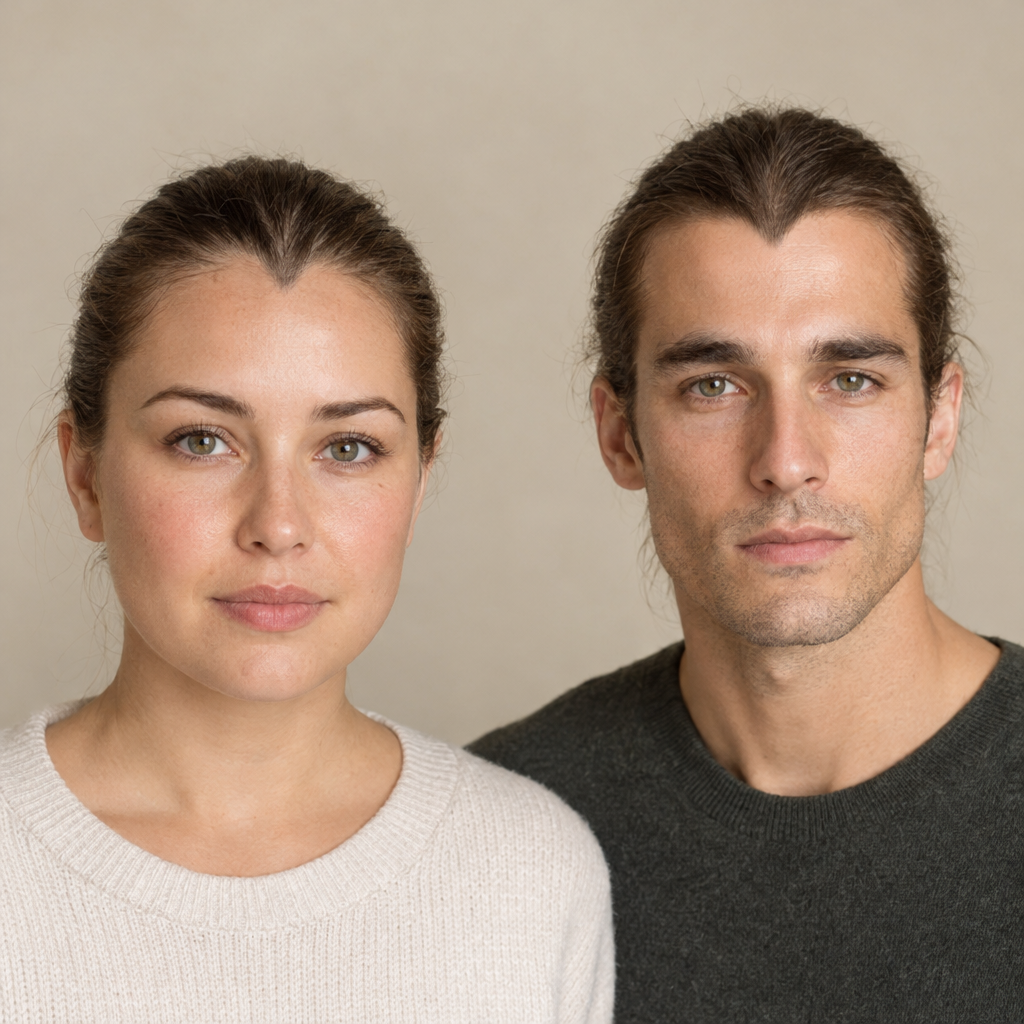
Two descriptions can be useful, and they do not have to produce exactly the same impression:
- Structural face shape: An approximate description based on relatively stable visible landmarks, including cheekbone width, jaw width and contour, chin shape, and facial length.
- Perceived face shape: The overall impression created by those landmarks plus the visible forehead, exposed temples, hairline, fringe, and surrounding hair volume.
Here, “structural” means looking mainly at facial contours. It does not mean that a photograph reveals or measures the underlying skeleton.
Someone with prominent cheekbones and a tapered chin may retain those characteristics across every hairstyle. Yet bangs can make the visible face seem shorter, while height at the crown can make the whole silhouette seem longer.
Visible forehead height is also not interchangeable with total facial length. A higher hairline exposes more forehead; it does not lengthen the middle or lower face. Face-shape labels are descriptive approximations, not exact biological classifications.
Why the hairline changes visible proportions
The eye reads the hairline as a boundary between the face and the hair. Three aspects of that boundary matter:
- Central height: How much forehead is visible above the eyebrows.
- Temple coverage: Where hair meets the sides of the forehead.
- Contour: Whether the upper boundary looks horizontal, curved, pointed, or irregular.
A high hairline may increase apparent upper-face length. A low hairline can create a more compact upper face, which sometimes reads as broader even when its actual width is unchanged.
Temple exposure works separately from central height. Two people with similar forehead height can have different upper-face silhouettes because one has fuller hair coverage at the temples.
These effects do not determine the whole face. A straight hairline can sit above a broad, angular jaw or a narrow, tapered jaw. Likewise, a rounded hairline does not necessarily mean a round face.
How common hairline patterns affect perceived face shape
The table separates visible forehead height, apparent upper-face width, and boundary contour. These are possible visual effects, not fixed rules.
| Hairline presentation | Visible forehead height | Apparent upper-face width | Apparent angularity |
|---|---|---|---|
| High | Usually taller | No consistent effect; temple position and surrounding hair determine width | Depends on the contour |
| Low | Usually shorter | May look proportionally broader because the upper face appears more compact | Depends on the contour |
| Straight | Variable | The horizontal boundary may emphasize breadth, especially when the temples are exposed | Creates a more structured upper edge |
| Rounded | Variable | No consistent widening or narrowing effect; temple position and surrounding hair volume determine the impression | Creates a softer upper contour |
| Widow’s peak | Lower at the center and higher toward the sides | No consistent effect; the point changes the boundary more than its width | The central point adds definition |
| Receding or M-shaped | More forehead is often exposed at the corners | Does not necessarily make the upper face narrower; the central hair-bearing section may narrow while the exposed forehead area increases | Creates more defined temple angles |
| Uneven | May differ between sides | May create an uneven width impression depending on temple coverage | Creates an irregular upper contour |
A few distinctions prevent common misreadings:
- High and low describe position, not shape. Either can also be straight, rounded, or peaked.
- A straight boundary emphasizes a horizontal line. That can make the forehead look more structured without making the jaw more angular.
- A rounded boundary softens the forehead outline. Rounding alone does not make the upper face wider or narrower, and the cheekbones and jaw may still be strongly defined.
- A widow’s peak is a central downward point. It does not establish a heart-shaped face. Look for the broader relationship between the upper face and a tapering lower face instead.
- An M-shaped outline describes the visible contour. The outline alone does not establish why it developed or whether it is changing.
- An uneven hairline can affect apparent balance. Natural side-to-side differences do not mean the underlying facial structure has changed.
Why exposed temples can change the result
Temple exposure creates a useful distinction: exposed forehead area, apparent forehead width, and the width of the central hair-bearing section are not the same thing.
- Exposed forehead area is the amount of visible skin between the brows, temples, and hairline.
- Apparent forehead width is the visual side-to-side span of the upper face.
- Central hair-bearing width is the width of the section of hair that remains above the center of the forehead.
Receding temples can expose more forehead skin while leaving a narrower central hair-bearing section. However, that does not automatically make the forehead or upper face appear narrower. The result depends on where the visible temple boundaries sit, how the surrounding hair is styled, and how the upper face compares with the cheekbones and jaw.
The resulting impression depends on the lower face:
- With a softly tapering jaw, the outline may look more oval.
- With prominent cheekbones and a narrow chin, reduced temple fullness may emphasize a diamond-like outline.
- With a relatively broad upper face and a tapered chin, a peaked boundary may contribute to a heart-like impression.
These are possibilities, not predictable category changes.
Hair placed around the temples can create the opposite effect by adding fullness to the upper silhouette. However, strands lying directly across the forehead may conceal its sides and narrow the visible skin area. Adding hair volume and covering forehead skin can have different effects.
A mature or changing hairline is simply one part of this visual description, not a flaw or a diagnosis.
A two-photo boundary test separates facial contours from hair effects
This comparison is useful if your face seems to change shape whenever you tie your hair back or change your part.
1. Take a clear, hair-away photo
Move your hair away from the forehead without pulling tightly. Leave both temples visible.
Position the camera straight ahead, approximately at eye level, and keep your head level with a relaxed expression. Avoid a very close selfie, which can exaggerate differences in distance between facial features and the camera.
2. Take a second photo with your usual hairstyle
Restore your normal part, fringe, face-framing pieces, and volume. Keep the following unchanged:
- Camera distance and lens or phone setting
- Camera height and head position
- Lighting and background
- Expression
- Crop and image scale
Move your hair, not the camera. Otherwise, perspective changes may look like hairstyle effects.
3. Compare changing boundaries with stable landmarks
Look at the images side by side.
What changed?
- Visible forehead height
- Temple coverage
- Width of the surrounding hair
- Height at the crown
- Amount of cheek or jaw covered by hair
What stayed consistent?
- Chin outline
- Jaw contour
- Cheekbone position and width
- Length of the visible middle and lower face
You can also compare two vertical references. Hairline-to-chin runs from the visible center of the hairline to the bottom of the chin, so it changes when more or less forehead is exposed. Brow-line-to-chin runs from an imaginary horizontal line across the brows to the bottom of the chin. Across matched photos, this second reference helps separate changing forehead exposure from the more stable portion of the face below the brows.
Brow-line-to-chin is not total facial length and should not be used as a standalone face-shape rule. It is simply a within-person comparison that can show whether the apparent change comes mainly from the upper boundary. If bangs conceal the hairline, do not treat the fringe edge as a new anatomical starting point.
A fringe may shorten the visible face, while crown volume or pulling the hair away may emphasize length. If the lower contours and brow-line-to-chin reference remain consistent, the difference is mainly in presentation.
Check the same features in a mirror if shadows or hair obscure them. Neither a mirror nor a photograph removes every ambiguity, but agreement between them can make the description more useful.
Use stable landmarks to resolve mixed impressions
When the forehead suggests one category and the lower face suggests another, use this order:
- Start with the chin and jaw contour. Does the lower face look rounded, tapered, broad, or angular? Separate chin shape from jaw width: a pointed chin can still accompany a relatively broad jaw.
- Compare cheekbone width with jaw width. Notice whether the cheekbones are clearly wider or whether the sides remain fairly similar in width.
- Assess length relative to width. Compare the visible width across the cheekbones with the face’s overall vertical impression. Then check hairline-to-chin and brow-line-to-chin separately. Hairline-to-chin includes exposed forehead height, while brow-line-to-chin provides a more stable matched-photo reference for the portion below the brows. Neither measurement is a standalone classification rule, and close camera distance or head tilt can distort both.
- Add forehead contour and hairline last. Use temple exposure, central height, and a peaked or curved boundary to refine the description rather than override the other observations.
For supporting context, facial proportions can help explain length-and-width comparisons. They should not become rigid numerical rules for assigning a label.
Use this simple decision framework:
- Clearer impression: Jaw, cheekbone width, and length suggest a similar overall shape in the mirror and both photos.
- Mixed impression: Lower-face contours stay consistent, but hair coverage changes the apparent category. Keep the facial description and hairstyle effect separate.
- Uncertain impression: Perspective, shadows, or coverage make the landmarks difficult to compare. A plain description such as “longer face with a tapered jaw” is more useful than forcing a label.
A face can reasonably sit between categories.
How hairstyles redraw the apparent upper boundary
Hair placement changes what is visible and where the surrounding silhouette has volume.
- Pulled-back styles reveal forehead height and the natural hairline. They also remove face-framing coverage, although the effect depends on whether the sides lie flat or retain fullness.
- Fringes and bangs conceal some forehead height and create a lower visible boundary. A dense fringe makes a more continuous boundary than a light, separated fringe.
- A center part exposes the forehead centrally and divides the surrounding hair into two sides. Its effect depends on how closely those sides fall against the face.
- A side part creates uneven forehead exposure and shifts volume toward one side, changing the balance of the upper silhouette.
- Crown volume adds height outside the face itself. It can lengthen the overall impression without altering facial length.
- Face-framing sections can cover the temples or cheeks, narrowing the visible face or softening the transition between them.
Texture matters as much as placement. Curly or coily hair may create a fuller outer outline, while straighter hair may lie closer to the face. The same cut or part can therefore create different visual effects depending on hair texture. Facefy’s Hair Style Try-On lets you preview hairstyles and compare how bangs, parting, and volume may change the way your face shape appears.
How to interpret an AI face-shape estimate
An AI-generated result is an image-dependent estimate, not a fixed classification.
If a hairstyle obscures your forehead, compare an estimate from that photo with one taken straight on with the forehead and both temples visible. Use the matched-photo setup above so hair coverage is the main difference.
If the category changes, that is evidence that hair coverage may have influenced the result, not proof that your face changed. Camera angle, lens perspective, crop, lighting, expression, image quality, and ordinary variation in the analysis can also affect the estimate.
Facefy’s Face Shape Detector can provide an optional estimate if you want another reference after comparing the photos. Consider it alongside your own observations of the jaw, cheekbones, chin, and facial length.
There is little benefit in repeatedly checking until one label appears. If the descriptions overlap, retain the practical details rather than searching for a definitive category.
Common questions about hairlines and face shape
Does your hairline count when determining face shape?
Yes, as part of the visible outline. However, it should not outweigh the jaw, cheekbones, chin, and overall length. Many face-shape descriptions include forehead width, so the hairline matters without being decisive.
Can a high hairline make a face look longer?
It can expose more forehead and increase apparent upper-face length, particularly with the hair pulled away. It does not necessarily mean the overall face is oblong.
Can a low hairline make a face look wider or rounder?
A shorter visible forehead can make the upper face look more compact or proportionally broader. Whether the whole face reads as round still depends on cheekbone width, facial length, and jaw contour.
Does a widow’s peak mean you have a heart-shaped face?
No. A widow’s peak describes the hairline’s central point. A heart-shaped description concerns the broader outline, especially an upper face that narrows toward the chin. Either feature can occur without the other.
Why does my face look different with my hair tied back?
Tying it back reveals the natural upper boundary and removes hair that may have covered the temples or cheeks. It also changes the volume surrounding the face, so the effect is not solely about forehead exposure.
Can an uneven hairline affect perceived balance?
Yes. Different heights or curves on either side can make the upper outline look less symmetrical. Mild asymmetry is common, and the hairline alone does not tell you whether the jaw or cheekbones differ.
Why do tools give different results across photos?
They analyze the information visible in each image. Hair coverage, angle, lens perspective, crop, expression, and lighting can all change that information. When results differ, a description of the features that remain consistent is usually more useful than choosing one label as the only correct answer.