Types of Curtain Bangs: 8 Variations Compared
Compare eight types of curtain bangs by length, density, center opening, styling effort, maintenance, and grow-out needs.
The main types of curtain bangs are classic, long, short, wispy, full, textured, curly, and bottleneck-inspired. These categories can overlap. A fringe might be both long and wispy, or curly and full.
The most useful differences are the shortest dry length, density, center opening, and connection to the surrounding layers. Choose according to how your front hair naturally falls, how much forehead coverage you prefer, and how often you are willing to reshape it.
What Makes a Fringe a Curtain Bang?
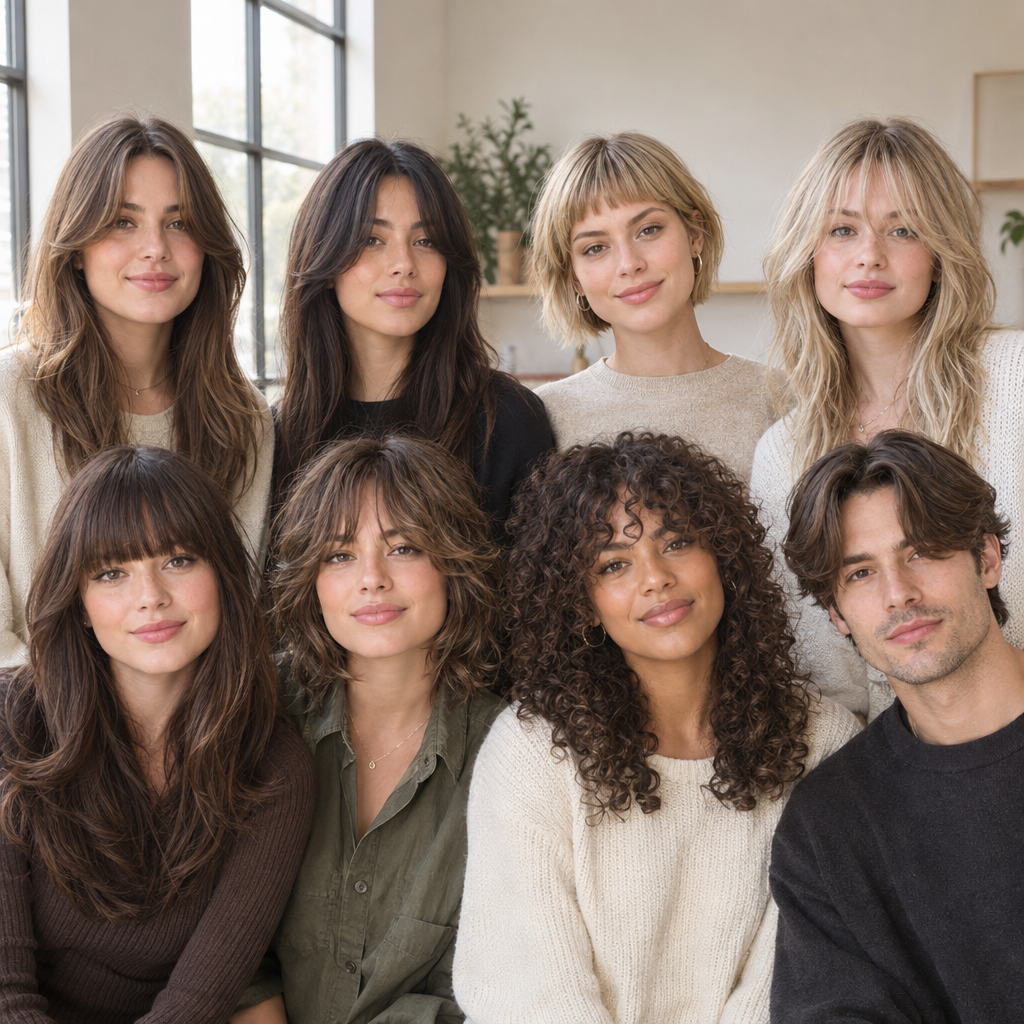
Curtain bangs are a fringe that opens around the middle of the forehead, with shorter central pieces becoming longer toward both sides. Picture two sections sweeping outward rather than one continuous line across the forehead.
Unlike ordinary face-framing layers, curtain bangs usually involve a distinct front section cut shorter than the surrounding hair. The boundary becomes less obvious with very long versions, which may resemble layers once tucked behind the ears.
Use four visible traits to compare reference photos:
- Length endpoints: Where do the shortest center pieces and longest side pieces rest when dry?
- Density: Is the fringe airy and separated, moderately filled, or full with substantial coverage?
- Center opening: How much forehead remains visible between the two sides?
- Blending: Does the fringe remain separate, connect visibly to layers, or merge softly into the surrounding hair?
Center-opening terms are descriptive rather than precisely measured:
- Narrow opening: The two sides meet close to the center, leaving only a slim area of forehead visible near the part.
- Moderate opening: The sides separate clearly around the center while still covering part of the forehead above the inner brow area.
- Broad opening: The fringe is directed farther outward, exposing more of the central forehead and creating a wider frame.
Opening width is partly a styling choice. Brushing the same fringe farther outward can reveal more forehead without changing the cut. Reference photos are most useful when they include front views showing the opening and profile views showing how the side pieces connect to the rest of the hair.
Salon labels are not standardized, and no version is universally flattering. These names describe different amounts of coverage, movement, and upkeep rather than better or worse cuts. Curtain bangs can frame different facial features depending on their length, density, and center opening. If you want to understand your facial outline before comparing styles, Facefy’s Face Shape Detector can provide an estimated face-shape classification to use as a reference, not a rule for choosing a haircut.
Eight Types of Curtain Bangs at a Glance
These are common interpretations, not fixed specifications. Lengths refer to where the hair rests when dry, allowing for waves, curls, and shrinkage. Styling effort is relative and assumes your natural part and texture already support the intended finish. If you’re still deciding which curtain bang variation to try, Facefy’s Hairstyle Finder can help you explore hairstyle ideas and compare different looks before choosing a style to discuss with your hairstylist.
| Variation | Defining cut traits | Typical styling effort |
|---|---|---|
| Classic | Brow-to-cheek sweep with a moderate opening | Moderate; reshape the curve |
| Long | Cheek-to-chin lengths with soft blending | Lower; more effort for a lifted finish |
| Short | Brow-level center with a distinct fringe outline | Moderate to high; reset the front regularly |
| Wispy | Light density with visible separation | Low to moderate; manage stray or oily pieces |
| Full | Dense front section with stronger coverage | Moderate to high; control roots and weight |
| Textured | Broken edge with piecey movement | Variable; guide separation without overloading it |
| Curly | Dry-length shaping with a curl-grouped opening | Variable; refresh individual curls as needed |
| Bottleneck-inspired | Short, narrow center with curved sides | Moderate to high; shape both the center and wings |
Grow-out and salon priorities can differ even when two variations look similar immediately after styling.
| Variation | Grow-out behavior | Main stylist discussion |
|---|---|---|
| Classic | Center pieces may reach the eyes before blending | Comfortable shortest length |
| Long | Gradually merges with surrounding layers | Tucking and tying-back length |
| Short | Remains visibly fringe-like during growth | Cowlick lift and brow clearance |
| Wispy | Light pieces usually merge gradually | Section size and unwanted gaps |
| Full | Strong coverage persists as length increases | Weight management without excessive thinning |
| Textured | Staggered endpoints remain apparent as the fringe lengthens, while the original piecey definition may become less noticeable | Separation, weight removal, and frizz |
| Curly | Dry shape changes as curls stretch or regroup | Shrinkage and dry endpoints |
| Bottleneck-inspired | Short center remains distinct after the wings begin blending | Center width and transition |
How the Eight Variations Look and Behave
1. Classic curtain bangs
Classic curtain bangs have a recognizable outward sweep, usually with center pieces around the brows or upper nose and sides extending toward the cheekbones. The fringe has enough length to curve away from the forehead rather than standing straight out.
This version provides visible coverage without forming a solid line across the forehead. A brief blow-dry may be needed to restore the curve after sleeping. During grow-out, the middle pieces can reach the eyes before they become long enough to tuck away.
2. Long curtain bangs
Long curtain bangs create a sweeping frame with less emphasis on a short central fringe. The shortest pieces often rest around the upper cheeks or cheekbones, while the sides may extend toward the mouth or chin.
They are a practical starting point if you want flexible coverage and a gradual transition during grow-out. However, long does not automatically mean tie-back friendly. Ask whether the shortest pieces will reach your usual ponytail or bun, not simply whether the sides can tuck behind your ears.
3. Short curtain bangs
Here, short describes the fringe rather than the rest of the haircut. The center pieces may rest around or slightly above the brows, with the sides reaching the outer-eye or upper-cheek area.
The shorter center makes the fringe outline more visible. It also gives cowlicks less length to work against, so an upward-growing section may require regular reshaping. These pieces generally cannot tuck behind the ears and may need clips during exercise or grow-out.
4. Wispy curtain bangs
Wispy describes low density and visible separation rather than one particular length. The fringe uses a relatively small section of hair, allowing parts of the forehead to remain visible between strands.
Wispy bangs create less visual weight, but they are not necessarily maintenance-free. Fine strands can separate further with oil, humidity, or heavy styling products. Ask how much hair will be included in the fringe section, especially if the front already has lower density.
5. Full curtain bangs
Full curtain bangs use a denser front section to create stronger coverage and a more substantial sweep. They often have a defined fringe shape with a deliberate transition into the sides.
The added weight can support a solid curve, but a lifted finish may require more drying control. As the fringe grows, the extra length can make the center feel heavier or reduce the opening. Discuss where weight should remain and where it can be reduced without creating unwanted short flyaways.
6. Textured curtain bangs
Textured curtain bangs have an intentionally broken edge and separated movement. Textured can describe the cutting technique, the styled finish, or both.
They suit someone who prefers a piecey result over a smooth, uniform curve. Naturally wavy hair may provide much of the movement without extensive styling. Straighter hair might need a small amount of lightweight product to maintain separation.
Removing too much weight can make certain hair types harder to control or create more flyaways than intended. Ask the stylist how the proposed technique will behave on your strand thickness, density, and natural pattern.
7. Curly curtain bangs
Curly curtain bangs follow the same shorter-center, longer-side structure, but the shape is formed by curl groups rather than a continuous edge.
A curl that looks long when stretched can sit much higher after drying. The stylist should account for shrinkage, differences between individual curl groups, and how you normally style the front. The left and right sides may also rest at slightly different dry endpoints even when their stretched lengths are similar.
Refreshing a few front curls may be enough on some days. On others, the opening may move or become less even as the curls regroup.
8. Bottleneck-inspired curtain bangs
This variation combines outward-sweeping sides with a shorter, narrower central section. The center often rests around the brows, while the sides curve toward the cheekbones.
It provides more central forehead coverage than a broadly opened curtain fringe. The short middle section may need attention even when the longer sides fall into place easily. During grow-out, the center remains recognizably fringe-like after the wings have started blending into the surrounding hair.
The Cut and the Styling Finish Are Not the Same Thing
Consider one long curtain fringe with cheekbone-length center pieces and sides ending near the chin. It can produce several different looks without being recut:
- Smooth and blended: Direct the ends into the surrounding hair with a brush. The fringe sits closer to the head, with less visible lift and a softer boundary.
- Flipped away from the face: Use a round brush to curve the sides outward, then let them cool before brushing through. The lifted ends make the center opening appear broader.
- Air-dried with natural texture: Arrange the front into its usual wave or curl groups while damp, then leave it mostly undisturbed. The opening may be less even, and the ends may sit higher.
Tousling adds separation. A pronounced curve creates apparent volume. Brushing pieces together increases apparent density. These changes do not necessarily require a different cut.
When comparing reference photos, ask where the shortest piece would fall if the curve relaxed. Also check whether the image shows a polished blowout or a finish you would realistically recreate.
How Hair Texture, Density, and Natural Growth Affect the Result
Texture describes the hair’s pattern, while density describes how much hair occupies an area. Strand thickness is another variable. Fine strands and low density are not the same thing.
- Straight hair: Shows the cutting edge clearly. A curved finish may need reshaping if the hair naturally falls flat.
- Wavy hair: Adds movement, but the waves on each side may bend at different heights and create an uneven opening.
- Curly hair: Can form a curtain fringe when the length and transition account for dry curl behavior and shrinkage.
- Fine strands: Can create an airy effect but may lose lift under heavy creams or oils. A very small fringe section can separate into sparse-looking pieces.
- High-density hair: Offers fuller coverage but may need careful weight distribution. Coarse strands can require more control when changing direction.
- Cowlicks and natural parting: Can push the fringe upward, sideways, or into a gap that does not sit exactly in the center.
Humidity, sleep, hats, and exercise can alter the opening after styling. If your front hair strongly favors one direction, a slightly off-center curtain may be easier to maintain than a perfectly centered version.
Hair behavior and your preferred routine are more useful starting points than rigid rules based on age, gender, or facial categories.
A Four-Step Check Before Choosing Your Version
1. Find your natural part
After washing, gently arrange your hair without forcing a center line. Notice where the front separates as it dries.
A naturally central opening may require less redirection. A strong side part does not rule out curtain bangs, but maintaining a centered finish may take more effort.
2. Check the direction of any cowlick
Look at the front roots. Do they lift upward, sweep sideways, or push two sections apart?
Show this movement to your stylist before choosing the shortest length. A lifted root can make a short fringe rest higher than expected.
3. Observe your front hair fully dry
Examine the front separately from the back lengths:
- Does it curl more tightly?
- Does one side bend inward while the other bends outward?
- Do strands group together or separate?
- How much shorter does it sit dry than damp?
Choose reference photos that resemble this behavior, not only your hair color or overall length.
4. Decide how much resetting fits your routine
Would you be comfortable dampening and reshaping the front after sleep, exercise, or humid weather? Or would you prefer to brush it into place and leave it?
Use those preferences to narrow the options:
- Minimal reshaping: Start by discussing a longer, softly blended version. A lighter section may help, but it can also separate more easily.
- More forehead coverage: Compare classic, full, and bottleneck-inspired versions.
- Natural movement: Consider textured or curly versions designed around your dry pattern.
- Frequent tying back: Prioritize the reach of the shortest piece rather than the style name.
- A broad opening: Ask for enough length to sweep the fringe outward without constant root correction.
The practical question is whether the cut fits your hair behavior, styling time, and tie-back habits.
What to Ask for at a Stylist Consultation
Use a specific request rather than relying on curtain bangs alone:
“I want the shortest center pieces to reach [point] when dry and the sides to end around [point], with [light, medium, or full] density. I want the fringe to [remain separate from my face-framing layers or blend into them]. If blended, I want the transition to be [subtle or clearly visible]. I prefer a [narrow, moderate, or broad] center opening.”
For example:
“I want the shortest pieces to reach my cheekbones when dry and the sides to reach my chin. I want a light-to-medium section that blends subtly into my front layers, with a broad opening. The side pieces should be long enough to tuck behind my ears.”
If you prefer a separate fringe, say so directly:
“I want the curtain fringe to remain distinct instead of connecting into my face-framing layers. Please keep the outer edge visible when viewed from the side.”
Bring a front view to show coverage and center-opening width. Add a profile view to show whether the fringe remains distinct or blends into the side layers. A naturally styled reference is also helpful because a polished salon photo cannot show how the cut behaves without a blowout.
Ask your stylist:
- Can you assess my natural part and cowlick while my hair is dry?
- Where will the shortest pieces rest without heat styling?
- How much hair will you bring into the fringe section?
- Will the fringe remain separate or connect to my existing layers?
- Will the short pieces pin back or reach my usual tie-back position?
- Which parts are likely to need reshaping first?
If you like the length in one photo and the density in another, say so. A stylist can use several references to understand different parts of the request.
Maintenance, Reshaping, and Growing Curtain Bangs Out
Refresh the front when needed
Bangs may become oily sooner than the rest of the hair because they touch the forehead and are handled frequently. Washing only the fringe can be enough between full washes.
If you plan to blow-dry it, gently blot the hair first so it is damp rather than dripping. Begin shaping the roots before they dry in an unwanted direction. For a small reset, lightly dampen the front instead of repeatedly adding more styling product.
Match the styling method to the finish
- Air-drying: Useful when your natural part and texture already create an opening. Arrange the pieces while damp and avoid excessive handling.
- Brief blow-dry: Useful for redirecting roots or restoring the sweep. Start with gently blotted, damp hair, use moderate heat, and keep the airflow moving rather than concentrating it on one spot.
- Round brush with a dryer: Adds a curved, lifted finish. Keep the dryer moving and let each section cool before brushing through.
- Flat iron or curling iron: Can add a slight bend, but direct-contact hot tools should only be used on fully dry hair. Repeated passes can overwork short front pieces.
Use a heat protectant suitable for your styling method, moderate heat, and as few passes as practical. Heat protection can reduce exposure, but it does not make repeated high-heat styling harmless.
Plan reshaping around the cut
A reshaping interval of roughly 4 to 8 weeks can be a starting point for discussion. The right timing depends on the initial length, hair growth, texture, and how much change you are comfortable with.
Short versions may feel overgrown sooner when central pieces begin reaching the eyes. Full versions can feel heavier as added length changes the opening and how the fringe sits.
Long, wispy, and strongly blended versions often transition more gradually into the surrounding layers. Disconnected ends or changing curl lengths may still benefit from occasional reshaping.
Expect a few grow-out stages
First, short center pieces become a longer fringe. Next, they may sweep aside but remain too short to tuck securely. Later, they start behaving like front layers.
During the middle stage, small clips or a softer side part can help. If growing the bangs out is your goal, ask your stylist to preserve length while softening the transition.
Curtain Bangs vs. Similar Fringe Styles
The clearest distinction is the relationship between the center opening, shortest point, and presence of a separate fringe section.
| Style | Center opening | Typical shortest point | Separate fringe section |
|---|---|---|---|
| Curtain bangs | Usually near the middle, from narrow to broad | Commonly between brow and cheek level | Usually, although very long versions blur the boundary |
| Bottleneck bangs | Narrow or nearly closed before widening outward | Usually around the brows | Yes |
| Side-swept bangs | Not the main feature; hair travels mostly to one side | Varies, often following a diagonal | Usually |
| Long face-framing layers | Created mainly by the part rather than a short fringe | Often around the cheeks, chin, or below | Not necessarily |
A cheek-length front section can reasonably be called long curtain bangs or short face-framing layers. A narrow curtain fringe may also resemble bottleneck bangs. If two labels seem accurate, describe the visible structure instead of trying to find one definitive name.
Previewing Curtain Bangs Without Treating the Image as a Guarantee
Once you have narrowed your preferred length, coverage, and opening, Facefy’s Hair Style Try-On can help you explore a different fringe look on a photo.
Use a preview to consider broad possibilities, such as stronger forehead coverage or a longer outward sweep. It cannot establish exactly how your hair will separate, shrink, or respond to humidity.
For a useful comparison:
- Choose a clear photo with even lighting and a straightforward camera angle.
- Keep the crop and expression consistent when comparing looks.
- Compare nearby variations rather than only one dramatic change.
- Evaluate central coverage, side length, and overall volume separately.
Lighting, existing hair volume, camera angle, and styling can influence the apparent result. Simulations may also represent curl groups, flyaways, wispy transparency, and fine edges imperfectly.
Treat the result as a conversation aid. Your natural part, cowlicks, dry texture, and styling tolerance still determine how the actual cut will behave.
Quick Answers About Curtain Bang Variations
What is the difference between wispy and full curtain bangs?
Wispy bangs use a lighter section with more visible gaps. Full bangs use a denser section for stronger coverage. Either version can be long or short because density and length are separate choices.
Can wavy or curly hair have curtain bangs?
Yes. The opening may be less uniform than it appears in a smooth blowout, and the length should account for the hair’s dry wave or curl pattern. Curly front sections may need extra allowance for shrinkage.
Which curtain bangs are easiest to grow out?
Long, softly blended versions generally merge into the surrounding layers more gradually. Shorter center pieces take longer to reach a tuckable length, even when the sides are already long.
Do curtain bangs need styling every day?
Not always. A fringe that follows your natural part and texture may need little adjustment. A precise, lifted sweep is more likely to need refreshing, especially after sleep, exercise, or moisture exposure.
How often should curtain bangs be reshaped?
Roughly every 4 to 8 weeks is a useful starting point rather than a fixed schedule. Short or full versions may need attention sooner, while longer blended pieces can usually change more gradually.
Are bottleneck bangs the same as curtain bangs?
They overlap, but bottleneck bangs usually have a shorter, narrower central section before curving into longer sides. For a salon consultation, it is more useful to describe the center length, side endpoint, density, opening, and connection to the surrounding layers.