Braids: Types, Techniques, Style Selection, and Care
Compare braid types, extension methods, scalp comfort, upkeep, and removal so you can choose a style that fits your hair and routine.
Braids are made by interlacing sections of hair. They range from simple three-strand plaits and French braids to close-to-scalp cornrows and individually sectioned box braids. Some use only your own hair, while others include added hair for length, fullness, color, or a particular finish.
The right choice depends on your hair’s condition, available length, scalp comfort, extension weight, styling time, and care routine. Secure should not mean painful. Persistent pain, headaches, bumps, disrupted sleep, or strong pulling at the hairline are reasons to loosen or remove the affected sections.
What counts as a braid?
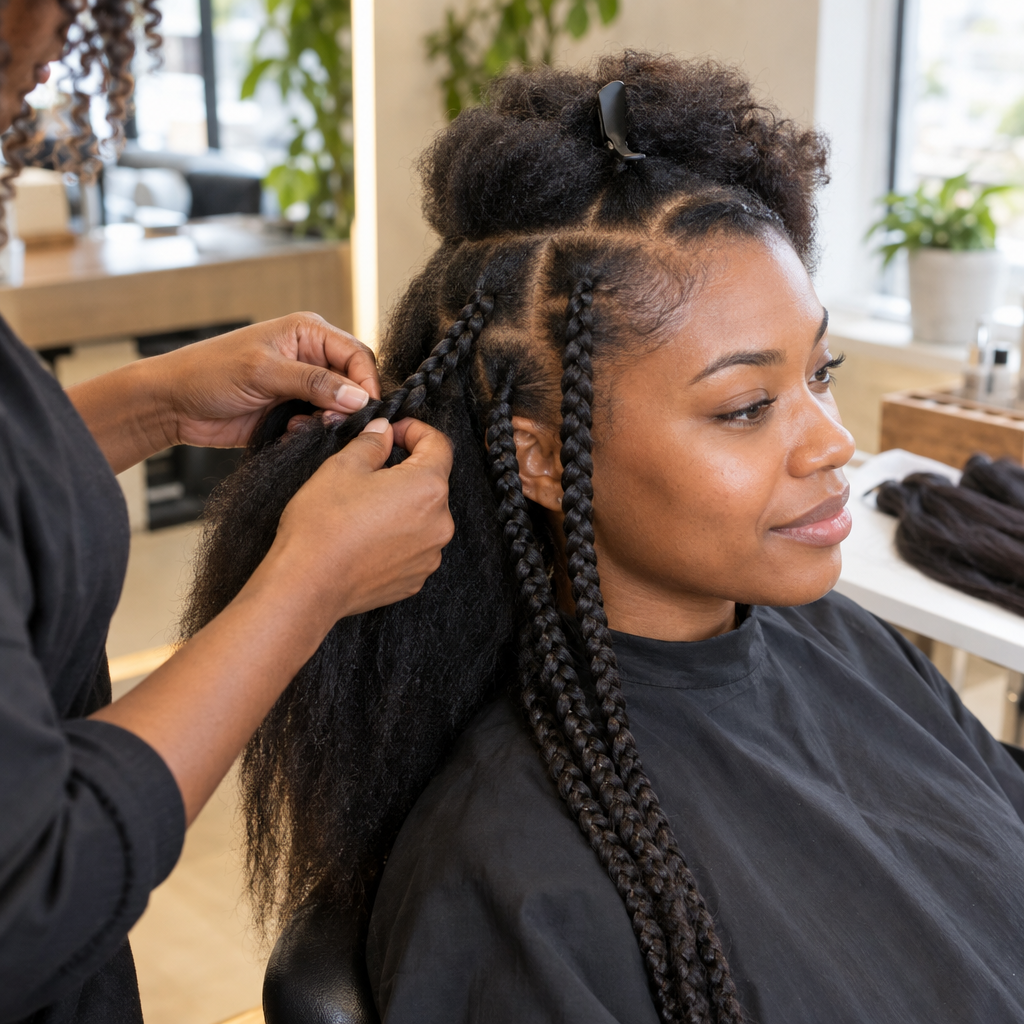
A basic braid repeatedly crosses sections of hair over or under one another. More intricate techniques change the direction of those crossings, how hair is added, or how many sections are handled.
A fishtail braid, for example, begins with two main sections. Small pieces are taken from the outside of each section and transferred across in an alternating pattern.
Braids, twists, and locs are not interchangeable terms:
- Braids: Sections interlace through repeated crossings.
- Two-strand twists: Two sections wrap around each other.
- Locs: Hair forms lasting, interlocked structures over time. Braids or twists can be used to begin locs, but established locs are not simply removable braids.
That distinction matters when booking an appointment. Installation, cleansing, upkeep, and removal can differ considerably, even when two styles have a similar silhouette.
The main braid families at a glance
Braid categories often overlap. A cornrow can use natural hair alone or include extensions, while a braided bun describes how completed braids are arranged rather than how they were constructed.
Braids using your own hair
Three-strand, French, Dutch, fishtail, crown, and waterfall braids can all be created without added hair, provided there is enough length and grip for the intended design.
A crown arrangement travels around the head. A waterfall braid releases selected pieces as it progresses, leaving hair hanging beneath the braided line. Neither name automatically implies extensions.
- Braids placed around the front can create a face framing effect by directing attention toward particular features.
Close-to-scalp braids
Cornrows follow defined rows or patterns along the scalp. The braider adds hair from the surrounding section while making repeated close-to-scalp crossings.
Feed-in describes gradually introducing extension hair as braiding progresses instead of attaching the full amount at the beginning. Feed-in methods are commonly used with cornrows and other scalp-following designs.
Ghana braids commonly feature substantial close-to-scalp braids built with added hair. Names and methods can vary between braiders, so reference photos and a description of the desired pattern are usually more useful than the name alone.
Individually sectioned and extension-assisted braids
Box braids are individual three-strand braids made from separately parted sections, often with square or rectangular partings. They can use natural hair alone, although extensions are common.
Knotless extension braids begin by interlacing the wearer’s own hair. Small amounts of extension hair are then fed into the braid as it continues. This creates a less bulky starting point than some traditional extension attachments, but comfort still depends on installation and total weight.
Micro braids describe very small individual braids rather than one particular anchoring method. Their size can make installation, cleansing, and removal especially time-consuming.
Culturally specific designs
Many braiding techniques have deep roots in African and African diaspora traditions. Fulani-inspired designs draw from Fulani braiding traditions and often combine scalp braids, individual hanging braids, and decorative elements.
No single modern salon pattern represents the full history or cultural meaning of these traditions. When using culturally specific names, look beyond social media labels and avoid treating distinct traditions as interchangeable trends.
Updos that rearrange completed braids
Braided buns, gathered styles, and crown arrangements reposition natural hair or completed braids. They do not necessarily add length or fullness, although extensions and accessories can change the finished weight.
- A high ponytail arrangement can concentrate the weight of long braids at the front, sides, or crown, so keep the base comfortably loose.
How popular braid types compare
The table separates strand construction, extension use, appearance, and care. Complexity is relative because hair length, braid size, pattern, and added hair can substantially change the work involved.
| Style | Formation method | Extension use | Typical effect | Main care consideration |
|---|---|---|---|---|
| Three-strand | Three sections repeatedly cross over the center | Optional | Simple hanging plait | Easy to undo and refresh |
| French | Outside sections cross over the center while loose hair is added | Optional | Integrated, woven appearance | Loosen hairline sections if they pull |
| Dutch | Outside sections cross under the center while loose hair is added | Optional | Raised, defined braid | Avoid pulling the edges wider too aggressively |
| Fishtail | Small outer pieces transfer across two main sections | Optional | Fine overlapping chevrons | Separate small sections patiently during removal |
| Cornrows | Repeated underhand crossings add hair along a close-to-scalp path | Optional | Defined rows or scalp patterns | Clean between rows and dry the roots thoroughly |
| Box braids | Each parted section is formed into an individual three-strand interlaced braid | Common, not required | Separate, movable hanging braids | Monitor roots, buildup, and attachment weight |
| Knotless braids | The braid starts by interlacing natural hair, then extensions are gradually fed into the same braid | Common | Individual braids with less bulky starts | Less root bulk does not eliminate the need to monitor tension |
| Feed-in cornrows | Added hair is introduced gradually during close-to-scalp underhand crossings | Integral to extension-assisted versions | A braid profile that gradually becomes fuller | Watch the anchor points and total extension load |
A full head of small individual braids usually takes much longer to install and remove than one or two larger braids. Ask for an estimate based on your actual hair, chosen size, length, and pattern rather than relying on the style name.
How to tell French, Dutch, fishtail, and cornrow braids apart
Use the crossing method first, then look at how the braid sits against the head.
- French braid: over the center. Each outside section crosses over the middle, with loose hair added as the braid progresses. The result appears woven into the surrounding hair.
- Dutch braid: under the center. Outside sections cross underneath the middle while picking up hair. This produces a more raised braid.
- Fishtail braid: small outer pieces. A narrow piece moves from the outside of one main section to the inside of the opposite section, alternating sides.
- Cornrows: close-to-scalp rows. Hair is added continuously along a defined path, commonly with underhand crossings that create a raised row.
Dutch braids and cornrows share some construction principles. One or two broad raised braids are commonly called Dutch braids, while multiple narrower scalp-following rows are commonly called cornrows. Row count alone is not a strict definition because two-cornrow designs also exist.
A photograph can suggest the technique, but it cannot show hidden attachment methods, root tension, or how heavy the finished style feels. Discuss those details separately with the braider.
Choose braids by finish, hair condition, and routine
Think about the visual result and then check whether its construction works with your hair and daily routine.
| Your priority | Starting option | Main trade-off |
|---|---|---|
| Quick everyday styling | Three-strand braid | Requires enough free length to hold |
| Raised definition | Dutch braids | Needs controlled, consistent sectioning |
| Close-to-scalp pattern | Cornrows | Individual areas can be harder to adjust |
| Added length | Extension-assisted individual braids | Adds weight and removal time |
| Formal arrangement | Crown braid or braided bun | Pins and anchor points affect comfort |
| Frequent restyling | Removable natural-hair braids | Requires more regular hands-on styling |
Placement also affects the overall impression. Braids directed upward can create height, while braids that follow the sides keep the silhouette closer to the head. Hanging braids place more visual weight around the shoulders and chest.
- Treat face shape as an optional styling reference, not a rule that limits which braid patterns you can wear.
The point where a braid ends can matter as much as where it begins. Short face-framing pieces draw attention higher, while longer pieces move with the rest of the style.
- Braids ending near the jawline can emphasize that level of the face, while longer braids shift the visual focus downward.
A pre-style suitability check
Before committing to a style, work through these questions:
- Is my scalp comfortable now? Existing soreness, irritated areas, or broken skin are reasons to pause rather than braid over the problem.
- Where is my hair fragile? Point out current breakage, tangled areas, and shorter hairline strands. These areas should not be forced into tight sections.
- Does the design pull on my hairline? Ask whether delicate areas can be left out or given less added hair.
- How much extension hair am I accepting? Compare a shorter or lighter version with the reference style. Both length and fullness affect the load.
- Can an uncomfortable section be adjusted? A loose hanging braid is relatively easy to remake. A tight scalp braid may need to be completely undone and rebraided.
Also consider how often you wash, whether you exercise or swim, your tolerance for a long appointment, and whether you have time for patient removal. Longer wear is not automatically better value if the style is uncomfortable or prevents effective cleansing.
Adapt braid choices to your hair and lifestyle
Short hair
There is no single minimum length for every braid. The braider needs enough hair to cross and hold the sections without continually pulling them taut.
Choose a pattern that works with the shortest areas, not just the longest section on top. If hair repeatedly slips out, simplify the design or leave that area unbraided. Added hair does not make inadequate grip harmless.
Fine or fragile strands
Favor lighter additions and section sizes that provide enough natural hair to support each braid. Neither very tiny sections nor very large, heavy braids are automatically gentler.
Ask for less added hair around vulnerable areas. If there is active breakage, a removable natural-hair style may be easier to monitor and adjust than a dense extension installation.
Curly and coily textures
Account for shrinkage when discussing finished length. Detangle gently, and ask whether the design requires stretching beforehand. High-heat straightening is not a universal prerequisite for braiding.
- Natural curls can soften the outline of a braid or create surface texture without indicating that the installation has failed.
Texture, density, and shrinkage can also affect how large each section appears. Reference photos should show a texture reasonably close to yours, but expect the finished result to retain its own movement and volume.
If you are still choosing an overall direction, Facefy’s Hairstyle Finder can help you explore broader styling ideas. A visual preview cannot determine scalp comfort, extension weight, or whether a particular installation method is suitable for your hair.
Sensitive scalp
Choose lighter additions and accessible sections that can be undone without dismantling the whole style. Tell the braider about sensitivity before installation begins, and speak up as soon as a section starts pulling.
A method described as gentle still depends on how it is installed. Less bulky roots do not guarantee lower tension.
Frequent workouts and swimming
For frequent exercise, prioritize scalp access and a design that does not have to be pulled tightly upward. Repeatedly gathering long or heavy braids can place additional strain around the front and sides.
After sweating, cleanse according to your scalp’s needs and let the roots dry before covering the hair for an extended period.
After swimming, rinse pool water or seawater out with fresh water. Direct the water through the roots and lengths, gently separate dense sections with your fingers, and squeeze out excess water without twisting the braids.
Added hair can become heavier when wet and may take longer to dry. If you swim several times a week, a lighter or less dense style may be easier to maintain than a full installation of long extensions.
Regular cleansing needs
Choose visible partings and manageable braid density so your fingertips can reach the scalp. Explain your normal wash routine during the consultation.
If your scalp requires frequent cleansing, that requirement should shape the design rather than being postponed to preserve the style.
What to know before adding extensions
Extensions change more than length. The amount of added hair attached to each section affects the load at its base, while the material influences texture, drying time, and heat tolerance.
Smaller braids are not automatically lighter overall. A dense installation containing many small extension braids can still carry substantial total weight.
The starting method also matters:
- Traditional extension box braids: Added hair is commonly secured near the root before continuing with three-strand interlacing.
- Knotless starts: The braid begins with natural hair, and extensions are introduced gradually.
- Feed-in construction: Extension hair is added progressively while the close-to-scalp braid is being formed.
Knotless and feed-in methods can create a less bulky starting point, but either can still be installed too tightly or contain more added hair than a section can comfortably support.
Color is another decision. Extensions can closely match your natural shade, introduce subtle contrast, or create a clearly separated accent.
- Use broader hair color ideas to decide whether you prefer a close match, blended dimension, or deliberate contrast before choosing extension hair.
Questions to ask your braider
Bring front, side, and back reference photos where possible. Then ask:
- “Can we create this outline with less added hair?”
- “Which braid size works with my density and shortest sections?”
- “Can the fragile temple hairs be left out?”
- “If one area pulls, can it be redone immediately?”
- “How long should installation and removal take?”
- “How should these attachments be undone?”
- “Will I be able to reach my scalp when washing?”
- “What are the drying and heat limits for this extension material?”
A complete request could be:
“I swim several times a week and want two French braids using only my own hair. Leave fragile temple hairs out, keep the roots comfortable, and show me how to undo and remake the style.”
For an extension style, try:
“I want medium individual braids at shoulder length, with lighter additions around the hairline. I need to reach my scalp when washing. Please keep the roots comfortable and redo any section that pulls.”
Prepare hair and check comfort after installation
Begin with a comfortable scalp and clean, gently detangled hair. Remove tangles in manageable sections rather than forcing a comb through resistance. Agree on any stretching or blow-drying before the appointment.
During installation, do not accept excessive pulling, tiny overloaded hairline sections, or visibly lifted skin as necessary for a neat finish.
Same-day comfort check
Check the style before leaving the appointment and again later that day:
- Is there persistent pain or a headache?
- Are any sections sharply pulling when you turn your head?
- Are bumps appearing around the roots?
- Does the skin look tented or lifted near an attachment?
- Does gathering the braids make the hairline hurt?
Ask for affected sections to be loosened or redone. If adjustment does not resolve the pulling, remove those sections.
Next-morning comfort check
Notice whether the style disrupted sleep, left your scalp sore, or caused worsening irritation. Do not wait to become accustomed to persistent pain. Loosen or remove the sections responsible.
Repeated or prolonged tension can contribute to traction-related hair loss. Persistent scalp symptoms or hair loss warrant guidance from a qualified healthcare professional rather than another tight installation.
How to wash, dry, and protect braids
Braided hair can be washed. The goal is to clean the scalp and hair without unnecessary friction, then dry the roots and full length completely.
Clean according to your needs
Oil, sweat, swimming, and product use influence cleansing needs. No single schedule suits everyone.
- Wet the scalp and braids thoroughly.
- Apply shampoo according to its directions, concentrating on accessible scalp areas.
- Massage with your fingertips instead of scratching with your nails.
- Let the cleanser move through the lengths without bunching or aggressively rubbing them.
- Rinse carefully around dense roots and extension attachments.
Use conditioner where it is appropriate for your hair and installation, then rinse as directed. Repeatedly adding oil or heavy styling products does not remove buildup or replace cleansing.
Dry the roots and full length
Gently squeeze out water and blot the braids with a towel. Avoid twisting heavy wet braids or vigorously rubbing the roots.
Separate the braids enough to let air circulate around the scalp and between dense sections. Check the roots, attachments, and inner layers because a dry surface does not mean the full installation is dry.
If extensions are present, follow the added-hair supplier’s heat instructions. Avoid concentrated hot airflow, keep the dryer moving, and stop if your scalp begins to feel hot. Do not assume that every synthetic or human-hair extension can tolerate the same dryer setting.
Avoid sleeping with a damp installation. If the style routinely takes longer to dry than your schedule allows, choose fewer, shorter, or lighter braids next time.
Reduce friction without adding tension
A smooth scarf, bonnet, or pillowcase can reduce nighttime friction. Keep any covering comfortably loose, and arrange the braids so their weight does not pull at the hairline.
Surface frizz is a normal result of natural texture, movement, washing, and wear. Do not repeatedly tighten the roots or aggressively brush delicate edges to remove it.
When to loosen or remove braids
There is no wear duration that is safe for every scalp, technique, and extension load. Use the condition of your hair, scalp, and installation to guide the decision.
Loosen, redo, or remove braids when you notice:
- Persistent discomfort: Pain, headaches, bumps, or worsening irritation.
- Increasing hairline stress: Pulling, fragile areas, or new breakage.
- Significant buildup: Residue that cannot be cleaned adequately.
- Matting at the roots: Shed hair and tangles beginning to join neighboring sections.
- Slipping extensions: Attachments moving and pulling unevenly.
- Unresolved dampness or odor: Difficulty keeping the installation clean and dry.
A planned wear period is not a reason to keep an uncomfortable style.
For removal, unravel gently from the ends. Do not cut added hair unless you are certain where your own hair ends. Work through accumulated shed hair section by section using your fingers and a suitable detangling product before combing. Stop at resistance rather than pulling through it.
Questions people ask about braids
Should braids hurt when first installed?
No. You may notice the feel or weight of a new style, but persistent pain, headaches, sleep disruption, bumps, or lifted skin are not signs of a successful installation. Have the affected sections loosened, redone, or removed.
Can braided hair be washed?
Yes. Focus on scalp access, gentle handling, thorough rinsing, and complete drying. Choose a braid pattern that accommodates your normal cleansing needs.
How can you sleep comfortably with braids?
Arrange the braids loosely and avoid lying directly on bulky attachments. Use a comfortable smooth covering if you prefer. If the roots hurt regardless of how you position the braids, address the tension rather than relying on a different pillow or sleeping position.
Which braids can be created without extensions?
Three-strand, French, Dutch, fishtail, cornrows, crown arrangements, and box braids can all be made using your own hair. Feasibility depends on the available length, density, and grip required for the intended design.
Can short hair be braided?
Often, but the technique must suit the available length. Repeated slipping or the need for strong pulling suggests that the pattern should be simplified or adjusted. Extensions are not a universal solution.
Are braids always protective?
No. Braids can reduce daily handling, but excessive tension, heavy additions, difficult cleansing, and rough removal can work against that benefit. They do not automatically prevent breakage or increase hair growth.
What is the difference between box braids and knotless braids?
Box braids describe individual braids created from separately parted sections. Knotless describes a starting method in which the braid begins with natural hair and extensions are gradually fed in. A style can therefore be both box-sectioned and knotless.
How do braids differ from twists and locs?
Braids interlace sections through repeated crossings. Twists wrap sections around one another. Locs are lasting interlocked structures, even when their starting method involved braids or twists.
Why can braids cause bumps or scalp pain?
Excessive tension is one possible cause, although irritation and other scalp problems can produce similar symptoms. Loosen or remove pulling sections. Seek qualified healthcare guidance if symptoms continue after the tension has been addressed.
How can product buildup be reduced?
Use styling products sparingly, cleanse when needed, and rinse thoroughly. If residue or root matting remains inaccessible, taking down the style may be more practical than adding another product.
Can beads, cuffs, and other accessories make braids uncomfortable?
They can add localized weight or catch on clothing and bedding. Begin with a small number, make sure attachments are secure without pinching the hair, and remove accessories that repeatedly tug or alter how the braid hangs.
A braid style should fit a workable care routine, not prevent one. Choose the construction, extension amount, placement, and upkeep requirements together so the finished style is comfortable as well as visually appealing.