Positive Canthal Tilt: Meaning and How to Identify It
Learn what positive canthal tilt means, how to identify it, what can distort photos, and why it is a neutral form of eye variation.
A positive canthal tilt means the outer corner of an eye sits higher than its inner corner. It describes the direction of the visible eye opening, not attractiveness, health, personality, ethnicity, or personal worth.
Head position, expression, and camera perspective can change how that direction appears. To identify it, look at each eye separately in a few neutral, front-facing photos rather than relying on one selfie.
What positive canthal tilt looks like
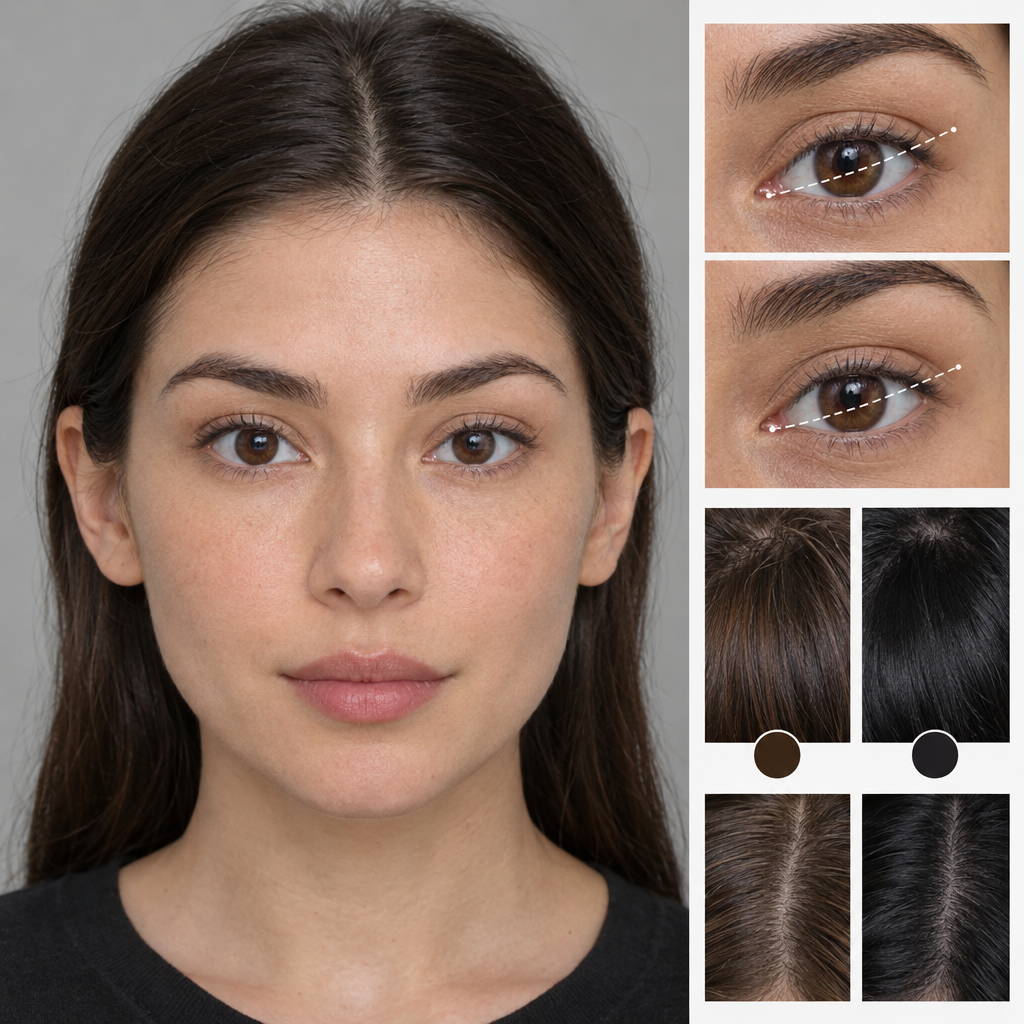
The two reference points are the medial and lateral canthi: the inner and outer corners where the upper and lower eyelids meet.
- Medial canthus: The inner corner near the nose.
- Lateral canthus: The outer corner near the temple.
The category depends on the outer corner’s height relative to the inner corner.
| Category | Outer versus inner corner | Inner-to-outer direction |
|---|---|---|
| Positive | Outer corner higher | Rising |
| Neutral | Corners approximately level | Approximately horizontal |
| Negative | Outer corner lower | Falling |
Always follow the line from the nose toward the temple. This matters because the two eyes face opposite directions in a photograph. A line rising toward the right edge of the image does not mean the same thing for both eyes.
“Positive” and “negative” are geometric labels here. They do not mean better and worse.
A simple two-point way to observe canthal tilt
This is an informal visual check, not a clinical measurement. You need a clear photograph, not an exact angle.
- Choose a suitable image. Use an unfiltered, front-facing photo with a relaxed expression, eyes looking toward the camera, and both corners clearly visible. Avoid squinting or deliberately widening your eyes.
- Check head orientation. The head should be upright, without a sideways lean. If the image is slightly rotated, use the overall facial midline as a guide to make it vertical. Do not simply rotate the photo until both eyes look level, because that can conceal natural differences. Choose another image if the face is also turned or tipped substantially.
- Find the two corners of one eye. Locate where the eyelid edges meet near the nose and near the temple. Ignore eyeliner wings, lashes, eyebrow ends, bright reflections, and shadows.
- Imagine or draw a straight line between those points. Follow it from the inner corner outward.
- Describe the direction. Rising suggests positive tilt, approximately level suggests neutral tilt, and falling suggests negative tilt.
- Repeat for the other eye. Keep the observations separate rather than averaging them.
Leave the result unclear if either corner is obscured. A tiny apparent height difference is not a reason to assign a precise angle or force a category. The uncertainty in locating a corner may be larger than the difference you are trying to describe.
Check three photos instead of relying on one selfie
Use three separate front-facing images with neutral expressions. Three is a practical comparison, not a clinical standard. The purpose is to notice whether the impression persists across photos, not to keep measuring until you get a preferred answer.
For each image, check that:
- The head appears upright and faces the camera.
- Neither eye is squinting.
- Both inner and outer corners are visible.
- There is no filter or makeup effect obscuring the endpoints.
Then compare each eye with itself across the three images.
| Observation across three photos | Useful description |
|---|---|
| Same category in all three | Consistent visible tendency |
| Category changes between images | Inconclusive |
| Corners remain difficult to locate | Insufficient visual detail |
For example, suppose the right eye appears positive in all three images, while the left eye appears neutral, positive, then neutral. The right eye shows a consistent positive tendency. The left eye remains inconclusive. Do not average the two eyes or use one eye’s result to classify the other.
If an eye looks positive in one image and neutral in two, leave it inconclusive rather than deciding by majority vote. There is no need to keep taking photos to resolve a borderline label.
Why canthal tilt can look different in photos
Several factors can alter the apparent corner-to-corner direction or make its endpoints harder to identify.
- Head roll: A sideways lean rotates both eyes within the frame. Because their inner-to-outer directions are opposite, it can make one eye appear more positively tilted and the other less so.
- Image rotation: A rotated photograph creates the same problem even if the person’s head was upright. The edge of the image is not automatically a reliable horizontal reference.
- Camera height: Looking toward a camera above or below eye level changes the visible eyelid opening. Tipping the head to meet the lens adds another perspective change.
- Close-range perspective: If the face is turned, the nearer side is projected differently from the farther side. A close selfie can exaggerate this difference and make the two eyes harder to compare.
- Squinting or smiling: These expressions narrow the opening and raise the cheeks. They can obscure the outer corner or change the contour that you mistake for it.
- Uneven lighting: A dark shadow can hide the exact meeting point of the lids, while a bright reflection can draw attention to the wrong point.
- Makeup, hair, and cropping: An eyeliner wing may suggest an upward direction that the actual corners do not follow. Hair or a tight crop can remove the facial context needed to judge head orientation.
A useful distinction is changed appearance versus changed anatomy. Lighting, image rotation, and makeup can change the impression without changing the underlying corner positions.
Canthal tilt is not the same as eye shape or brow angle
A “lifted” appearance can come from several features. The corner-to-corner line describes only one of them.
| Feature | What it describes | Observable cue and limitation |
|---|---|---|
| Corner tilt | Inner-to-outer direction | Relative height of the two eye corners |
| Eye outline | Overall opening contour | Rounded, elongated, or tapered appearance |
| Crease or hooding | Upper-lid fold visibility | Visible crease or skin overlapping part of the crease |
| Under-eye support | Contour beneath the lower lid | Hollows or fullness may be visible, but a photograph cannot establish the strength or condition of underlying structural support |
| Brow angle | Eyebrow direction | Brow rise, arch, and tail position |
“Under-eye support” is often used loosely in appearance discussions. A photograph shows surface contours, but it cannot reliably establish the condition or strength of underlying supporting tissues.
An elongated, almond-like eye shape can have a positive, neutral, or negative corner orientation. These terms describe different dimensions and are not interchangeable.
Likewise, skin folding over the upper lid or deep-set eyes can make the corners harder to see, but neither determines their tilt. An upward-sloping brow may reinforce an impression of lift even when the eye corners are approximately level.
The two eyes may not have identical tilts
Assess the left and right eyes separately before describing an overall tendency. One may appear positively tilted while the other looks closer to level.
Mild left-right differences are common visual variation and should not automatically be treated as a problem. A single whole-face label can hide that variation. If you’re curious about visible differences between the two sides of your face, Facefy’s Symmetry Checker offers a photo-based facial symmetry assessment. Its results are estimates influenced by lighting, camera angle, and expression, rather than precise measurements of individual eye-corner angles.
Useful descriptions include:
- “Both eyes appear mostly positive.”
- “One eye appears positive; the other is approximately neutral.”
- “Mixed orientation, with the second eye unclear.”
Keep your left-right labels consistent if comparing mirrored and unmirrored images. Otherwise, you may accidentally compare different eyes.
There is no need to repeatedly measure small differences. A broad description is usually enough for understanding the feature.
What positive canthal tilt does and does not mean
Positive canthal tilt is a descriptive anatomical variation, not an objective attractiveness standard.
Words such as “lifted,” “sharp,” or “youthful” describe subjective impressions. They are not measurements, and the same corner orientation can look different depending on the eye outline, eyelid contours, brows, expression, and surrounding facial structure.
Tilt alone cannot establish:
- Health or a medical diagnosis.
- Personality or temperament.
- Ancestry or ethnicity.
- A genetic condition.
- Attractiveness or personal worth.
The appearance of tissues around the eyes can change gradually with age, including the visibility of folds and surrounding soft-tissue contours. These changes may affect how the corners look or how easy they are to identify. A photograph cannot establish the cause, however, and differences in expression, camera position, lighting, or image rotation may create a similar effect.
When a change around the eyes needs professional attention
A stable difference noticed across ordinary photos is generally an appearance observation, not a diagnosis. A new or sudden change, especially with symptoms or after an injury, belongs in a different category.
Seek prompt medical advice for sudden eyelid drooping, new eyelid weakness, difficulty closing an eye, or significant swelling. Eye pain, new vision changes, or an injury affecting the eye may require urgent assessment.
For guidance on eye injuries and urgent symptoms, use a healthcare resource rather than an appearance category. Sudden vision loss or severe eye pain warrants immediate medical attention.
An appearance-analysis tool cannot diagnose the cause of a sudden or functional change.