Canthal Tilt Test: How to Measure Eye-Corner Angle Correctly
Learn how a canthal tilt test works, locate the correct eye-corner landmarks, correct photo tilt, and interpret results without overclaiming.
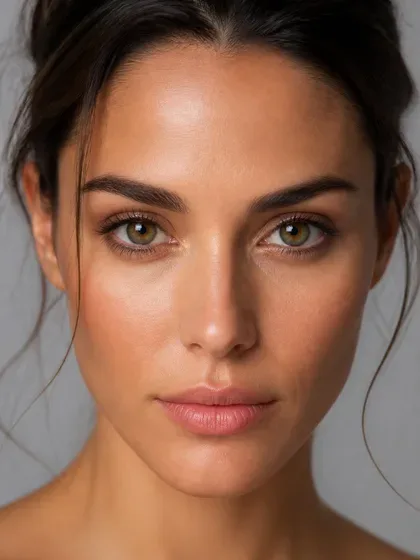
A canthal tilt test compares the line between the inner and outer corners of each eye with a level horizontal reference. The result is positive when the outer corner is higher, approximately neutral when the corners are level, and negative when the outer corner is lower.
For a useful photo-based estimate, identify the actual eyelid junctions, correct any head roll, and assess each eye separately. The result describes visible geometry in that photograph, not attractiveness or eye health.
What a canthal tilt test measures
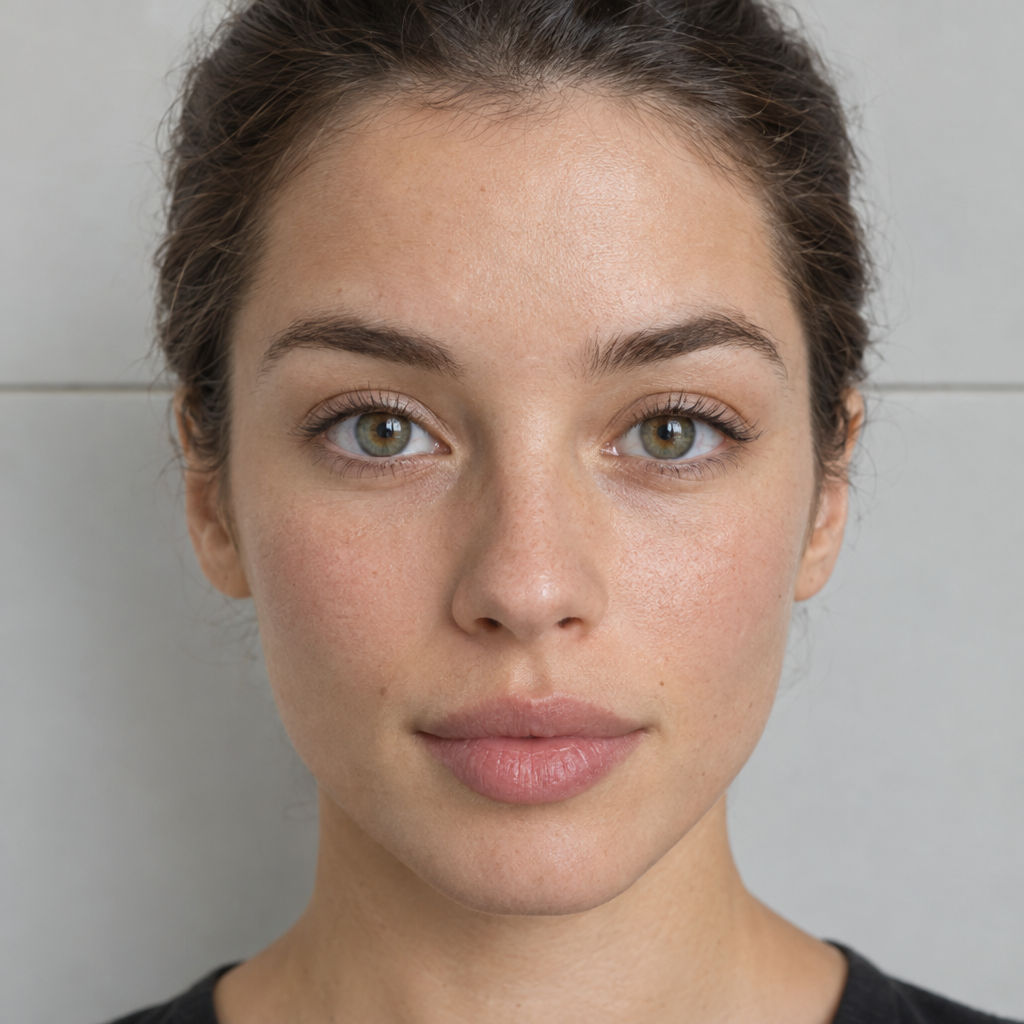
The test uses two specific endpoints, known as the medial canthus and lateral canthus:
- Medial canthus: the inner corner near the nose where the upper and lower eyelids meet.
- Lateral canthus: the corresponding meeting point at the outer corner, toward the temple.
The line connecting these points describes the orientation of the eye opening, also called the palpebral fissure. It does not follow the eyebrow, the eyelid crease, or the curve of the upper lashes.
| Category | Outer-corner position | Visual cue |
|---|---|---|
| Positive | Higher than inner corner | Rises toward the temple |
| Approximately neutral | Level with inner corner | Roughly horizontal |
| Negative | Lower than inner corner | Falls toward the temple |
Read the direction from the nose toward the temple for each eye. Because the eyes face opposite directions across an image, a positive tilt does not slope the same way across the screen on both sides.
“Positive” and “negative” are geometric terms, not better-and-worse labels.
How to perform a manual canthal tilt test
You can use a photo editor with straight-line and rotation controls. An angle-measuring function is optional.
1. Choose a suitable photograph
Use an unfiltered, front-facing image with:
- A relaxed face and naturally open eyes.
- A camera positioned near eye level.
- Even lighting across both eyes.
- Clearly visible inner and outer corners.
- Enough detail to distinguish where the eyelids meet.
Avoid very close selfies, turned faces, squinting, and wide-angle effects. Keep the full face visible initially so you can judge alignment before zooming in.
If a corner is hidden by hair, shadow, or makeup, choose another image rather than guessing its position.
2. Correct head roll before drawing lines
Head roll means tilting the head toward either shoulder. It can make one eye’s outward slope look steeper while making the other look flatter.
Use a genuinely level photograph, or rotate the image until the overall facial midline appears vertical. Consider the central forehead, nose bridge, and chin together as an approximate guide. Natural left-to-right differences mean no single feature is a perfect alignment reference.
Do not rotate the image simply to make the two eyes level. That could erase the difference you are trying to observe.
Rotation can correct in-plane head roll, but it cannot undo a face turned sideways or angled up or down. For those problems, use another photograph.
3. Mark the two corners of one eye
Zoom in and mark the inner and outer eyelid junctions.
Exclude:
- Eyelashes and mascara tips.
- Eyeliner wings.
- Bright tear reflections.
- Eyebrow edges.
- The upper eyelid crease.
At the inner corner, use the meeting point of the eyelid margins, not the brightest reflection or the edge of the pink tissue.
4. Compare the corner line with horizontal
Draw a straight line between the marked points. Then draw a separate horizontal reference through the inner corner in the corrected image.
Follow the corner line outward toward the temple:
- Rises: positive.
- Appears level: approximately neutral.
- Falls: negative.
- Too unclear to distinguish: inconclusive.
There is no need to impose a universal degree cutoff. If moving a marker slightly changes the category, the photograph does not support a confident classification.
5. Repeat for the other eye
Mark and assess the second eye independently. Do not extend one line across both eyes or use eyebrow alignment as a substitute.
Why each eye needs its own result
The two eyes can have similar or different visible angles. One may appear positive while the other appears neutral or negative.
Record the results separately, for example:
My left eye: positive. My right eye: approximately neutral.
Use your own anatomical left and right, not just the left and right sides of the screen. A mirrored selfie can otherwise make your notes confusing.
Averaging the angles into one whole-face result hides the difference. Small differences may reflect normal variation, head alignment, or uncertain corner placement rather than a meaningful change. If you’re interested in exploring visible differences between the two sides of your face, Facefy’s Symmetry Checker offers a photo-based facial symmetry assessment. Its results are estimates influenced by lighting, camera angle, and expression, rather than precise measurements of individual eye-corner angles.
The overall outline of the eyes is a separate feature. Two eyes can have similarly tapered outlines but different corner angles.
Optional: estimating the angle numerically
A number can help if you want to describe the slope more precisely, but classification does not require one.
In the corrected image, measure:
- The horizontal distance between the corners, using a positive distance for either eye.
- The vertical corner difference, defined as positive when the outer corner is higher.
Use:
Angle = arctangent(vertical corner difference ÷ horizontal corner distance)
Set your calculator to degrees, or convert its result from radians to degrees.
For example, if the corners are 100 pixels apart horizontally and the outer corner is 5 pixels higher:
Angle = arctangent(5 ÷ 100) ≈ +2.9°
If the outer corner is 5 pixels lower, the estimate is approximately −2.9°. These are arithmetic examples, not category thresholds or appearance standards.
Watch the image-coordinate direction
Many image editors count vertical coordinates downward from the top of the image. In that system:
- Vertical difference = inner-corner y − outer-corner y
- Horizontal distance = absolute difference between x-coordinates
Subtracting in that order makes a higher outer corner positive. Using the absolute horizontal distance prevents the sign from reversing between the left and right eyes.
The number still depends on corner placement, head alignment, perspective, and image quality. Decimal places do not make an uncertain photograph more precise.
Use three photos to check whether the result is stable
A single photograph can produce a misleading impression. A limited three-photo comparison helps show whether the classification is reasonably consistent.
- Select three separate front-facing photographs with relaxed expressions and visible corners.
- Correct head roll in each image.
- Assess the left and right eyes independently.
- Record all results before comparing them.
| Photo | Your left eye | Your right eye |
|---|---|---|
| 1 | Positive | Neutral |
| 2 | Positive | Neutral |
| 3 | Positive | Negative |
In this example, the left eye has a consistent positive classification. The right eye’s result is inconclusive because its category changes.
Use this decision rule:
- Same category in all three: a consistent photo-based estimate.
- Category changes: inconclusive, rather than whichever result you prefer.
- Corner hidden or face turned: replace that unsuitable image.
Three photos are a practical comparison, not a clinically validated protocol. Consistency does not remove every source of photographic error.
After this check, Facefy’s Canthal Tilt Test can provide an optional automated second estimate. Treat its AI-generated assessment as photo-dependent, not definitive. If the results disagree, uncertainty is a reasonable endpoint; repeated checking is unlikely to make an ambiguous image more informative.
Why canthal tilt can look different between photos
Before interpreting a difference as a change in your eyes, check the image conditions.
| Possible issue | Practical response |
|---|---|
| Head roll | Correct alignment before measuring |
| Camera too high or low | Use an eye-level photograph |
| Close-range perspective | Move the camera farther away |
| Face turned sideways | Choose a straight-on view |
| Squinting or smiling | Relax the cheeks and eyelids |
| Hair or shadows obscure corners | Choose a clearer image |
| Eyeliner or lash effects | Mark only eyelid junctions |
| Reflections near inner corners | Use softer, even lighting |
| Low resolution or tight crop | Use the clearer original image |
Head position and camera position are separate problems. A level camera cannot compensate for a tilted head. Likewise, a straight head does not eliminate perspective changes from a camera positioned well above or below it.
Expression also matters. Smiling, raising the cheeks, or tightening the eyelids can alter the visible corner area and eye opening. Makeup and lashes can create a strong diagonal impression without changing the locations of the actual corners.
If the eyelid junction cannot be identified confidently, leave that image out of the comparison.
Canthal tilt is not the same as eye shape or eyebrow angle
Several features contribute to how eyes look, but they describe different things:
- Canthal tilt: the direction of the line connecting the two corners.
- Eye outline: the overall roundness, length, or tapering of the opening.
- Eyelid exposure: how much upper or lower eyelid is visible.
- Hooding and crease position: how the skin folds above the eye and how much crease is visible.
- Eyebrow slope: the direction of the brow, which may differ from the corner line.
A person can have a tapered eye outline, a partly covered upper crease, and approximately neutral corner tilt at the same time. These descriptions are not competing labels.
An upward eyeliner wing or lifted lash pattern can emphasize an upward visual direction, but neither belongs in the measurement. These features also cannot reliably establish personality, ethnicity, genetic background, or character.
What the test cannot tell you
A canthal tilt test describes visible geometry in a particular photograph. Neither a manual measurement nor an AI classification objectively determines attractiveness, health, or personal worth.
It cannot diagnose eyelid disorders, nerve problems, injury, or conditions present from birth.
Long-standing left-to-right differences without symptoms may reflect normal variation, but a photograph cannot establish their cause. New or marked differences, especially after an injury, deserve medical assessment rather than interpretation through an appearance tool.
Seek prompt medical care for pain, vision changes, new weakness, or difficulty closing an eye. Sudden facial weakness with speech difficulty or arm weakness requires emergency care.
There is no need to keep measuring a stable feature or compare it with an idealized angle. “Approximately neutral” or “inconclusive” can be an adequate description.
Canthal tilt test FAQs
Can the two eyes have different canthal tilts?
Yes. Record each eye separately. One may appear positive while the other looks neutral or negative; averaging them would conceal that difference.
Does head tilt affect the result?
Yes. Head roll changes the eye-corner lines relative to horizontal. Correct it before measuring, and use another image if the face is also turned or angled up or down.
Can eyeliner or eyelashes change the classification?
They can change the apparent slope or lead you to mark the wrong endpoint. Use the points where the upper and lower eyelids meet, not lash tips or eyeliner wings.
Why do different photos give different results?
Head alignment, camera height, perspective, expression, lighting, makeup, and image clarity all contribute. If the category changes across three suitable photographs, describe the result as inconclusive.
Is positive canthal tilt more attractive?
No tilt category provides an objective measure of attractiveness. Preferences vary, and a single eye-corner angle cannot represent a person’s overall appearance.
Can the test identify a medical condition?
No. It is an appearance-based geometric estimate. New changes or symptoms need assessment by a healthcare professional, regardless of the measured angle.