Low-Maintenance Short Bob Haircuts for Thick Hair
Compare low-maintenance short bobs for thick hair by texture, bulk control, daily styling, grow-out, and salon upkeep needs.
The most manageable short bob haircuts for thick hair keep enough weight at the perimeter to control expansion while removing bulk selectively inside the cut. A softly layered bob can be a useful starting point when the ends are already full and excess density is concentrated internally. Previously thinned ends, fragile lengths, or strongly uneven shrinkage need a more individual assessment.
The right choice depends on where your hair expands, how it dries naturally, and whether you want easier mornings or longer gaps between salon visits. Going shorter does not automatically mean less work, especially if your current length helps hold your texture down.
What “thick hair” means before choosing a bob
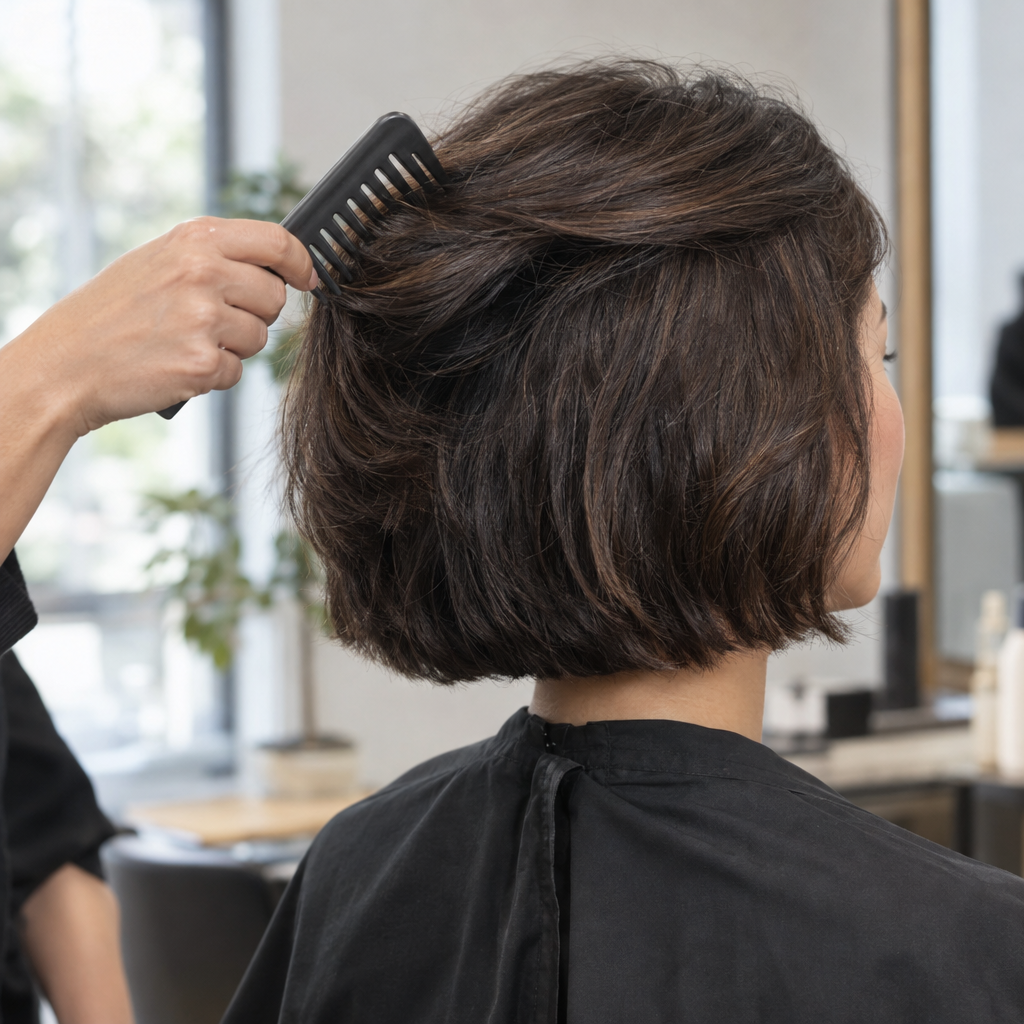
Thick hair can describe several different characteristics:
- High density: Many strands grow close together. Even fine individual strands can create substantial bulk when there are enough of them.
- Coarse strand thickness: Individual hairs have a larger diameter. They may create a firm, full silhouette without unusually high density.
- Both: Densely packed, coarse strands may require particularly careful decisions about length and weight distribution.
Density helps determine how much hair sits inside the shape. Strand thickness affects how that hair bends, settles, and responds to styling. Neither tells you everything about texture.
Straight hair may form a compact, heavy edge. Waves can push outward at a particular bend. Curly hair may shorten and widen considerably as it dries. The same wet length can therefore produce very different finished shapes.
Choose the perimeter position from the dry result, not just the wet measurement. The perimeter is the visible bottom edge. If it lands where your hair naturally bends outward, it may need more styling than an edge sitting slightly above or below that point.
Five short bobs compared for thick hair
Start by matching the structure to the location of your bulk. “Low effort” here assumes you are comfortable wearing your natural texture instead of recreating a polished blowout every morning.
Match the structure to your hair
| Bob structure | Best density or texture fit | Bulk-control area |
|---|---|---|
| Softly layered | Dense straight or wavy hair with a full perimeter and internal bulk | Selected interior sections |
| Graduated | Dense hair needing controlled back shaping | Nape and back weight distribution |
| Subtle inverted | Dense hair that benefits from extra front length | Back, with optional internal removal |
| Concealed undercut | Very dense hair with concentrated nape bulk | Hidden nape or interior panel |
| Blunt | Naturally compact straight or wavy hair | Minimal removal, with optional targeted interior work |
A softly layered bob is not automatically the safest option for every thick texture. It works best when the bottom edge has enough density to remain supported after selected interior weight is removed. If the ends have already been heavily thinned or different sections shrink by noticeably different amounts, the stylist may need to preserve weight or work zone by zone.
Compare daily effort and grow-out
| Bob structure | Likely daily demand | Grow-out tradeoff |
|---|---|---|
| Softly layered | Low if the layers follow the natural pattern | Layers may become less distinct, but the outline remains soft |
| Graduated | Low to moderate; the back may need direction | The shaped back gradually loses definition |
| Subtle inverted | Low to moderate; front sections may need smoothing | The angle becomes less noticeable |
| Concealed undercut | Less bulk, but the covering hair still needs styling | Short regrowth may lift the longer layer or form a ridge |
| Blunt | Low if the hair settles smoothly | Uneven growth is easier to see along the precise edge |
Softly layered: Keeps a substantial bottom edge while creating movement inside. A jaw-length version may work well, but a slightly lower edge can be easier if your waves expand beside your cheeks.
Graduated: Uses shorter lengths underneath and progressively longer lengths above to create a shaped back. It redistributes weight rather than simply removing as much hair as possible.
Subtle inverted: Has a slightly shorter back and longer front. The angle and graduation are separate decisions. A longer front does not require a heavily stacked back.
Concealed undercut: Removes a hidden section of hair, usually at the nape. It can reduce substantial bulk, but the short panel needs a clear maintenance or grow-out plan.
Blunt: Keeps a largely continuous bottom line. It can be manageable when the hair naturally settles into that line, but a blunt edge alone does not control interior density.
Equivalent growth is more noticeable on a geometric perimeter because the design depends on an exact line, angle, or nape position. As individual sections grow at slightly different rates, the edge can look uneven and the intended angle begins to blur. A softer outline already contains movement and variation, so small changes tend to blend into the shape for longer.
A seven-point check before cutting your hair
Make these observations on fully dry hair worn in your usual part, preferably without straightening it first.
-
Look at density at the scalp. Separate a few sections at the top and sides. A narrow visible part with densely packed hair suggests higher density. Lighting, hair color, and part placement affect the impression, so treat this as a rough observation.
-
Feel an individual strand. A fine strand may be difficult to feel between your fingers; a coarse strand tends to feel more distinct. This checks strand thickness, not the number of hairs.
-
Observe your drying pattern. Does your hair dry straight, form loose bends, develop defined spirals, or behave differently in different areas? Note whether the underside is more textured than the surface.
-
Compare wet and dry length. Watch where the same front and nape sections sit when wet and fully dry. Show your stylist the difference instead of assuming shrinkage will be equal everywhere.
-
Locate strong growth patterns. Check for a cowlick at the crown, hairline, or nape. Notice whether short sections stand upward, split apart, or sweep sideways.
-
Find the primary bulk zone. Is the fullness beside your cheeks, at the bottom edge, behind your ears, or through the back? “Heavy behind my ears” is more useful than “too thick everywhere.”
-
Separate daily styling from salon upkeep. Decide whether you want a completely no-heat routine or would accept targeted blow-drying. Identify the specific sections you would be willing to dry, such as the nape, roots, or front pieces, and set an honest morning limit. Separately, decide how readily you can return for reshaping.
Keep your observations simple. “The back dries compactly, but the sides expand” gives a stylist a useful starting point.
How a stylist can reduce bulk without weakening the shape
Removing more hair is not always the answer. The aim is to leave enough support at the edge while changing how weight sits inside.
Internal layering: reduce selected interior weight
Internal layering uses shorter lengths beneath the surface to create movement and reduce density in chosen areas. The outside can remain relatively full and smooth.
It is most useful when the perimeter is sufficiently dense, the ends are in good condition, and the bulk is concentrated inside the shape. The stylist should also consider how each section behaves when dry.
Across different textures, the prerequisites vary:
- Straight hair: The edge should have enough density to avoid looking hollow after weight removal. Because straight hair shows cutting lines clearly, the transition between lengths needs to remain controlled.
- Wavy hair: The stylist should identify where each wave bends and how the strands group together. Removing too much support can make the surface expand or separate.
- Curly hair: The dry pattern and shrinkage by zone should be assessed before deciding where shorter interior pieces can sit without creating gaps.
- Coily hair: Weight removal should account for strong contraction and the finished dry outline. Matching the amount removed from every section may produce an uneven result if shrinkage varies.
When to be cautious: Previously over-thinned hair may already contain many short pieces. More internal removal can leave gaps or unsupported ends. Fragile or heavily processed lengths may also benefit from preserving weight.
Graduation: redistribute weight through the back
Graduation creates a sequence of lengths, usually shorter underneath and longer above. This can shape the nape and prevent all the hair from collecting along one horizontal edge.
It suits someone who wants a defined back rather than an entirely one-length outline.
When to be cautious: Graduation can build visible fullness. Heavy stacking may exaggerate a back section that already expands strongly, and a precise graduated shape usually needs more deliberate reshaping.
Concealed undercut: remove a hidden section
A concealed undercut takes a nape or interior section much shorter while longer hair covers it. Unlike subtle layering, it removes a distinct portion of the bulk.
It can be practical for exceptionally dense hair, particularly when the lower back feels heavy or takes a long time to dry.
When to be cautious: The section may show when you tuck or lift your hair. During grow-out, the short regrowth can push against the covering lengths, creating a ridge or extra fullness at the boundary.
Why “thin it out everywhere” can backfire
Short surface or crown layers are not interchangeable with controlled internal weight removal. They can change the entire silhouette, adding lift or width where you wanted less.
Thinning shears, point cutting, and razors are not inherently unsuitable for thick hair. The result depends on placement, amount, texture, and hair condition. Aggressive or indiscriminate use can leave flyaways, separated ends, or a hollow-looking perimeter.
Ask where weight needs to come out and what will remain to support the shape, rather than requesting one tool or technique throughout the cut.
The most manageable bob structure for each texture
Thick straight hair
A softly layered bob or subtle inverted outline can reduce a heavy, block-like finish while keeping the edge substantial. A blunt version is also reasonable if your hair naturally falls compactly.
Internal layering is most suitable when the ends are full and the unwanted bulk sits behind the ears or inside the sides. If the perimeter is already sparse, preserving the edge may be more important than removing additional weight.
Watch for: Straight hair makes cutting lines and unevenness easy to see. A very precise edge can require more frequent tidying even when daily styling is simple.
If the nape grows upward, extra length there may be easier than forcing a very short back to lie flat.
Thick wavy hair
A softly layered bob around jaw length or slightly below can work when the wave groups remain supported by a full edge. Place the bottom line with the wave pattern rather than cutting directly through an outward bend and expecting it to turn under.
Internal layering should be selective. It is most helpful when excess density is clearly concentrated inside the shape and the waves still form consistent groups after some weight is removed.
Watch for: Short surface layers can spring outward, increasing width and making the surface harder to settle. Removing too much weight may change how the waves group together.
For an air-dried finish, bring a reference showing natural movement rather than only a brushed-out salon wave.
Thick curly and coily hair
A rounded bob or softly graduated structure can distribute fullness while respecting the natural pattern. Agree on the shortest acceptable dry length, including the sections with the most shrinkage.
Internal layering is better suited to hair with a dense, well-supported perimeter and a reasonably predictable dry pattern. When contraction differs sharply between the front, crown, sides, and nape, each zone may need a different amount of length and weight.
Watch for: The front, crown, and nape may contract differently. Choosing the outline from wet hair alone can leave one area shorter than expected.
Mixed textures may also need different treatment by zone. A looser back section and tighter sides do not necessarily need matching amounts of weight removal.
- Facefy’s Hairstyle Finder can help you explore different bob outlines before your appointment. Treat the previews as visual references, not predictions of shrinkage, density, movement, or the final salon result.
How to personalize the length without making upkeep harder
The exact position of the perimeter often matters more than the haircut’s name. Before settling on jaw, chin, or neck length, consider how the edge interacts with your natural bends, ear-tucking habits, and nape growth.
A chin-length bob may feel compact on straight hair but expand considerably when a wave or curl is released. A slightly longer front can preserve weight and make ear-tucking easier. A shorter back may dry faster, but it can also expose an upward-growing nape.
Face framing pieces should also be planned from their dry position. Ask where the shortest front section will land naturally and whether it will stay behind your ear without repeated heat styling.
Choose the length according to your routine, not only the salon finish. If you usually air-dry, judge references by their natural texture and outline rather than a smooth round-brush result.
What to ask your stylist for
Bring one or two reference photos with reasonably similar natural texture and density. Point to specific details: the bottom edge, fullness behind the ears, back profile, shortest visible pieces, and amount of movement through the surface.
- Use a short bob reference to identify the length and silhouette you want to discuss, while allowing for differences in natural hair behavior.
Then describe your routine and limits. A practical consultation request could be:
“Please assess where my hair expands when it is dry and naturally settled. I usually wear this part and want to spend about five minutes styling. I’m comfortable with the front sitting just below my chin when dry, but not above it. Could we remove weight selectively inside while keeping a substantial bottom edge? I’d prefer restraint with short crown and surface layers. Please show me where graduation or a hidden shorter section would change the shape, and explain how each option will grow out.”
Adjust the landmarks to your preference. “At my chin when dry” is clearer than “quite short.”
Before cutting begins, discuss:
- Your usual part: Changing it can alter how the sides hang.
- Dry front length: Identify the shortest acceptable position for the front pieces.
- Ear-tucking: Demonstrate it so the stylist can assess what becomes exposed and whether the front needs more length.
- Uneven shrinkage: Point out the sections that shorten most.
- Nape behavior: Show any lifting or sideways growth.
- The natural finish: Explain whether you want to air-dry, use no heat, or blow-dry only selected sections.
- Perimeter fullness: Ask whether your ends can support internal layering without looking sparse.
- Grow-out: Ask which area will lose its shape first and what a maintenance visit would involve.
Useful follow-up questions include:
- “Will this back need daily smoothing?”
- “Can we preserve more weight here so the sides stay compact?”
- “Where would you remove bulk, and where would you leave support?”
- “How will this look if I air-dry it?”
- “If we add an undercut, is the long-term plan to maintain it or blend it out?”
Low daily effort and low salon upkeep are not the same
A cut can dry quickly yet need regular reshaping. Another may require a little morning attention but remain wearable as it grows.
| Maintenance priority | Useful starting point | Main compromise |
|---|---|---|
| Minimal morning styling | Structure matching the natural dry shape | Less control over an exact polished finish |
| Longer gaps between trims | Soft outline with restrained layering | Gradually changing length and fullness |
| Crisp salon-like outline | Precise blunt or graduated edge | More styling or reshaping |
| Less nape bulk | Carefully planned concealed undercut | Separate short-panel upkeep |
Morning styling
Work on the area that actually needs help. If the outline settles well but the roots split at the back, a short session of directional blow-drying at the roots may be more efficient than repeatedly straightening the whole bob.
If you want a no-heat routine, say so before the cut. Your stylist can then assess whether the proposed length and back structure will settle without root direction or smoothing.
Use heat protectant when heat styling, and avoid excessive heat or repeated passes.
Wash-day handling
For a simple air-drying routine:
- Gently squeeze out excess water without rough rubbing.
- Set your usual part while the roots are damp.
- Arrange the front and bottom edge in their intended direction.
- Apply a small amount of a suitable leave-in or hold product.
- Minimize handling as the natural pattern forms.
- Assess the shape only once it is fully dry.
A cut that looks wide halfway through drying may settle differently afterward. Conversely, one that lies flat when wet may expand substantially.
Salon upkeep and grow-out
A sharp line has a narrow margin for change. Small differences in growth can alter the angle, expose unevenness, or blur a defined nape because the design relies on exact alignment. A softer edge already contains variation, so equivalent growth tends to be less obvious.
There is no universal trim schedule. Growth rate, texture, cutting technique, and your tolerance for a changing silhouette all matter.
Ask for a personalized starting interval, then watch for functional signs: the back no longer settles, the sides take longer to arrange, or the edge reaches an awkward bend.
Humidity and chemical processing can also change moisture response and styling needs. More effort on a humid day does not automatically mean the cut needs additional thinning.
Situations that need extra planning
These conditions do not rule out a short bob, but they can change which version feels easy.
-
Strong upward or sideways nape growth: A very short back may expose hair that will not lie down naturally. Leaving more length or adjusting the nape outline may reduce daily effort.
-
Large changes in humidity: Explain how your hair behaves outside the salon. A compact, blow-dried finish is not a reliable guide to its shape on a damp day.
-
Previously over-thinned lengths: Retaining weight and gradually rebuilding the perimeter may be more helpful than adding another round of thinning.
-
Uneven curl shrinkage: Ask for the outline to be assessed when dry. Matching wet lengths does not guarantee a visually even finished edge.
-
Concealed-undercut grow-out: As the short panel lengthens, it may begin lifting the covering layer or creating a visible ridge. If the back suddenly looks fuller even though the longer hair has not changed much, undercut regrowth may be the cause. Decide with your stylist whether to keep trimming the panel or gradually blend it into the bob.
-
Chemical processing: Lightened, relaxed, or otherwise processed sections may bend, absorb moisture, or hold shape differently from newer growth.
A photograph cannot reliably reveal these details. Your naturally settled hair and a clear description of its everyday behavior are more useful than a freshly polished finish alone.
Common mistakes that make a thick bob harder to manage
Removing weight from every section. This can leave the ends sparse while the real bulk remains higher up. Identify the crowded areas first.
Adding short crown layers automatically. These can create lift, which may be the opposite of your goal.
Cutting at the widest point of an outward bend. A small length adjustment can matter more than extensive thinning.
Choosing a reference with very different hair. A smooth bob on finer, lower-density hair may require substantial styling to resemble it on dense, textured hair.
Assuming blunt means wash-and-go. A simple cutting line does not guarantee simple drying behavior.
Ignoring shrinkage and growth direction. Both become more noticeable when there is less length weighing the hair down.
Choosing an extreme angle without considering upkeep. The sharper the design, the more noticeable small changes become as it grows.
Judging only the salon finish. Ask what the cut is likely to look like with your usual routine, not just a round-brush blowout.
Questions about short bobs for thick hair
What type of bob is usually easiest to manage with thick hair?
A softly layered bob can be a useful starting point when excess bulk is concentrated internally and the perimeter is full enough to remain supported. The easiest length is the one that works with your dry pattern, which may be slightly below rather than exactly at the jaw.
If your ends have already been heavily thinned or different areas shrink unevenly, preserving weight or using a more customized structure may be easier than adding layers throughout.
Can a short bob make thick hair look wider?
Yes. Removing length can release waves or curl contraction, and an edge that lands at an outward bend may emphasize width. This is not necessarily undesirable, but it should be an intentional choice.
Should thick hair always be layered in a bob?
No. Hair that naturally settles into a compact shape may work well with minimal layering. Dense hair and coarse strands are different characteristics, and neither automatically calls for extensive thinning.
Can a blunt bob be low maintenance?
Yes, if the hair naturally falls into the intended outline and you accept its natural finish. Keeping a perfectly crisp edge is a separate commitment from making it easy to style each day.
Can a thick wavy bob be air-dried?
Often, provided the length and weight distribution support the wave pattern. Expect natural bends rather than a uniformly tucked-under edge. Some people may still need a small root refresh or light hold product.
How often does a short bob need reshaping?
There is no single interval that suits every bob. Return when the shape stops functioning as intended: the back becomes difficult to settle, the angle loses definition, or the perimeter reaches an awkward position.
Is a concealed undercut practical for very dense hair?
It can be, particularly when bulk is concentrated at the nape. It is less suitable if you want unrestricted grow-out or frequently wear the hair lifted. Ask to see the proposed section and discuss how it will look both covered and exposed before deciding.