Diamond Face Shape vs. Oval Face Shape: How to Tell the Difference
Compare diamond and oval face shapes by cheekbone width, forehead, jawline and outline, with photo tips for identifying mixed traits.
A diamond face shape is typically widest at the cheekbones, with a noticeably narrower forehead and jaw and a tapered chin. An oval face shape is generally longer than it is wide, with smoother width distribution. The forehead is often slightly wider than the jaw, and the outline narrows gradually without a sharp cheekbone-width peak.
The most useful distinction is how width changes across the whole face, not face length or prominent cheekbones alone. Being longer than wide is common in oval faces, but it is not exclusive to them. Diamond outlines can also be long, and oval faces can have defined cheekbones.
Diamond vs. oval face shape at a glance
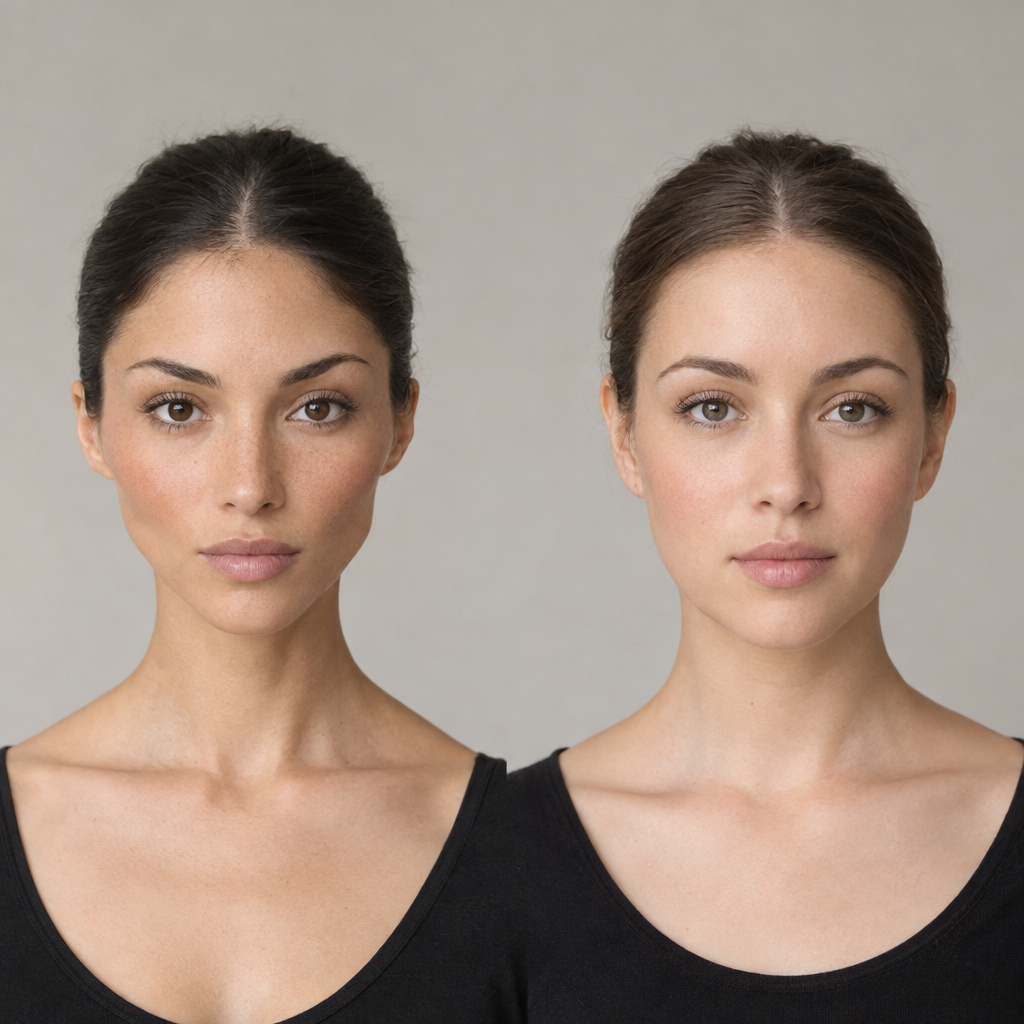
Compare these six features together rather than letting one feature decide the category:
- Widest point: On a diamond face, the cheekbone line is usually the clear widest point. On an oval face, the cheekbone region may still be widest, but the difference from the forehead is generally less pronounced.
- Forehead: A diamond outline has a forehead visibly narrower than the cheekbones. An oval outline usually has a broader upper face relative to its jaw, with a gentler transition toward the cheeks.
- Cheekbones: Diamond cheekbones create a distinct middle-face width peak. Oval cheekbones can look high or sculpted without dominating the outer outline.
- Side-outline transition: Diamond outlines change direction more noticeably as they widen toward the cheeks and narrow below them. Oval outlines follow a smoother, more continuous curve.
- Jawline: A diamond jaw is noticeably narrower than the cheekbone span. An oval jaw also narrows, but usually through a more gradual taper.
- Chin: A diamond chin often looks tapered or pointed, although it can be rounded. An oval chin is commonly rounded with a gentle taper. Chin shape alone does not settle the comparison.
Cheekbone prominence is not the same as cheekbone width. Prominence describes how projected or defined the cheeks look, which shadows can emphasize. Width describes their side-to-side span relative to the forehead and jaw.
Jaw width should also be separated from definition. A narrow jaw can have a distinct edge, while a wider jaw can have a softer contour. If this distinction is difficult to see, reviewing the difference between jaw width and jawline definition can help clarify what you are comparing.
Use the three-zone width check
This visual check is useful when both labels seem plausible. You do not need exact measurements or a fixed width ratio.
Start with a photo that meets these five conditions:
- Front-facing camera: Face the camera directly, with it positioned around eye level.
- Neutral expression: Relax your mouth and jaw rather than smiling broadly or clenching.
- Level head: Keep your chin neither lifted nor tucked, and avoid tilting sideways.
- Visible facial outline: Pull hair away from the temples, cheeks, and jaw.
- Enough camera distance: Avoid an arm’s-length close-up. If practical, place the camera roughly 1 to 2 metres away and crop afterward.
Use even lighting and a clear image so you can follow the edges of the face rather than shadows.
Compare the upper, middle, and lower face
Upper face, at the forehead: Compare the broadest visible forehead span between the temples, not a narrow indentation in the hairline. Use the same reference point across all comparison photos. Hairline shape can affect the upper outline, but it does not determine the overall category.
Middle face, at the cheekbone line: Look for the outermost visible cheekbone span. Ask whether it extends clearly beyond both the forehead and jaw, rather than simply looking defined under the lighting.
Lower face, at the jaw: Compare the width around the jaw angles, where the lower face turns toward the chin. Do not substitute the narrow tip of the chin for the entire jaw span.
A pronounced middle-zone peak, with both the upper and lower zones noticeably narrower, supports diamond traits. Gradual transitions without a sharp width peak support oval traits. This relative-width approach is more useful here than trying to interpret all facial ratios as a single face-shape formula.
Two questions to break a tie
- Is the cheekbone line clearly wider than both the forehead and jaw?
- Does the outline change direction noticeably around the cheekbones, rather than tapering smoothly?
“Yes” to both suggests diamond traits. A smaller difference between zones and a smoother contour suggest oval traits. If the answers point in different directions, a mixed description may fit better. These are descriptive clues, not a diagnostic score.
Why selfies and hairstyles can change the apparent result
A close selfie can exaggerate features nearer the camera relative to the sides of the face. This perspective effect is common with wide-angle phone selfies because the camera is held nearby. It can make the middle face appear more dominant, but it does not reliably turn one face shape into another.
Other details can also shift the visible outline:
- Head position and framing: Looking up or down, turning slightly, or using a crop that hides one side makes width comparisons less dependable.
- Expression: Smiling changes cheek fullness; tightening the jaw can make the lower outline look more defined.
- Hair: Strands over the temples or jaw can create an artificial taper. Volume beside the face may be mistaken for facial width.
- Lighting and makeup: Side lighting and contour can emphasize cheekbones without changing their actual span.
- Cheek fullness and image quality: Soft-tissue contours affect the visible silhouette, while blurry or heavily filtered images make its boundaries harder to judge.
Natural left-to-right differences can also make the outline look slightly different depending on head rotation and lighting. If this affects your comparison, learning how facial symmetry appears in photos can help you avoid judging the whole outline from one side alone.
For a simple repeatability check, compare two or three suitable images taken at different times or distances, keeping the head position and forehead reference consistent. There is no need to keep collecting photos.
If the classification changes across those images, treat the result as mixed or photo-sensitive rather than forcing a label from whichever selfie looks most convincing.
When your features sit between diamond and oval
Natural faces rarely match a geometric outline perfectly. These three combinations explain much of the overlap.
An oval face with high or prominent cheekbones: The cheeks may catch the light strongly or look sculpted, while the forehead-to-cheek-to-jaw transition remains smooth. “Oval with prominent cheekbones” communicates that distinction better than automatically choosing diamond.
A diamond-leaning face with a rounded chin: A pointed chin is not mandatory. If the cheekbones are clearly widest and both the forehead and jaw are narrower, “diamond-leaning with a softer chin” may describe the outline well.
A long diamond face that resembles oblong: Length can draw attention away from the width pattern. If the sides widen distinctly at the cheekbones and narrow above and below, diamond traits may still be the more useful description.
Face-shape categories are visual styling frameworks, not exact biological or medical classifications. A mixed label is not an incomplete answer.
A quick check for heart and oblong face shapes
Two nearby categories can help resolve remaining uncertainty:
- Heart-shaped outlines are generally more upper-face dominant, with the forehead or temple area broad relative to the jaw. Diamond outlines peak more clearly at the cheekbones. A tapered chin can occur in both.
- Oblong outlines are mainly distinguished by sustained length and relatively straighter sides. A long face with a pronounced cheekbone-width peak may lean diamond instead.
Length alone cannot reliably separate diamond, oval, and oblong. The distribution of width and the way the sides narrow remain more useful.
Using a face-shape detector as a second opinion
If you can see the width relationships but remain unsure which category describes them, Facefy’s Face Shape Detector can estimate a likely face shape from a clear, front-facing photo.
Treat the result as an AI-generated visual estimate, not an objective verdict. Camera angle, lighting, lens choice, camera distance, hair, expression, crop, and image quality can all affect the output.
Compare the estimate with your three-zone check. If it conflicts with the visible outline or varies across suitable photos, “between oval and diamond” may be more informative than accepting one category without context.
Diamond and oval face shape questions
Can an oval face have prominent cheekbones?
Yes. High or defined cheekbones can occur within a smoothly tapered oval outline. Their prominence does not necessarily mean the cheekbone span is dramatically wider than the forehead and jaw.
Is a diamond face always angular?
No. The width pattern can lean diamond even when the chin is rounded or the jaw transition looks soft.
What is usually the widest part of an oval face?
The cheekbone region is often widest, but it typically blends gradually into the forehead and jaw rather than forming an abrupt, dominant peak.
Can a face sit between diamond and oval?
Yes. For example, your cheekbones may be clearly widest while the side outline remains softly curved. Describing both traits can be more useful than insisting on a single category.
Do hairlines determine face shape?
No. They influence the visible upper outline, but the relationship among the forehead, cheekbones, and jaw matters more. Compare the broadest visible forehead span consistently rather than focusing on an individual hairline point.
How accurate are AI face-shape detectors?
They provide photo-dependent estimates, and there is no single accuracy figure that applies to every tool or image. For this comparison, the useful question is whether the estimate fits the visible width pattern, not whether it gives you a perfectly definite label.