How to Get Fluffy Hair Without Frizz: A Texture-Aware Guide
Learn how to create soft, fluffy hair with texture-specific routines, low-heat techniques, troubleshooting tips, and realistic expectations.
Fluffy hair is soft, airy hair with lifted roots, gentle movement, and visible separation rather than a stiff, heavily sculpted finish. Lightweight styling products, targeted root lift, and a drying method suited to your natural texture can help create it.
If your hair already feels too fluffy or puffy, you may need the opposite approach: more conditioning where needed, better definition, and less disturbance during drying. The useful first question is where you want volume and where you want control.
What fluffy hair looks and feels like
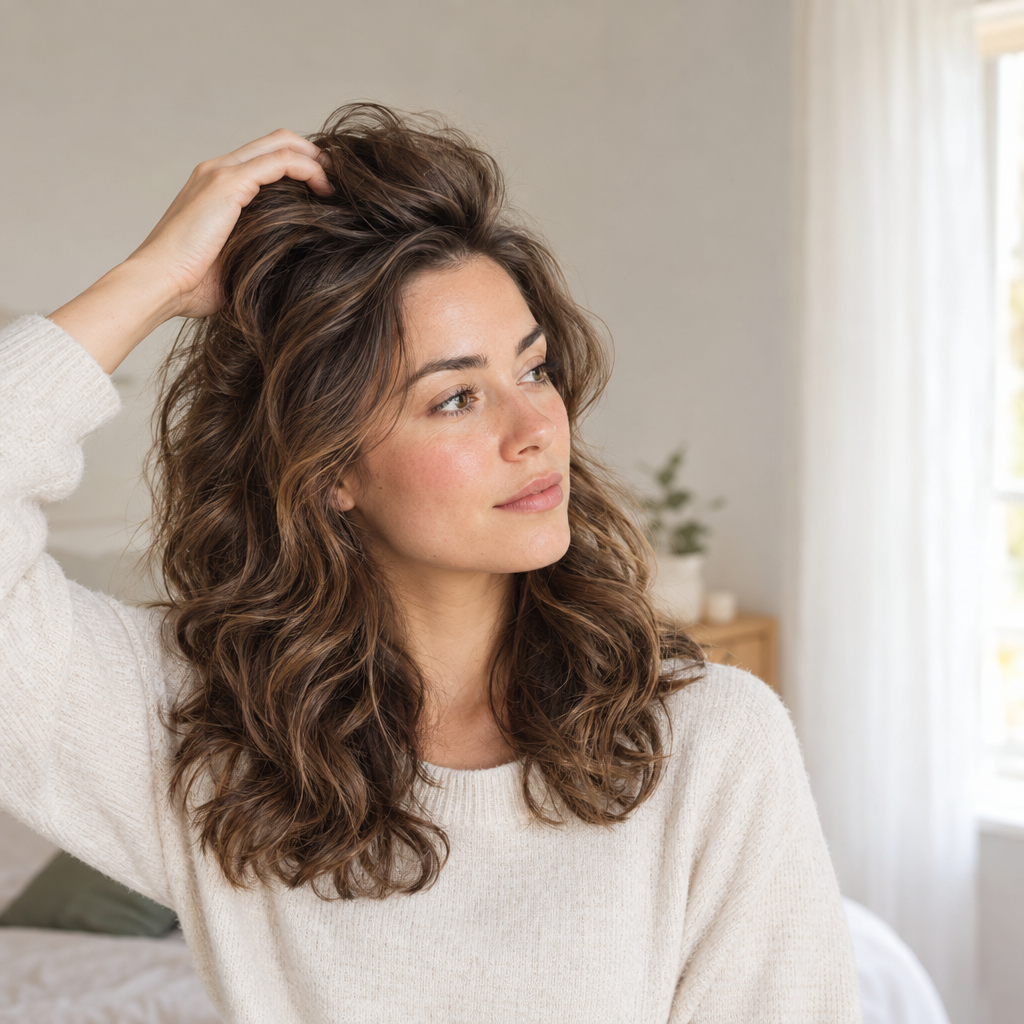
Intentional fluffiness is about how hair moves, not just how much space it occupies. Hair can have plenty of volume while feeling rigid, or have a soft, airy finish without looking especially large.
These descriptions can overlap. A fluffy hairstyle may include natural frizz, and neither frizz nor fullness is inherently a problem.
| Look | Roots and strand separation | Surface, movement, and first adjustment |
|---|---|---|
| Intentional fluffy hair | Lifted, softly separated | Soft and flexible; maintain light hold |
| Ordinary volume | Variable lift and separation | Loose or structured; target lift where needed |
| Frizz | Any amount of lift; scattered strands | Fuzzy or irregular; reduce drying friction if desired |
| Unwanted puffiness | Often flatter roots with expanded lengths | Broad or undefined; improve conditioning and definition |
“Ordinary volume” simply describes the space a hairstyle occupies. It does not specify softness, definition, or surface finish.
Frizz is not automatic proof of damage. Humidity, natural texture, brushing, drying technique, and product balance can all affect how individual strands sit. Some flyaways and surface texture are normal, even in well-conditioned hair.
Decide whether you want more fluffiness or more control
Before choosing products, check these five variables on clean hair without a heavy styling finish.
- Natural texture: Does your hair dry mostly straight, in waves, in curls, or in tight coils? Mixed patterns are common. Notice the pattern before brushing it apart.
- Strand thickness: Are individual strands fine, medium, or coarse? This describes each strand, not the amount of hair on your head. Fine strands often need less product; coarse strands may need more conditioning.
- Overall density: Does your hair have relatively light or substantial overall coverage? Scalp visibility changes with parting, lighting, and clumping, so a casual look is only a styling guide, not a measurement.
- Current condition: Do the lengths feel flexible, rough, tangled, coated, or fragile? Bleached or chemically processed sections may need gentler handling than untreated roots.
- Location of the result: Are the roots flat, the mid-lengths too wide, or the ends fuzzy? Also note whether the result appears immediately after drying or several hours later.
Strand thickness and density are independent. You can have many fine strands or fewer coarse strands, and those combinations respond differently to the same routine.
Choose your direction
- Flat roots, comfortable lengths: Add lift at the roots rather than more product throughout.
- Flat roots, puffy mid-lengths: Lift the roots while preserving definition below them.
- Rough surface, undefined lengths: Prioritize conditioning, gentle drying, and suitable hold.
- Soft volume that quickly collapses: Check whether moisture remains at the roots and whether products are too heavy.
- Hair that feels coated or stiff: Simplify the routine before adding anything else.
Humidity, accumulated product, a heavy haircut, and drying hair pressed against the scalp can change the outcome. Adjust one variable at a time so you can tell what helped.
A simple base routine for soft, flexible volume
1. Cleanse according to your scalp’s needs
Wash often enough to keep your scalp comfortable and remove oil or product that weighs down the roots. There is no single washing schedule that creates fluffy hair.
If hair feels coated despite regular washing, an occasional clarifying wash may help. Follow the product directions and consider color-treatment requirements. Stronger cleansing is not automatically better for dry or fragile lengths.
2. Condition where softness is needed
Concentrate conditioner on areas that tangle or feel rough, usually the mid-lengths and ends. Avoid automatically coating the roots if that makes them collapse.
Coarse, curly, or coily hair may need conditioning closer to the roots too. Placement should follow your hair’s response, not a universal “never condition near the scalp” rule.
3. Start with one suitable styling product
For fine or straight hair, a lightweight mousse or root-lifting product may provide support without a heavy coating. Waves, curls, and coils may benefit from a foam or gel that helps strands stay grouped during drying.
Begin with the lower amount suggested on the label, distribute it evenly, and increase only if the result needs more support. Product formulas vary too much for one universal pump count.
4. Lift the roots while preserving the lengths
Choose one root-lift technique from the sections below. Keep the lengths moving smoothly or grouped in their natural pattern rather than roughing up the whole head.
5. Finish only when fully dry
Use fingers to arrange straight hair or gently separate selected curls. If your styling product forms a cast, soften it after drying rather than brushing through it.
Dry shampoo can refresh oily roots between washes, but repeated layers may leave hair dull, stiff, or coated. It is not a substitute for cleansing.
How to make straight, wavy, curly, and coily hair fluffy
Straight hair: build lift before separating
- Starting condition: Damp, towel-blotted hair, not dripping wet. Press with the towel rather than rubbing.
- Root-lift method: Blow-dry selected roots opposite their usual direction.
- Drying method: Use controlled airflow along the lengths. Fingers or a brush can guide larger sections without repeatedly working the same area.
- Finishing step: Let hair cool, then separate it with your fingers for movement.
- Avoid: Heavy oils or creams throughout fine lengths, which can make the shape collapse.
If straight hair is coarse or rough at the ends, a small amount of conditioner or smoothing product there may improve movement without sacrificing root lift.
Wavy hair: protect the wave groups
- Starting condition: Evenly damp hair with styling product distributed through the lengths.
- Root-lift method: Place a few lightweight clips at flat areas near the crown.
- Drying method: Air-dry with minimal touching or diffuse with gentle airflow.
- Finishing step: Once fully dry, gently scrunch and loosen the roots with your fingertips.
- Avoid: Brushing apart partially dry waves, which can create width without useful lift.
Fine waves often need lighter product application. Denser waves may need smaller sections for even distribution and drying, rather than simply more product.
Curly hair: keep definition, then add fullness
- Starting condition: Wet or very damp hair so styling product can be distributed without repeatedly disturbing the curls.
- Root-lift method: Clip selected roots without pulling the curl lengths straight.
- Drying method: Diffuse gently, using as little repositioning as practical.
- Finishing step: Soften a fully dry cast, then separate only a few curls if you want more fullness.
- Avoid: Repeatedly touching, stretching, or rearranging curls while they set.
More separation generally means more width and less distinct definition. Stop when the balance suits you. Every curl does not need to be divided.
Coily hair: choose where you want expansion
- Starting condition: Conditioned, sectioned hair with styling product applied where needed.
- Root-lift method: Use careful root clips or low-tension positioning that supports the roots without stretching the scalp.
- Drying method: Air-dry fully or diffuse gently, allowing extra time for dense sections.
- Finishing step: Separate selected dry sections, or lift just the roots with fingers without pulling through the ends.
- Avoid: Rough dry brushing and tight stretching to force a larger silhouette.
Shrinkage influences both visible length and fullness. A defined style may look shorter and more compact, while additional separation creates a broader silhouette. Neither is the more correct result.
For lower-density hair, preserve enough grouping to avoid an overly separated finish. For fragile or chemically processed hair, reduce manipulation and heat rather than chasing maximum lift.
Four techniques for root lift and a softer finish
Root clipping
Best for: Selected flat areas in wavy, curly, or coily hair, especially near the crown or part.
On damp hair, use a lightweight styling clip to support a small root section slightly away from the scalp. Let the lengths hang in their usual pattern. Remove the clip gently once the section is dry.
Limitation: Heavy clips, overly large sections, or pulling hair taut can create dents or disturb the pattern. The clip should support the root, not tug at the scalp. Clipping is not essential if it feels uncomfortable or catches your hair.
Blow-drying against the growth direction
Best for: Straight hair and loose waves that lie flat at the roots.
With hair damp rather than dripping, move a root section temporarily opposite its usual direction while drying. Once the roots are dry, return the section to its preferred position and smooth the lengths with controlled airflow.
Use heat protectant as directed, keep the dryer moving, and avoid pressing the nozzle against the hair.
Limitation: This creates temporary lift. For tighter curls and coils, forceful redirection may stretch or disrupt the natural pattern. More heat does not guarantee longer-lasting volume.
Diffusing
Best for: Waves, curls, and coils that lose definition under a concentrated blast of air.
Use a diffuser attachment with gentle airflow. Start by hovering around the hair to limit disturbance. Then, if it suits your pattern, support sections in the bowl without repeatedly lifting and dropping them.
Limitation: Diffusing can still create frizz if airflow is too strong or handling is excessive. It may take longer than direct blow-drying, especially with dense hair.
Scrunching out a cast
Best for: Hair that has dried into a firm shell from gel or mousse.
A cast is the temporary firm coating some styling products form as they dry. Once the hair is fully dry, gently squeeze sections upward with clean, dry hands to soften that coating.
Limitation: Scrunching damp hair can break up forming curl groups and create fuzz. If the finish remains sticky or stiff after gentle scrunching, the formula or amount may not suit your hair.
Aggressive teasing, repeated high heat, and strong tension are not necessary for fluffiness. They can contribute to breakage or leave hair harder to detangle.
How haircuts and products change the silhouette
Layers can remove weight and encourage movement, but they do not automatically create soft volume. Shorter layers may also produce more width, especially where waves and curls spring outward. Facefy’s Hairstyle Finder can help you explore haircut ideas that complement your preferred volume, length, and overall silhouette before choosing a style.
Discuss these parts of the haircut separately:
- Crown layers: Influence how the top moves and where fullness gathers. Very short layers may need more styling to sit as intended.
- Face-framing pieces: Change movement around the front without necessarily lifting the crown.
- Perimeter weight: The fullness retained along the bottom edge. Removing too much can make lower-density ends look sparse.
Curl pattern and shrinkage affect where layers sit when dry. Reference lengths should be discussed in the finished state, not only while hair is wet or stretched.
What to ask your stylist
Bring front and side references, preferably showing hair similar to yours. Face-framing layers and the placement of volume can change how a hairstyle looks around your face. Facefy’s Face Shape Detector can offer a starting point for exploring face shape and considering different framing options, although personal preference and natural hair texture should guide your final choice. Then clarify:
- Desired root lift: “I want more height at the crown, not more width beside my cheeks.”
- Shortest layer: “Where will the shortest layer sit when my hair is dry?”
- Preferred width: “I like fullness through the top, but want the sides more contained.”
- Perimeter fullness: “Please keep the bottom edge substantial.”
- Everyday effort: “I usually air-dry” or “I am comfortable blow-drying the roots.”
Product weight matters too. Mousse and foam often suit airy finishes; gel can help textured hair retain shape before its cast is softened. Rich creams and oils may help dry lengths but can reduce lift when applied too generously.
The best combination depends on texture, strand thickness, density, condition, and the finish you enjoy. Styling does not increase the number of follicles.
How to control hair that feels too fluffy or puffy
If your goal is less expansion, do not follow every volume-building step. Keep the lift you like and target the areas that feel overly wide or undefined.
- Rough mid-lengths and ends: Apply conditioner thoroughly there. If needed, use a small amount of leave-in conditioner, then assess the dry result before adding more.
- Waves or curls that spread after brushing: Detangle gently while conditioned, then let the pattern set with less disturbance.
- A fuzzy surface after drying: Press out water instead of rubbing, lower the airflow, and reduce handling.
- Soft hair that expands in humidity: A suitable hold product may help maintain grouping better than adding more oil.
- Dense hair with too much side width: Discuss preserving weight or changing layer placement rather than automatically cutting shorter layers.
Hair that becomes fluffy after washing may simply be showing its natural pattern without the weight of oil or previous styling products. Technique, humidity, and product balance can also contribute. More conditioning is useful when hair needs it, not as an automatic answer to all fullness.
Troubleshooting flat roots, frizz, stiffness, and excess width
These are possible causes, not diagnoses. Start with the adjustment that best matches your routine.
| Result | Possible cause | Low-risk adjustment |
|---|---|---|
| Flat roots | Buildup or heavy root conditioning | Cleanse appropriately; move conditioner lower |
| Frizzy surface | Rough airflow or touching damp hair | Lower airflow; handle less |
| Stiff or crunchy finish | Dry cast or excess product | Scrunch a dry cast; reduce the next application if hair stays coated |
| Volume collapses quickly | Moisture at the roots, heavy product, or humidity | Let roots dry fully; simplify products |
| Excessive mid-length width | Broken curl groups or short layers | Preserve definition; discuss layer placement |
| Frizzy ends | Friction, dryness, or weathering | Condition ends; detangle gently |
| Uneven lift | Growth patterns or uneven drying | Clip selected roots; dry evenly |
A crunchy cast and excessive product are not the same issue. If gentle scrunching makes fully dry hair soft, the cast was doing its job. If hair remains coated, sticky, or difficult to move, use less next time or choose a different formula.
Likewise, flat roots do not always mean you need stronger hold. They may simply have dried pressed against the scalp. Further drying is appropriate only if moisture remains. Hair that feels cool to the touch is not necessarily wet, particularly after cool-air drying, and dry roots do not need additional heat simply because they feel cool.
Heatless volume, overnight protection, and next-day refreshes
Create lift without heat
Root clips can support selected areas while hair air-dries. On straight or loosely wavy hair, temporarily moving the part while the roots dry may also encourage lift.
Loose rollers or low-tension setting methods can create a fuller shape on suitable hair, but they may change the natural pattern. Allow hair to dry fully before releasing the set. Heatless styling is not damage-free if it involves tight pulling or snagging.
When using heat, follow both the tool and heat-protectant instructions. No single temperature is appropriate for every texture, condition, or appliance. The American Academy of Dermatology’s hair-care guidance also emphasizes gentle handling and limiting excessive heat.
Protect the shape overnight
Choose an arrangement that does not pull:
- For shorter hair, a smooth pillowcase may be simpler than tying it up.
- For longer waves or curls, a loose high gathering may reduce compression if it stays comfortable.
- For coils, a roomy bonnet or loosely arranged sections may help preserve the chosen shape.
Smooth fabric can reduce friction, but it cannot prevent every flattened root. Avoid tight elastics and uncomfortable overnight tension.
Refresh only what needs it
Mist a flattened root section lightly, lift it with fingers or a clip, and allow it to dry. If curls have lost definition, dampen only the affected sections and reshape them gently.
Add a little styling product only if the existing product is not enough. Repeatedly layering dry shampoo, oil, mousse, and spray can make hair less flexible.
Temporary volume will change with humidity, sleep, hats, and movement. A targeted refresh is usually more practical than recreating the entire style.
Use photos as references, not promises
A hairstyle photograph shows a moment, not how the hair behaves all day. Extensions, professional blowouts, strategic lighting, retouching, and movement can all influence the result.
A three-photo reality check
To assess your own styled hair, take:
- A front view: Look at crown lift and the balance between top volume and side width.
- A side view: Check the silhouette, including the crown, back, and fullness at the ends.
- A natural-light view: Use indirect daylight to see strand separation and surface texture without dramatic lighting.
Keep camera distance, camera height, and posture reasonably consistent. Avoid holding the phone unusually close or tipping your chin to change the silhouette.
For inspiration images, look for equivalent views of the same haircut when available. A single close, low-angle, or backlit photograph can exaggerate volume. A wide-angle lens used close to the head can alter perspective, while a contrasting backdrop or hair caught in motion can make the outline look fuller.
If you are comparing layered cuts, Facefy’s Hair Style Try-On can help you visualize broad hairstyle silhouettes before discussing them with a stylist. Treat the image as a comparison aid, not a prediction of exact density, texture, strand behavior, movement, or salon results.
Styling can alter visible lift, shape, and separation. It cannot establish actual follicle density, diagnose hair loss, or guarantee that an AI preview or reference-image hairstyle will behave the same way on your hair.
Common questions about fluffy hair
Can fine or thin hair look fluffy?
Yes. Fine strands or lower-density hair can often look airier with targeted root lift, light product application, and enough perimeter fullness. These are different characteristics: “fine” describes strand thickness, while “thin” often refers to lower density.
Heavy products and excessive layering can work against the desired result. Styling can change visible fullness, but it does not create additional hair.
What products add volume without making hair stiff?
Lightweight mousse, foam, and flexible-hold root products are common options. The formula, amount, and placement matter more than the category name.
For textured hair, a gel that dries firm may still produce a soft finish after the cast is gently scrunched out. Start with one styling product rather than stacking several.
Can fluffy hair be created without heat?
Yes. Root clipping, temporary part changes, and loose setting methods can create lift without a dryer. Results depend on natural pattern, hair weight, humidity, and whether the roots dry completely in the lifted position.
Why does volume disappear soon after styling?
Common reasons include moisture remaining at the roots, products that are too heavy, humidity, or the weight of longer hair. A hat, sleep, or repeatedly touching the roots can also flatten the shape.
Before adding stronger hold, check whether moisture remains and move conditioning products away from areas where they cause collapse. Do not apply more heat based on coolness alone if the roots are already dry.
Does brushing curly hair make it fluffy or frizzy?
It can create either effect, depending on the intended style. Dry brushing separates curl groups and usually produces a softer, broader, less-defined outline. It can also create tangles or breakage if done roughly.
For airy but defined curls, separate selected dry curls with fingers instead of brushing through the entire style.
When is the concern more than styling?
Persistent scalp irritation, pain, scaling, patchy loss, or unusual shedding should be discussed with a qualified healthcare professional. Changing products or adding volume cannot determine the cause.
For ordinary styling concerns, aim for the amount of lift, softness, and definition that feels comfortable and manageable on your own hair.