Burst Fade Guide: Variations, Barber Requests, and Upkeep
Learn what defines a burst fade, compare its main variations, explain your preferred cut to a barber, and plan for upkeep and grow-out.
A burst fade is a curved fade concentrated around each ear. Instead of continuing evenly around the head, the transition follows a semicircular path and usually preserves more length toward the back.
The defining feature is the curve, not the style on top. To get the version you want, agree on three separate details with your barber: where the arc sits, how far it spreads, and how short its shortest point will be.
What makes a fade a burst fade?
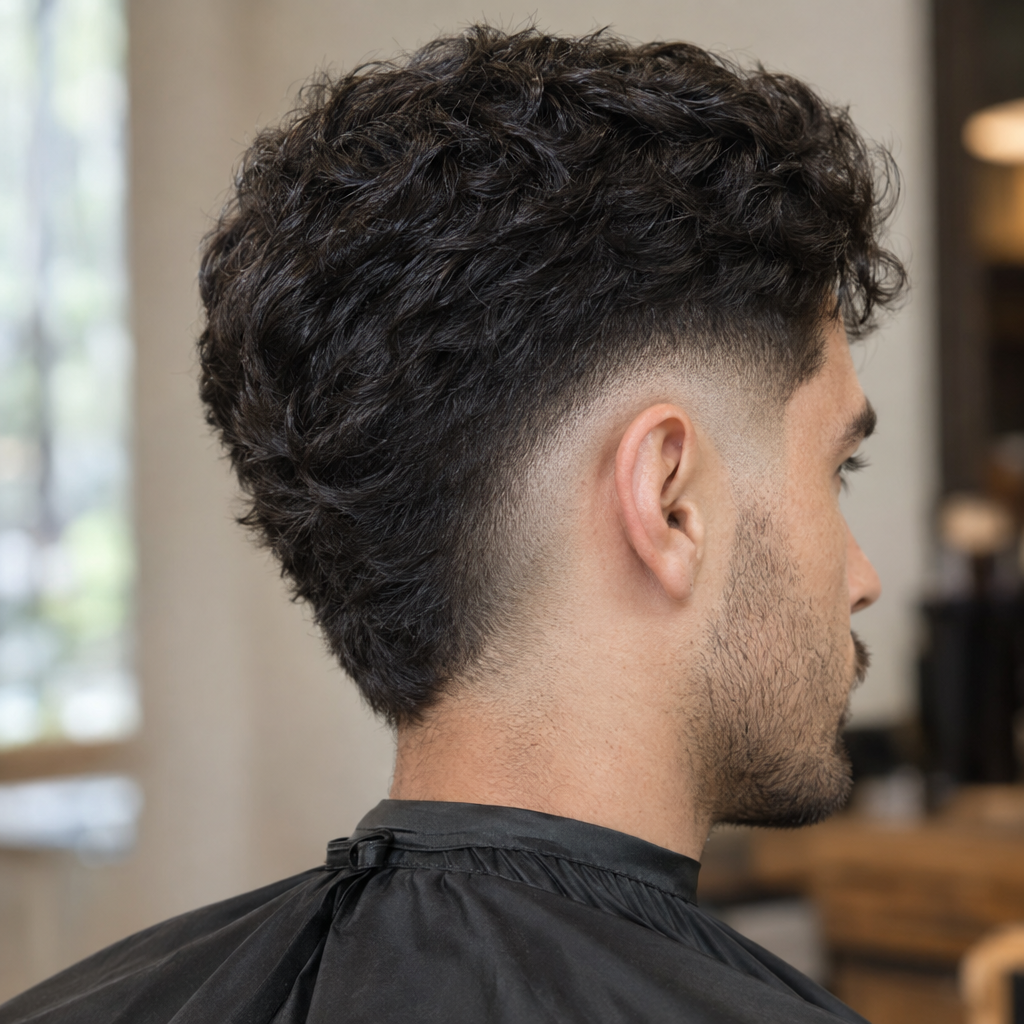
Viewed from the side, a burst fade radiates around the ear. The hair is shortest close to the ear and gradually becomes longer farther from it. This creates a rounded transition rather than a broad horizontal band.
The amount of hair behind the arc can vary. One version may preserve substantial back length, while another keeps the back compact. Terms such as “burst taper” and “mohawk fade” can also mean slightly different things between barbershops, so show the curve and back length you want instead of relying on the name alone.
Key distinctions include:
- Burst fade: Describes the curved faded area around the ear.
- Mohawk or faux hawk: Describes the longer central shape running over the head.
- Mullet: Describes a silhouette with visibly greater length at the back.
- Short textured cut: Can use a burst fade without preserving a central ridge or long back.
Burst fade vs. drop fade, temple fade, and taper
Compare these cuts by looking at where the fade begins, the route it follows, how much back length remains, and the silhouette it creates.
Burst fade
- Starting area: Close to the ear.
- Path: A rounded arc radiating around the ear.
- Back length: Often preserves more hair behind the arc, although this is optional.
- Silhouette: Closely faded ear areas with a fuller top, back, or both.
Drop fade
- Starting area: At the chosen height along the sides.
- Path: Drops behind the ears and continues across the back.
- Back length: Usually removes more weight from the lower back than a burst fade.
- Silhouette: A lowered fade line that wraps around the head.
Temple fade
- Starting area: Around the temples and sideburns.
- Path: A localized transition rather than a complete arc around the ear.
- Back length: Usually unaffected unless the neckline is separately tapered.
- Silhouette: Defined front corners with fuller surrounding sides.
Conventional taper
- Starting area: Selected edges, commonly the sideburns and neckline.
- Path: Gradually lengthens inward from those edges.
- Back length: Most of the hair remains above the neckline transition.
- Silhouette: A fuller outline with gently shortened edges.
A fade that continues evenly around the head removes weight across a broader band. If you want fullness behind the ears, point to that area before the barber connects the sides across the back.
Low, mid, and high burst fade variations
Height controls how much weight remains above the ear. It does not determine whether the shortest area reaches skin.
| Placement | Position and effect | Main trade-off |
|---|---|---|
| Low | Compact arc close to the ear, with more side weight retained | The curve appears subtler |
| Mid | More visible curved transition with moderate upper-side fullness | Exposes more of the side area |
| High | Arc extends farther above the ear for stronger contrast | Leaves less upper-side weight |
There is no universal boundary separating low, mid, and high placements. Ear position, head contours, hair density, and barber interpretation can all affect the result. Ask the barber to indicate the intended upper boundary before cutting.
Burst taper vs. burst skin fade
A burst taper commonly refers to a softer version that leaves visible short hair at the shortest point. However, some barbers also use “taper” to describe a smaller transition area. The word alone does not settle the length or size of the arc.
A burst skin fade blends down to exposed or nearly exposed skin around part of the curve. This creates stronger contrast, especially with dark or dense hair. Fresh growth may also become noticeable sooner because there is a greater difference between the shortest and longest areas.
For a softer finish, ask to leave visible stubble instead of saying “not too short.” If you have a preferred guard length, discuss it with your barber, but remember that guard systems, blades, and lever positions are not completely interchangeable.
Choosing the overall silhouette
Start with the longer hair you want to preserve, then choose the fade that supports it.
- Textured top: Maintains visual weight above the arc without requiring a long back.
- Rounded or sculpted top: Curls and coils can create fullness above a closely faded outline. Decide whether you want a rounded shape or a taller center.
- Mohawk or faux hawk: Preserved central length creates a directional silhouette. Show how narrow or broad you want the central section.
- Modern mullet: Combines the curved fade with noticeably longer hair at the back. A burst fade by itself does not create this shape.
- Short top: Can sit forward, remain cropped, or brush upward depending on length, density, and styling effort.
Before choosing, consider three questions:
- How much back length do you want to keep?
- How noticeable should the faded sides be?
- How often are you willing to refresh the shortest areas?
Also consider how the top behaves without deliberate styling. A highly sculpted reference may require more daily work than the same cut shown in its natural state.
- Optional preview: Facefy’s Hair Style Try-On can help you compare broad changes in top volume, side exposure, and retained back length before your appointment.
A virtual preview cannot reproduce exact clipper blending, scalp visibility, growth patterns, or hair density. Use it as a reference for the overall silhouette rather than a guarantee of the finished result.
How a burst fade behaves on different hair textures
Texture changes how the faded area connects to the longer hair. Density and contrast between the hair and scalp also affect how clearly the arc appears.
-
Straight hair: Changes in length and unintended blend lines may be particularly visible in dark, dense hair. Ask for a gradual transition into the longer side section.
-
Naturally wavy hair: Movement can soften the boundary, but longer sections may lift above the arc. Show the barber how your hair sits with your normal styling routine.
-
Curly hair: Shrinkage affects the finished top and back length. Agree on the intended dry length rather than judging the shape only while the hair is wet or stretched.
-
Coily hair: Compact texture can support a strongly defined outline. Preserve sufficient length wherever you want the silhouette to remain full.
-
Related resource: Explore additional curly and coily hairstyle ideas using examples with a similar density, texture, and dry length.
Two less obvious factors can also affect the result:
- Growth patterns around the ear: Hair may lift or lie in different directions on each side. The barber may need to adjust the arc or leave slightly more length rather than forcing two perfectly identical curves.
- Low hair-to-scalp contrast: Light, fine, or lower-density hair may produce a softer boundary than dark, dense hair. Cutting it shorter will not necessarily recreate the contrast shown in a reference photo.
A six-part burst fade request for your barber
Bring side, back, and top views of the same cut when possible. A front-facing photo rarely shows how far the arc extends or how much back length remains.
Use this six-part request:
- Fade height: “I want a low, mid, or high burst. Can you show me where the upper boundary will sit?”
- Shortest length: “Leave visible short hair, go very close, or take it to skin. What length would create that finish on my hair?”
- Arc size: “Keep the curve tight around the ear, or extend it farther toward the temple and back. Keep this area behind the ear fuller.”
- Top length: “Leave approximately ___ inches or centimeters when dry. I usually wear it ___ and style it with ___.”
- Back length: “Leave the back reaching ___ with this amount of fullness. Remove only ___ from the ends.”
- Neckline and edge-up: “Keep the neckline natural, rounded, squared, or tapered. Treat it separately from the ear-level arc. Keep the front hairline natural or lightly defined without moving it farther back.”
A complete request might sound like this:
“I want a low burst with visible short hair, not skin. Keep the arc compact around each ear. Leave about five centimeters on top when dry so I can push it forward, and preserve the back length shown here. Keep the neckline natural and the front edge lightly defined.”
Ask one final question before the cutting begins: “Will this leave the amount of hair behind the ears that I’m pointing to?” This addresses a common mismatch between the name of the fade and the intended shape.
What to check before leaving the chair
Use the mirror to view both sides and the back under normal lighting. A brief check is enough. Natural growth and head contours can prevent exact side-to-side matching.
- Comparable arc height: Both curves sit at a similar level, allowing for natural differences between the sides.
- No unintended dark guideline: The transitions do not contain an obvious leftover stripe.
- The requested curve: The blend follows the ear instead of becoming an even fade around the entire head.
- Preserved back length: The agreed length and fullness remain behind the arc.
- Agreed hairline treatment: The front edge has not been taken farther back or made sharper than discussed.
If something differs from your request, point to the specific area. “Can we soften this line without raising the fade?” is more precise than “Can you blend it more?”
Burst fade upkeep and grow-out
A high-contrast or skin-level burst fade may need refreshing approximately every two to three weeks if you want it to remain crisp. A softer version that leaves visible short hair may remain acceptable for roughly three to five weeks. If you are reconsidering the fade height or volume on top, Facefy’s Face Shape Detector can provide a photo-based estimate as one styling reference, though angle, lighting, hair coverage, and image quality can affect the result. These are planning ranges, not fixed schedules.
The shortest area around the ear and the sideburn outline often lose definition before the top and back need reshaping. Ask whether a maintenance appointment can focus on refreshing the sides while preserving the longer sections.
As the hair grows, the arc becomes less distinct and may begin to resemble a softer taper. Keeping more back length can make the overall grow-out feel less abrupt, although the transition may still need occasional blending.
Connecting the fade to the neckline is optional. Agree on this before the cut because it changes how much lower-back weight remains. Avoid widening the arc yourself between visits, since small corrections can gradually move its boundary higher.
Common burst fade questions
Can a burst fade be low?
Yes. “Burst” describes the curved path, while “low” describes its placement. A low version can leave visible short hair or finish at skin level.
Does a burst fade work on every hair texture?
It can be adapted to straight, wavy, curly, and coily textures. The transition will look different depending on movement, density, shrinkage, and contrast with the scalp.
Does it always leave the back long?
No. A burst fade often preserves more hair behind the arc, but the back does not have to be long. You can request a compact back without connecting the fade evenly across the entire head.
Does it have to connect to the neckline?
No. The curved fade around the ear can remain separate from the neckline, especially when preserving lower-back fullness matters.
What reference photos should I bring?
Choose images showing the side curve, back length, and top shape. References with a similar hair texture and density are more useful, but they still cannot guarantee an identical result.
Does a burst fade grow out cleanly?
It can, particularly when the longer sections connect smoothly to the faded area. Softer finishes usually develop a less abrupt transition as they grow. Choose the shortest length based on how you want the cut to look between appointments, not only on how crisp you want it on the first day.