Crew Cut Guide: Variations, Barber Instructions, Styling, and Upkeep
Learn what defines a crew cut, compare fades and tapers, choose for your hair, and get clear barber, styling, and upkeep guidance.
A crew cut is a short haircut with tapered or faded sides and a graduated top. The hair is longest at the front, then becomes progressively shorter toward the crown. That sloping top profile distinguishes it from a uniform buzz cut.
The right version depends less on rigid face-shape rules and more on hair texture, density, growth direction, preferred contrast, and willingness to style and maintain it. A soft taper offers gentler grow-out, while a close fade creates a sharper outline that usually needs more frequent attention.
What defines a crew cut?
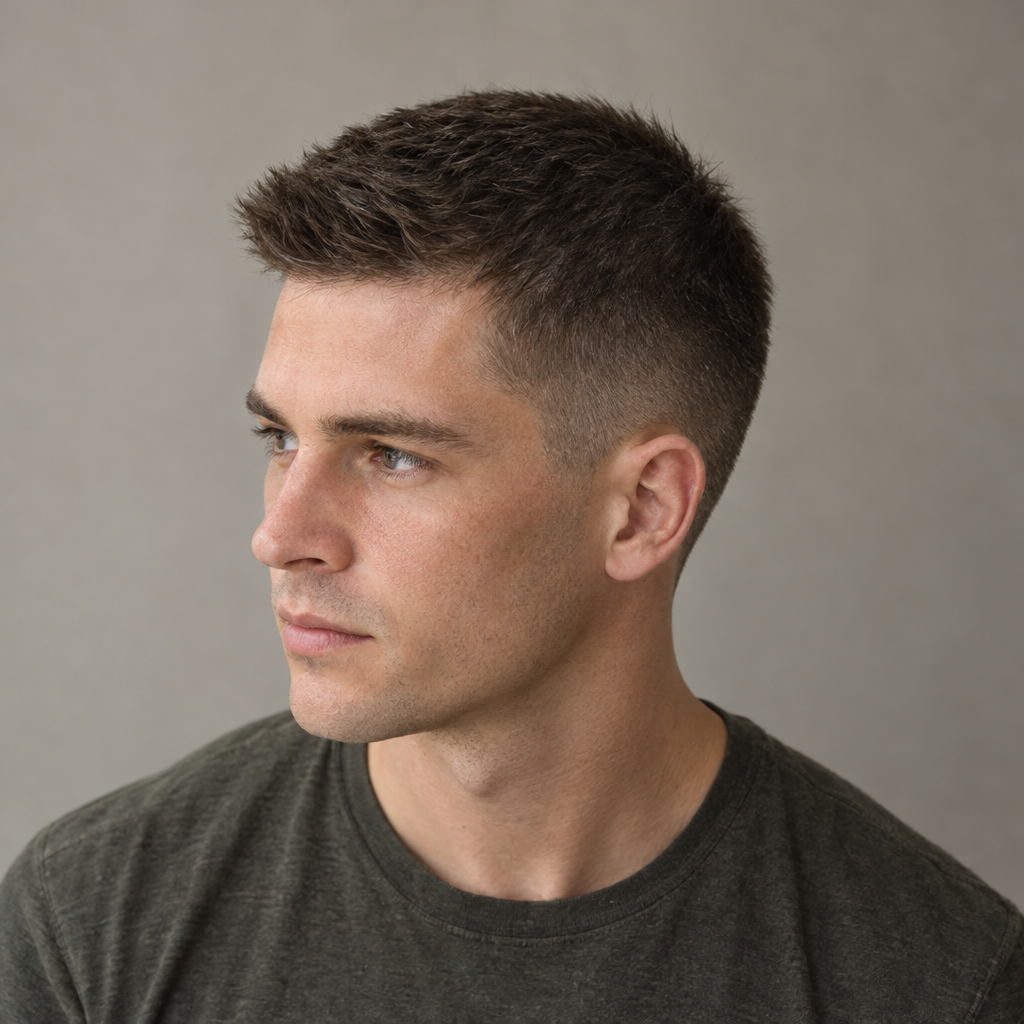
A crew cut has three structural features:
- A slightly longer front: Enough length to create some height or direction.
- A graduated top: The hair becomes shorter toward the crown instead of remaining one length throughout.
- Shorter sides and back: These can be softly tapered, faded, or cut skin-close.
The name is commonly associated with rowing crews, and the style has longstanding collegiate and military associations. Modern versions are not limited by gender, occupation, or institution.
There is no single required top length. A compact version may have only modest front lift, while a styleable crew cut might retain approximately 2 to 4 cm at the front. Longer versions allow more visible texture or a sideways sweep. All still rely on front-to-crown graduation.
Crew cut vs. buzz cut, Ivy League, and high and tight
Haircut names sometimes overlap between barbers. Compare the structure and visible result rather than relying on the label alone.
| Criterion | Crew cut | Buzz cut | Ivy League | High and tight |
|---|---|---|---|---|
| Top-length profile | Graduated from a longer front to a shorter crown | Usually close to one length across the top | Longer, usually graduated and shaped for combing | Short or compact top with distinctly close sides |
| Front length | Often enough for slight lift; approximately 2 to 4 cm is one styleable option | Commonly a clipper length, often about 3 to 13 mm, though longer versions exist | Usually long enough to part or sweep, often around 4 to 8 cm | Commonly short enough to stand or lie compactly, often about 6 to 25 mm |
| Side treatment | Tapered or faded at any practical height | May be uniform, tapered, or faded | Usually tapered or faded with more side coverage | Very close sides, typically extending high on the head |
| Styling flexibility | Small lift, forward texture, or sideways direction | Very limited at shorter lengths | Side part, combed front, or controlled sweep | Limited, although a slightly longer top can be textured |
| Maintenance level | Low daily styling; trim frequency depends on the side finish | Minimal daily styling; regular length resets keep it uniform | More daily styling and control; trim timing depends on shape | Little daily styling, but close sides show regrowth quickly |
The measurements are useful reference points, not universal definitions. Texture, shrinkage, cutting technique, and local naming conventions all affect how each style is described.
A crew cut preserves more front shape than a uniform buzz cut without requiring the longer, deliberately combed finish associated with an Ivy League. A high and tight is defined more by its closely cut, high sides than by a particular front-to-crown slope.
Crew-cut variations and how they grow out
Side treatment and top treatment are separate decisions. You can combine a textured top with a low fade, for example, or pair a longer front with a classic taper.
| Variation | Defining feature | Styling commitment | Visible grow-out |
|---|---|---|---|
| Classic taper | Softer sides with gradually shortened edges | Low | The outline softens gradually |
| Low fade | Close transition near the lower edges | Low | The lower edges lose definition first |
| Mid fade | Transition around the middle of the sides | Low | Side contrast gradually softens |
| High fade | Closely cut area extends farther up the head | Low | Regrowth is visible across a larger side area |
| Textured crew cut | Deliberate separation across the top | Low to moderate | Texture becomes fuller and less defined |
| Short crew cut | Compact front-to-crown graduation | Very low | Front lift becomes more noticeable as it grows |
| Longer crew cut | Extra front length for lift or direction | Moderate | The front may begin to fall or separate |
Choose according to the finish and commitment you want:
- Classic taper: Useful when easy grow-out matters more than strong contrast.
- Low fade: Retains more coverage higher on the sides while defining the lower edges.
- Mid fade: Makes the side transition more prominent without taking the close area to the upper sides.
- High fade: Extends the closely cut area farther up the head. Perceived contrast also depends on the retained upper-side length and how the transition is blended.
- Textured top: Creates visible separation and usually benefits from a small amount of product.
- Short top: Requires little manipulation but provides less control over direction.
- Longer top: Offers more styling room, with a greater need to reset the front after washing or sleeping.
Fade height describes how far the closely cut area and transition extend up the head. It does not specify the shortest length. A low fade can be skin-close, while a high fade can retain visible hair.
A 60-second check before choosing your version
Look at clean, dry hair in ordinary daylight before applying product. Spend roughly 10 seconds on each point, then decide which factors matter most.
- Front hairline: Do you want the natural line clearly visible, or enough front length to direct the hair forward or sideways?
- Crown direction: Notice where a cowlick makes the hair lift, split, or spiral. Does your intended styling direction work with it?
- Density: Is coverage fairly consistent, or are there areas where added separation would expose more scalp?
- Scalp-to-hair contrast: How noticeable is the scalp through the hair? Strong contrast can make small length changes appear more pronounced.
- Styling willingness: Will you spend a minute directing the front, or do you want an almost hands-off finish?
A softer taper generally grows out more gradually. Additional front length provides more control over direction, while restrained texturizing may preserve coverage where density is lower.
Wetness, overhead lighting, hair color, and cut length all affect perceived scalp visibility. One photograph is not a definitive picture of density.
Adjust the cut for growth patterns, curls, density, and upkeep
Strong crown growth patterns
Leaving additional length around a strong crown swirl may help the hair settle instead of standing up or splitting. The barber can also adjust where the top begins to shorten.
Extra length does not guarantee that the hair will lie flat. Ask the barber to inspect its dry, natural direction before deciding how short to go.
Fine or lower-density hair
Fine describes strand thickness, while density describes how closely hairs are distributed. They are different characteristics, although both affect the finished appearance.
Avoid excessive thinning or deep separation in visibly sparse areas. Preserving weight can create a more continuous-looking surface, while heavy texturizing may reveal more scalp.
Wavy, curly, and coily hair
Retain enough top length for the natural pattern you want to remain visible. Tight curls and coils can appear much shorter when dry, so discuss the desired dry length rather than judging only stretched or wet hair.
If you are deciding between a compact shape and a version that preserves more texture, Facefy’s Hairstyle Finder can help you explore hairstyle options before an appointment. Treat a preview as a discussion reference, not a prediction of shrinkage, density, or how the crown will settle.
Straight hair often shows the graduated profile clearly. Waves, curls, coils, and coarse strands may need different lengths and weight distribution to manage spring, lift, and bulk.
Lower-maintenance preferences
Choose a softer taper when easy grow-out matters more than sharp contrast. Keeping some side coverage generally makes new growth less conspicuous than it is against freshly exposed skin.
Low daily styling and low appointment frequency are different goals. A skin-close fade may need almost no morning effort but more frequent barber visits.
Choose the sides by coverage and maintenance
Once you have chosen a fade or taper, decide four additional details.
1. The shortest side length
Tell the barber whether you want visible coverage, a very short clipper finish, or exposed skin at the base. Fade height alone does not communicate this choice.
A broader guide to fade haircuts can help clarify how placement and blending change the side profile before you choose a finish.
2. The transition placement
Point to where you want the transition to begin and where you expect it to blend into the upper sides. Labels such as low, mid, and high can vary between barbers, so a visual reference is useful.
3. The sideburns
Specify whether you want the sideburns retained, tapered, sharply outlined, or blended into the fade. Their length can be chosen separately from the rest of the sides.
4. The neckline
A natural or tapered neckline usually softens gradually as it grows. A blocked neckline has a defined border that becomes more noticeable when new hair appears below it.
If you have preferences about exposing head contours, scars, or areas of scalp visibility, explain them neutrally. These are coverage choices, not features that need correcting.
Crew-cut guard numbers are starting points, not formulas
Common clipper references are approximately:
| Guard | Nominal length |
|---|---|
| #1 | 3 mm |
| #2 | 6 mm |
| #3 | 10 mm |
| #4 | 13 mm |
Guard lengths can vary slightly by clipper brand and attachment system. Lever position, cutting direction, hair compression, and barbering technique can also change the effective result.
A barber might use guards on the sides and shape the top with scissors, clipper-over-comb, or scissor-over-comb. The latter two techniques use a comb to lift and guide the hair while the cutting tool removes length beyond it.
A guard number does not describe graduation. Asking for a number two on the sides still leaves the front length, crown shape, transition height, shortest fade length, and neckline undecided. The same guard also looks different on fine, coarse, straight, or curly hair.
How to evaluate a crew-cut reference photo
Choose a reference for its hair characteristics and haircut structure, not simply because you like the model’s overall appearance. A person who seems to share your face shape may still have very different density, growth patterns, texture, or available front length.
Check these six details:
- Texture: Does the hair lie flat, stand upright, wave, curl, or coil similarly to yours?
- Density: Is the coverage comparable, including visible scalp-to-hair contrast?
- Top profile: How quickly does the length shorten from the front toward the crown?
- Fade height: Where does the transition sit, and is its shortest area skin-close or visibly covered?
- Dry front length: Compare the model’s dry front length with the hair you currently have and the result you want. A styled front can look longer or shorter depending on lift, curl, and camera angle.
- Front direction: Is the front lifted, pushed forward, or swept sideways? Is product or blow-drying holding it there?
Bring front, side, and back views when possible. A front-facing photograph can conceal crown graduation, side bulk, and neckline shape.
Lighting, camera angle, styling products, and image editing can change the apparent finish. Photo-based previews can still help communicate a silhouette. Facefy’s hair style try-on offers a visual reference, but no preview can reliably predict density, growth direction, scalp visibility, or how freshly cut hair will settle.
What to tell your barber
A useful request makes six decisions explicit: front length, crown graduation, side length or technique, transition height, neckline finish, and texture.
Use this adaptable script:
“I want a crew cut with about [desired length] at the front, gradually shortening toward the crown. Use [guard number or clipper-over-comb] on the sides with a [low, mid, or high fade, or a soft taper confined to the edges]. Make the shortest area [skin-close or preferred guard length]. Finish the neckline [natural, tapered, or blocked], and add [light, defined, or no additional] texture on top. Keep the sideburns [preferred length].”
For example, you might request approximately 25 mm at the front, shortening toward the crown, with a #2 starting length on the sides, a soft edge taper, a tapered neckline, and light texture. That is one possible request, not a universal formula.
Before cutting, ask:
- “Will this front length stand up or fall sideways on my hair?”
- “Should we preserve more length around the crown?”
- “How will the fade look once the shortest area starts growing?”
- “Will the reference need more daily styling than I want?”
Arrive with the natural front and crown visible if possible. Reference photos support the conversation, but they do not replace clear decisions about length, placement, and finish.
How to style a crew cut by hair type
Start with towel-dried hair unless your product specifies otherwise. Rub a small amount between your hands, distribute it lightly, then use the remaining product to shape the front. Add more only if needed.
Straight hair
Direct the front forward, slightly upward, or sideways with a lightweight matte cream or paste. For stubborn growth direction, a brief blow-dry on low or medium heat can establish the shape before product is applied.
Wavy hair
Use a flexible cream or light paste and guide the hair with your fingers. Avoid repeatedly combing it flat if you want to retain movement.
Curly and coily hair
Apply a small amount of curl cream or flexible gel to damp hair. Arrange the curls gently, then let them dry without excessive handling. Pressing the top flat can obscure the texture you retained length to show.
Coarse hair
A firmer paste may help manage lift. Begin sparingly because additional product cannot compensate for a top cut too short to settle. Discuss controlled weight removal rather than automatically thinning the entire top.
Fine hair
Choose lightweight products and restrained separation. Heavy waxes or wet-looking finishes can clump strands together and make scalp visibility more noticeable.
A longer crew cut can sweep sideways. If you want a pronounced part and an extended, combed front, an Ivy League may describe the intended result more clearly.
How often to trim a crew cut
The schedule depends on the finish you want to preserve.
| Desired finish | Practical trim estimate |
|---|---|
| Very crisp or skin-close fade | Every 1 to 2 weeks |
| Conventional fade or taper | Every 2 to 4 weeks |
| Softer, grown-out outline | Every 3 to 5 weeks |
These are practical estimates, not rules. Growth rate, hair contrast, transition height, and preferred neatness can shift the timing.
The sides may need attention before the top. Ask whether an occasional edge or fade refresh can preserve the outline without shortening the front unnecessarily.
Between appointments, wash according to your scalp and product needs, rinse out buildup, and reset the front lightly. Avoid chasing an uneven fade at home. Taking one area higher can make the surrounding transition harder to balance.
Common crew-cut mistakes to avoid
- Asking only for a guard number: Specify the top graduation, shortest side length, and transition placement too.
- Expecting a uniform top: If that is your goal, describe it explicitly rather than relying on the term crew cut.
- Cutting the crown without checking growth direction: Preserve length where needed before committing to a compact profile.
- Choosing a reference with very different hair: Compare texture, density, growth direction, and dry front length before copying the finish.
- Choosing exposed sides without considering upkeep: A softer taper may fit your schedule better.
- Treating heavy texturizing as an automatic improvement: Hair removal should serve your density, texture, and intended shape.
- Assuming a face-shape label decides the haircut: Hair behavior and maintenance preferences are usually more useful decision factors.
Crew cut questions, answered
How long is the top of a crew cut?
There is no fixed length. The defining feature is a longer front that gradually shortens toward the crown. Approximately 2 to 4 cm at the front is one styleable option, but shorter and longer versions can retain the same structure.
Can a crew cut have a fade?
Yes. A crew cut can be combined with a low, mid, or high fade. Fade height and the shortest side length are separate decisions.
Can you style a crew cut to the side?
Usually, if the front has enough length and the natural growth direction allows it. A more pronounced part and longer combed shape begin to resemble an Ivy League.
Does a crew cut work with curly or wavy hair?
Yes, when the cut retains enough length for the desired pattern. Judge curl length in its dry state and account for shrinkage before choosing the top length.
Can anyone wear a crew cut?
The haircut is not limited by gender or a particular face shape. Growth patterns, density, preferred coverage, styling habits, and maintenance expectations influence which version is practical.
What if the crown sticks up?
Ask the barber to assess its natural direction before shortening it further. Additional length or a different graduation point may help the cut work with the growth pattern.
A crew cut is easiest to choose when you separate the decisions: top graduation, front length, side coverage, fade or taper placement, neckline, texture, and upkeep. If you want to compare those choices visually before your appointment, the Hairstyle Finder offers a practical next step.