Double Eyelids: Crease Types, Related Features, and Normal Changes
Learn what double eyelids are, how they differ from monolids and hooding, why crease visibility changes, and when to seek medical care.
Double eyelids have a visible crease above the upper lash line when the eyes are open. Called the supratarsal crease, this fold can be tapered, parallel, partial, or more noticeable on one side. Some eyelids show several fold lines rather than one.
A visible crease is a normal anatomical variation found across populations. It is separate from hooding, overall eye shape, and folds at the inner corners of the eyes, so several of these features can occur together.
What having double eyelids means
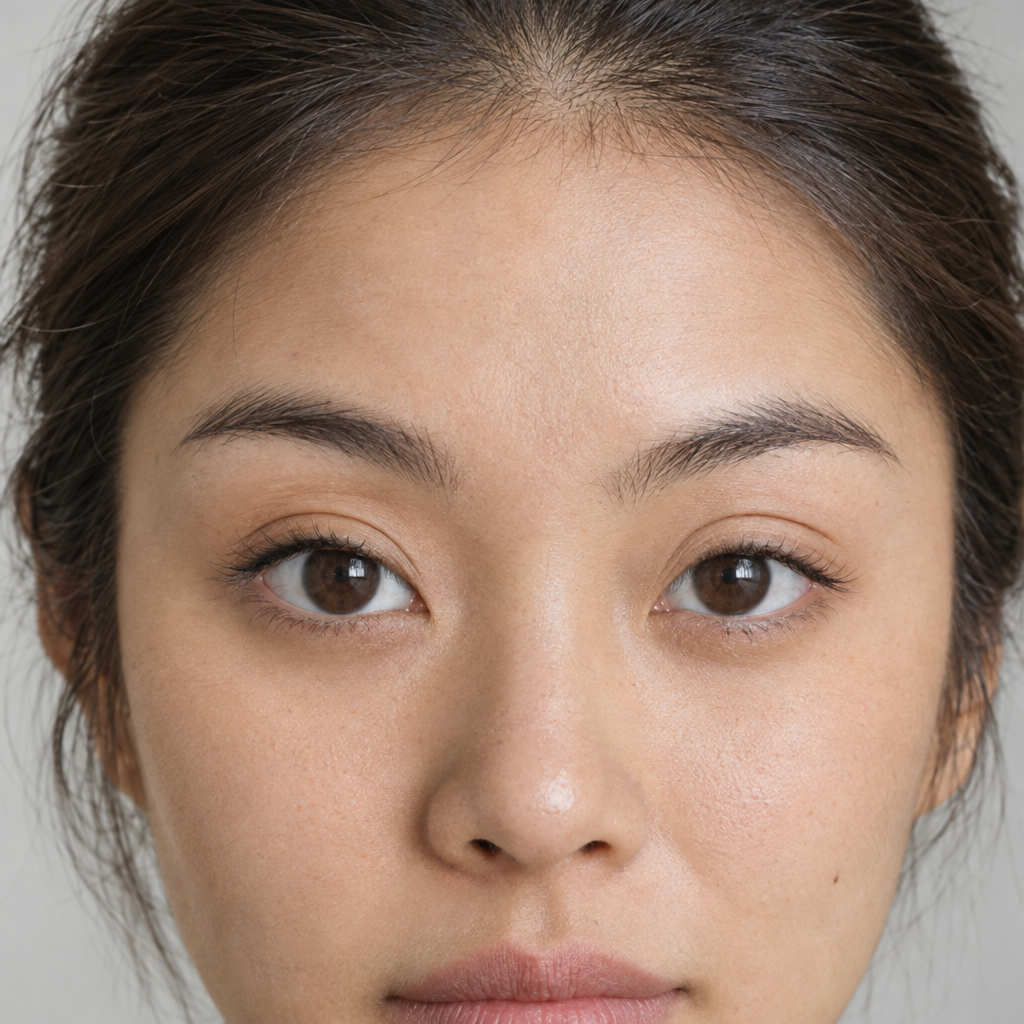
“Double eyelid” describes an upper eyelid with a crease, not two eyelids or two layers of skin. The crease relates partly to connections between the skin and underlying structures involved in lifting the upper lid. These include the levator aponeurosis, a tendon-like extension of the muscle that raises the eyelid.
Those connections, together with the distribution of skin and underlying tissue, influence how the lid folds. Crease height, length, depth, and visibility vary between people and between a person’s two eyes.
Although the term is especially common in East Asian beauty discussions, visible upper-eyelid creases occur across populations. A crease pattern alone cannot reliably identify someone’s ethnicity or ancestry.
Double eyelids, monolids, and hooding are descriptions, not rankings of attractiveness. The presence or absence of a crease alone also does not tell you how well an eye functions.
Eyelid creases are also different from canthal tilt, which describes the relative position of the inner and outer eye corners. Facefy’s Canthal Tilt tool can help you explore this separate appearance feature without treating either characteristic as a measure of attractiveness or eye health.
Double eyelids, monolids, hooding, and epicanthal folds are different features
The useful distinction is where the fold sits and what it covers, rather than whether the eye appears “more open” in a particular photograph.
Double eyelids
- What and where: A crease above the upper lash line, visible to some degree with the eyes open.
- Can coexist with: Hooding, an epicanthal fold, or both.
- Common confusion: Assuming a double eyelid must show a broad, uninterrupted strip of lid. A low crease may leave very little visible space.
Monolids
- What and where: No clearly visible upper-eyelid crease when the eyes are open. Lines may still appear when the lid closes.
- Can coexist with: An epicanthal fold and varying amounts of overlying upper-lid skin.
- Common confusion: Calling any concealed crease a monolid. An existing crease may instead be hidden by hooding.
Hooded eyelids
- What and where: Upper-lid skin folds over part of the crease or the mobile lid, the area between the lashes and crease.
- Can coexist with: A visible upper-eyelid crease and an epicanthal fold.
- Common confusion: Treating hooding as proof that no crease exists. Hooding describes coverage, not crease absence.
Epicanthal folds
- What and where: A skin fold near the inner eye corner that can cover part of that corner.
- Can coexist with: Double eyelids, monolids, and hooding.
- Common confusion: Using “epicanthal fold” and “monolid” interchangeably. They describe different locations and features.
The coexistence rule: A person can have a visible upper-eyelid crease and still have hooding, an epicanthal fold, or both.
Crease type is also separate from broader eye shape and eye position. For example, the outline of the eye opening and how deeply the eye sits beneath the brow are not determined by whether an upper-lid crease is visible.
Five common double-eyelid crease patterns
These labels describe visible presentations. They are not diagnoses, fixed categories, or beauty rankings.
| Crease pattern | Main visible cue |
|---|---|
| Tapered | Narrows toward the inner corner |
| Parallel | More consistent separation from the lash line |
| Partial or incomplete | Visible along only part of the lid |
| Multiple | Two or more fold lines |
| Asymmetrical | Creases differ between the two eyes |
Tapered crease
A tapered crease approaches the lash line near the inner corner and becomes more distinct toward the outer eye. The inner portion may merge visually with a nearby skin fold.
Look at the direction of the crease, not just how much lid is showing. A tapered crease can be subtle or pronounced.
Parallel crease
A parallel crease follows the upper lash line with relatively consistent separation across much of the lid. “Parallel” is an approximate visual description, not a requirement for mathematically equal spacing.
The crease may remain distinct near the inner corner, although skin folds can affect how clearly that portion is visible.
Partial or incomplete crease
A partial crease appears along only part of the eyelid or fades before reaching one corner. It may be clearer in the middle or outer portion of the lid.
An incomplete-looking crease in one photograph may also reflect lighting or coverage by overlying skin.
Multiple creases
Two or more fold lines may appear above the lashes. They may be consistently visible or become more noticeable under particular conditions, such as changes in puffiness or expression.
Several fine lines on a closed lid do not necessarily mean several distinct creases will remain visible when the eye opens.
Asymmetrical creases
The two eyes may differ in crease height, shape, continuity, or visibility. One might have a tapered crease while the other has a partial crease.
Long-standing differences can be ordinary variation. A new, sudden difference deserves separate attention, particularly if the lid position or eye comfort has also changed. If you’re curious about visible facial asymmetry, Facefy’s Symmetry Checker offers an appearance-based way to explore differences between the two sides of your face. It cannot determine the anatomical cause of asymmetrical eyelid creases or assess a new eyelid change medically.
A simple way to observe your upper-eyelid crease
You can check the visible fold with a mirror alone. Look once with your forehead relaxed and your eyes open, then gently close your eyes to see where the lid naturally folds. A short phone recording is optional if you want to compare the two views without holding an expression.
- Choose soft, even frontal light. Face a window without direct sunlight or use diffuse indoor lighting. Remove makeup or anything obscuring the lid if comfortable, without scrubbing or pulling.
- View one: look straight ahead. Relax your forehead and eyebrows. Notice whether a fold remains visible above the lashes and whether upper-lid skin covers any part of it.
- View two: gently close your eyes. Look for where the skin naturally folds or where a line lies. Do not squeeze, stretch, press, or tape the lid.
- Compare the views. A line visible with the eye closed may become partly concealed when it opens. Closed-lid lines alone do not establish an open-eye crease pattern.
If you use a phone, keep it at eye level in steady frontal light. Record only a few seconds while looking forward and gently closing your eyes. The recording is a visual reference, not a diagnostic test.
Use these decision points:
- A crease remains visible with relaxed, open eyes: This fits the usual description of double eyelids.
- A crease appears present but is covered by skin: Hooding may explain the limited visibility.
- No crease is clearly visible when open: The appearance may fit a monolid, but shadows or overlying skin can make it difficult to distinguish.
- The eyelids are swollen, irritated, or unusually dry: Wait until they settle and look on another day rather than inspecting repeatedly. Seek care if symptoms persist or are concerning.
A mirror or photo can show visible features, but it cannot determine the medical cause of a new change. Camera angle, lighting, makeup, and expression can all alter what you see.
Why an eyelid crease can look different over time or in photos
It helps to separate changes in the image from changes in the eyelid itself.
1. Photo or expression effects
These can alter apparent crease visibility without establishing an anatomical change:
- Raised eyebrows: Lifting the brows can expose more lid and make a crease easier to see.
- Directional lighting: Overhead or side lighting can deepen shadows, while frontal light may make the same fold look shallower.
- Camera angle: A camera above or below eye level changes which lid surfaces are visible.
- Smiling or squinting: Both can change the eye opening and the way surrounding skin folds.
If two pictures look different, first compare the brow position, gaze, and lighting rather than assuming the crease has changed.
2. Temporary physical changes
Short-lived changes in the skin or surrounding tissue can affect the fold:
- Morning puffiness or fluid retention: Swelling may obscure a crease or alter where the skin folds.
- Irritation or rubbing: These may make the lid look swollen or uneven.
- Makeup or adhesive residue: Product can emphasize a line or temporarily affect how the skin sits.
Fatigue or lack of sleep may coincide with puffiness and expression changes. That does not mean they create a permanent anatomical crease.
3. Persistent or sudden changes
These need a different response from an inconsistent photograph:
- Gradual changes over years: Age-related shifts in skin elasticity and tissue distribution can change how much crease is visible without necessarily changing the basic outline of the eye opening.
- A newly persistent crease difference: If one lid remains notably different from its usual appearance, a clinician can assess it.
- Sudden drooping: Do not treat a new change in lid position as merely a crease variation.
- Changes after an injury or difficulty closing an eye: These need professional assessment rather than comparison with reference photos.
The two eyes may naturally differ in tissue attachments, skin distribution, and hooding. However, you cannot identify those underlying differences reliably from a photograph alone.
Eyelid tape, glue, and cosmetic procedures have different limits
There is no need to change a natural eyelid crease. For anyone considering cosmetic alteration, the important distinction is between temporarily positioning the skin and undergoing a procedure that changes tissue attachments.
Eyelid tape or glue
- Purpose: Temporarily positions the skin to create or emphasize a fold.
- Duration: Temporary. Repeated use cannot be assumed to produce a lasting anatomical crease.
- Key limitation: The effect depends on the product, skin, and lid movement; it may be visible or uncomfortable.
- Main safety consideration: Adhesives can cause redness, irritation, or skin sensitivity. Avoid irritated or injured skin, stop if a reaction occurs, and remove the product gently according to its instructions.
Non-incisional, suture-based procedures
- Purpose: Uses sutures to create or reinforce a crease, generally without a full-length incision.
- Duration: Potentially longer-lasting than adhesives, but the fold may change or become less defined.
- Key limitation: Suitability and results vary with individual anatomy. “Non-incisional” does not mean non-surgical or risk-free.
- Main safety consideration: Risks include infection, suture-related irritation, uneven results, and other eyelid complications.
Incisional surgery
- Purpose: Creates or changes a crease through an incision and tissue adjustment.
- Duration: Intended to be longer-lasting, although healing and aging can alter the result.
- Key limitation: It involves recovery and scarring, and the outcome may not match expectations.
- Main safety consideration: Risks include infection, uneven creases, scarring, dry-eye symptoms, and difficulty closing the eye.
Risks differ by technique and individual circumstances. The American Academy of Ophthalmology provides general information about eyelid surgery, potential complications, and recovery considerations.
Anyone considering a procedure should consult an appropriately qualified ophthalmologist, oculoplastic surgeon, or relevant licensed specialist. Ask about expected healing, individual risks, and what happens if the result changes or affects eye comfort. Photos alone cannot establish which method, if any, is suitable.
When an eyelid change needs medical assessment
Medical safety
Seek prompt professional assessment for sudden eyelid drooping, eye or eyelid pain, vision changes, facial weakness, a recent eye or facial injury, or inability to close an eye fully.
Use urgent or emergency medical services if symptoms are severe, rapidly worsening, or accompanied by sudden visual or neurological symptoms, such as difficulty speaking or new limb weakness.
A photograph or appearance-analysis tool cannot determine the cause of these symptoms.
A long-standing crease difference without symptoms is different from a newly drooping lid. The timing of the change and any accompanying symptoms matter more than which cosmetic label seems to fit.
Common questions about double eyelids
Can hooded eyes also have double eyelids?
Yes. Hooding can partly cover an upper-eyelid crease that is still present. A person may have a visible crease toward the outer lid while the inner portion is covered.
Is an epicanthal fold the same as a monolid?
No. An epicanthal fold sits near the inner eye corner. “Monolid” describes the absence of a clearly visible upper-eyelid crease with the eye open. Either feature can occur without the other.
Why might one eyelid look double while the other looks like a monolid?
Natural differences between the lids, unequal hooding, puffiness, expression, and lighting can affect crease visibility. If the difference is new and persistent, or comes with discomfort or a change in lid position, seek professional advice rather than judging it from appearance alone.
Can a double eyelid appear or disappear?
Its visibility can shift temporarily with puffiness or expression, or gradually as the surrounding skin changes. A crease becoming less visible does not necessarily mean the underlying fold has disappeared. A sudden, persistent change should not be explained from photographs alone.
Do eyelid tape and glue create permanent double eyelids?
They temporarily reposition the skin and cannot be relied on to create a permanent crease. If they cause irritation or discomfort, stop using them. A natural crease does not need to be made deeper, more visible, or identical on both sides.