Dark Brown Hair vs Black Hair: How to Tell the Difference
Compare dark brown and black hair in daylight, understand hair levels and dye labels, and assess color commitment before choosing a shade.
Dark brown hair usually reveals a visible brown base in indirect daylight, while black hair keeps a deeper overall appearance, even when it shows warm, neutral, or blue reflections. The main difference is depth, not the color of a shiny highlight. Check clean, dry roots against a neutral background rather than relying on direct sun, flash, or a shade name.
Hair charts commonly place black at level 1, darkest brown at level 2, and dark brown at level 3. Those numbers are useful references, but brands and salons can label depths differently. If you are choosing a dye rather than identifying your natural color, consider both the appearance you want and how easily you may want to change it later.
Dark Brown Hair vs Black Hair at a Glance
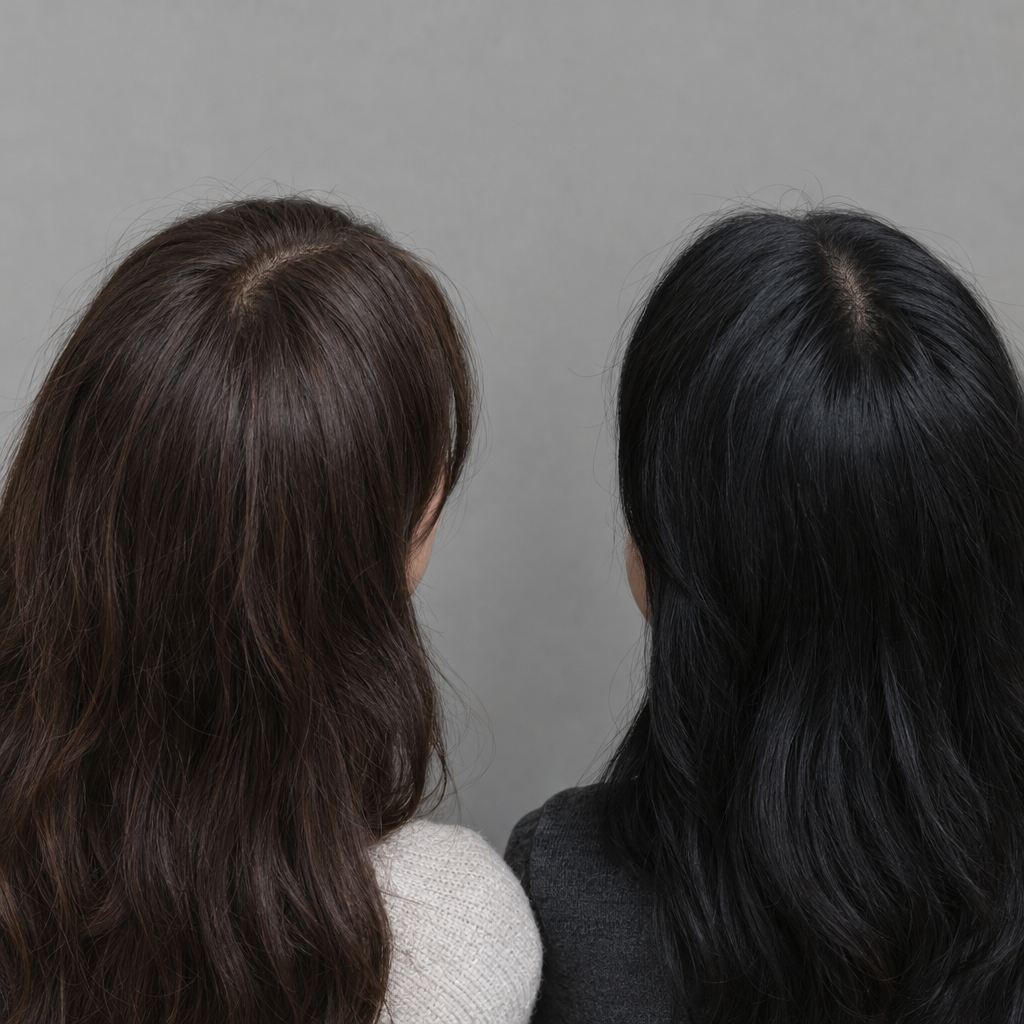
Compare both colors under the same lighting and with similar surface shine. Dark brown can look black in a dim room, while black hair can show brown-looking reflections in bright light.
| Criterion | Dark brown | Black |
|---|---|---|
| Base depth | Deep, but visibly brown under suitable lighting | Deepest overall appearance |
| Indirect daylight | Brown base is often visible between the brightest highlights | Base generally remains very deep, even when the surface shows warm or cool reflections |
| Low-light appearance | May appear black; dim lighting is not a reliable way to distinguish it | Usually continues to appear black, but low light still reveals little about exact depth |
| Typical chart position | Often level 3, with darkest brown commonly placed at level 2 | Often level 1 |
| Visible regrowth contrast after dyeing | Natural level-3 roots generally contrast less with a matching level-3 brown than with level-1 black on the same chart. Gray or much lighter roots can contrast with either shade. | Level-1 black can create a stronger line against natural level-3 roots. Gray or much lighter roots may also remain noticeable against black. |
| Future lightening after permanent dye | With comparable permanent formulas and application histories, permanent dark brown is generally less difficult to lighten than permanent black, but it can still require correction. | With comparable permanent formulas and application histories, permanent black generally deposits more artificial dark pigment and can be harder to lighten evenly. |
The last two rows apply to colored hair rather than natural color alone. Formula, repeated applications, hair condition, and the intended target shade can matter more than the brown-versus-black label. Identifying a natural depth is also a different task from removing artificial pigment.
Depth and Reflection Are Two Different Color Traits
Depth describes how light or dark the hair looks overall. Reflection describes the color you notice when light catches it. When choosing between dark brown and black hair, you can also consider how each shade looks alongside your natural coloring. Facefy’s Color Analysis can help you explore color combinations as a personal styling reference, although it cannot determine your natural hair depth or guarantee that a particular shade will suit you.
For example:
- A black base may show blue, neutral, red, or other warm reflections.
- A dark brown base may show chocolate, ash, red, or golden reflections.
An ash-brown shade does not become black because it looks cool. Similarly, a warm gleam does not automatically make black hair brown.
Look at the body of the color between the brightest highlights. If brown remains visible across that area in indirect daylight, the hair is more likely to sit in the darkest-brown or dark-brown range. If only a glossy streak looks brown while the surrounding hair stays extremely deep, that streak alone is not enough to classify it.
Shine can make reflections more conspicuous without showing the underlying depth clearly.
A Three-Step Check for Black or Very Dark Brown Hair
Use this check to estimate your natural depth or describe your current color more clearly.
- Inspect clean, dry roots in indirect daylight. Stand near a window, out of direct sun. If you color your hair, look at untreated regrowth rather than dyed lengths. Roots that have also been dyed cannot reveal your natural shade.
- Place the hair against a matte white or neutral gray background. A plain card behind a small section helps reduce interference from bright clothing, walls, or patterned surroundings. Avoid glossy backgrounds.
- Look for a brown base away from glare. Examine the root area between shiny highlights. A consistently visible brown base suggests darkest brown or dark brown. Hair that remains extremely deep, without a clearly visible brown base, may be described as black.
Direct sun and flash are unsuitable for the final judgment. Both can exaggerate highlights and reflections. Very dim lighting is also unhelpful because it can conceal the distinction entirely.
Treat the result as approximate near the boundary. “Very dark brown that looks black indoors” may be a more useful description than forcing a single label.
What Hair Levels and Shade Names Actually Mean
Many professional color charts use this starting reference:
- Level 1: Black.
- Level 2: Darkest brown.
- Level 3: Dark brown.
Brands, product lines, and professional systems can assign or name these levels differently. A number is most useful when you and your colorist are looking at the same chart.
Natural color descriptions also differ from manufactured shade names. “Natural black” on a package describes a formula, not a promise that it will match your untreated hair. “Blue-black” suggests a cool reflection, but its exact depth and intensity depend on the product.
Soft black, espresso, and darkest brown are insufficient descriptions on their own. Soft black and espresso are not standardized categories, and even familiar depth labels vary across ranges.
Compare the brand’s own swatches and instructions. Do not assume that two products with the same name, or even the same level number, will give identical results on your hair.
Why Very Dark Hair Looks Different Across Roots, Lengths, and Photos
Different parts of your hair can reasonably look like different shades. For identifying natural depth, the most useful comparison is usually clean, dry, untreated regrowth in indirect daylight.
Here is how to interpret common exceptions:
- Dyed lengths with natural roots: The roots show your current natural color; the lengths show the effects of previous formulas and fading. Assess them separately rather than averaging them.
- Sun-faded ends: Older lengths may look lighter or warmer than newer growth. Brown-looking ends do not necessarily mean your natural root color is brown.
- Gray-containing hair: Compare visible pigmented, undyed growth when available. Gray strands and dyed lengths are not reliable indicators of the original brown-or-black depth. If no pigmented, uncolored growth is visible, this check cannot establish the person’s original natural depth.
- Wet hair: Hair usually looks darker when wet. Wait until it is fully dry before comparing depth.
- High shine: Bright reflected streaks can obscure the base. Examine the areas beside those streaks rather than using the brightest section as your reference.
- Phone-camera processing: Automatic exposure and white balance can alter apparent depth and warmth. Filters, editing, flash, and screen settings add further variation.
- Indoor lighting and nearby colors: A dim room can make dark brown appear black. Warm bulbs or strongly colored surroundings can give black hair a brown-looking cast.
Texture and strand direction also change how light reflects from the surface. A smooth section and a loosely curled section of the same hair may photograph differently. Different hairstyles can also change how dark hair appears by affecting volume, strand direction, and the way light reflects across the surface. Facefy’s Hair Style Try-On lets you explore different hairstyle appearances using a photo, but the preview should not be treated as an accurate measurement of hair color or depth.
Uneven fading or a difference between roots and lengths does not, by itself, indicate a problem. It often reflects different color histories and exposure.
What to Consider Before Coloring Hair Black or Dark Brown
Separate two questions: Do I like this appearance? and What will this formula do on my current hair?
Your starting depth, previous dye, gray coverage, and porosity can affect the outcome. Porosity describes how readily hair takes up and loses moisture and color. More porous areas may take color differently from less processed roots.
A digital preview can help with appearance preference, but it cannot predict the precise chemical result or whether the color will develop evenly.
Before choosing permanent black, ask these three questions
- Do I expect to go lighter soon? If so, discuss a less committing route with a colorist. Permanent black can be difficult to lighten evenly, especially when the intended next shade is substantially lighter.
- Is there previous dye through the lengths? Repeated applications can create pigment buildup. Tell your colorist about all earlier dark dye applications, even if the color has faded or is no longer obvious.
- Do I want subtle regrowth? Compare the proposed shade with your natural roots, including any gray strands. The greater the difference in depth, the more noticeable new growth is likely to be.
Dark brown is not automatically easy to remove, and a nonpermanent label does not guarantee complete washout. Formula, hair condition, accumulated pigment, and color history all matter.
For substantial lightening or color correction, arrange a professional consultation rather than assuming a lighter box dye will remove existing dark pigment.
Follow the product’s allergy-alert testing directions before each application, including its specified timing. Perform a strand test where directed. These tests serve different purposes: an allergy-alert test addresses possible reactions, while a strand test helps assess the likely color result and how the hair responds.
How to Describe the Exact Color You Want
Use a three-part formula for your color request:
- Approximate depth: For example, level 2 to 3 on the colorist’s chart.
- Desired reflection: Neutral, softly warm, ash, or a distinct blue reflection.
- Two unedited reference images: One in indirect daylight and one in ordinary indoor lighting, ideally showing the same desired color.
A useful request might sound like this:
“I want a level 2 to 3 depth with a neutral or softly warm reflection. It can look nearly black indoors, but I want a brown base visible in daylight.”
For a deeper result:
“I want it to read as black in indirect daylight, without a strong blue reflection. How would that work with the color already in my lengths?”
Choose references with a similar starting depth or color history when possible. Explain whether your priority is a nearly black result, a clearly visible brown base, or a particular reflection. That gives a colorist more useful information than “espresso” alone.
Once you understand the commitment, Facefy’s Hair Color Try-On can help you compare black and dark brown appearances from a photo. Use an evenly lit, unfiltered image with dry hair, neutral clothing, and your usual minimal makeup. Compare nearby depths first, then warmer or cooler variations, rather than changing everything at once.
Treat the preview as a way to communicate your preference, not as a guaranteed dye outcome. Lighting, image quality, and screen settings can all affect the comparison.