Curly Hairstyles: Cuts, Styling Methods, Upkeep, and Salon Tips
Compare curly hairstyles by length, density, shrinkage, volume, and upkeep, with practical styling and salon guidance.
The best curly hairstyles work with your hair’s dry length, density, shrinkage, natural volume, and styling routine. Curly pixies and rounded bobs create shorter silhouettes, layered lobs and shags redistribute fullness, and long layers retain length while adding movement. Twist-outs, half-up curls, puffs, and loose buns offer temporary changes without committing to a cut.
Curl-pattern labels can help describe your hair, but they cannot predict how a hairstyle will behave by themselves. Start with how your hair normally dries, where you want fullness, and how much styling and refreshing you enjoy.
Start with five factors that shape your curly hairstyle
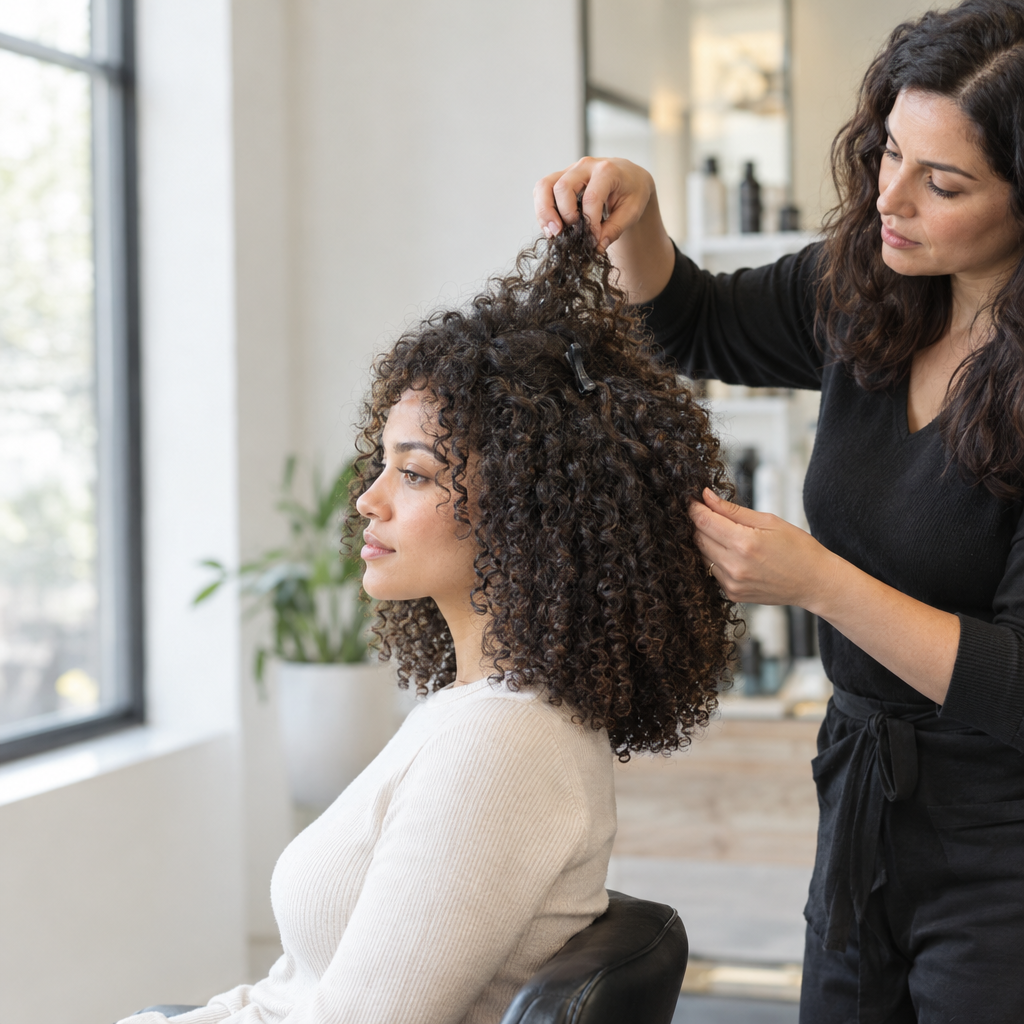
Assess your hair when it is dry and styled as you normally wear it.
- Current dry length: Note where the front, sides, and back rest, using landmarks such as the eyebrows, cheekbones, jawline, shoulders, collarbone, or upper back.
- Density at the scalp: Gently part your hair in several places under ordinary lighting. Describe the overall density as lower, medium, or higher rather than trying to calculate it precisely.
- Approximate shrinkage: Compare where a dry curl rests with where the same section reaches when gently extended. Check the front, crown, and nape because they may behave differently.
- Preferred volume placement: Decide whether you want fullness at the roots, crown, sides, ends, or evenly around the head.
- Available styling time: Consider initial setup, drying time, and ongoing refresh work separately. A style with a short setup may still dry slowly, while a detailed set may need little attention afterward.
Strand thickness is different from density. Fine strands can become weighed down by rich products even when the hair is dense. Coarser strands may respond differently to product hold and section size, but thickness alone does not determine which routine will work.
Wavy hair may lose its grouping when heavily coated. Curly hair may have flatter roots and springier ends. Coily hair may show substantial shrinkage and benefit from section-by-section styling. These are possibilities, not fixed rules, and several behaviors can coexist on one head.
A practical starting brief might be: “My hair dries near my shoulders, has higher density, and shrinks noticeably at the front. I want crown volume, enough dry length to gather it loosely, and no more than a short morning refresh.”
Face shape can be an optional preference within this assessment. You may enjoy height at the crown, fullness beside the jaw, or curls falling around the cheekbones, but no face outline requires a particular hairstyle. Hair behavior, comfort, density, shrinkage, and maintenance usually provide more practical guidance.
Know whether you are choosing a cut, arrangement, or curl set
These categories solve different problems. They can be combined, but they are not interchangeable.
| Category | What changes | Examples |
|---|---|---|
| Haircuts | Lasting length, weight, and shape | Pixie, bob, layers |
| Everyday arrangements | Where existing hair sits | Half-up style, puff, bun |
| Curl-setting methods | Temporary grouping or pattern | Wash-and-go, twist-out, coils |
| Protective or low-manipulation styles | Handling and containment | Loose tucked updo |
Haircuts change the perimeter, layers, weight distribution, and silhouette. The perimeter is the visible outer edge where the hair ends.
Everyday arrangements reposition existing hair. A puff gathers curls but does not create them.
Curl-setting methods influence the temporary finish. A wash-and-go encourages the existing pattern through product application and drying. Twist-outs and braid-outs form a temporary pattern through setting and takedown. Shingling controls curl grouping, while finger coiling provides more individual control by shaping selected sections.
Protective or low-manipulation styles aim to reduce daily handling, sometimes by tucking away the ends. Their usefulness depends on tension, installation, wear time, and scalp comfort. A style is not protective simply because it is an updo.
Loosen or remove anything that causes pain, persistent pulling, or scalp irritation.
Compare curly hairstyles by volume, setup, and upkeep
Use this table to create an initial shortlist. Setup describes the work required to create the style. Ongoing upkeep covers refreshing and preservation after that initial work.
| Option | Main volume or finish | Initial setup | Ongoing upkeep |
|---|---|---|---|
| Curly pixie | Compact, top-focused texture | Moderate | Moderate, with targeted resets |
| Tapered crop | Fuller top with shorter sides | Moderate | Moderate to higher if contrast must stay sharp |
| Rounded bob | Curved outline with side fullness | Moderate | Moderate, especially at the perimeter |
| Layered lob | Distributed volume and movement | Moderate | Moderate |
| Curly shag | Crown volume and airy layers | Moderate to higher | Moderate to higher |
| Long layers | Adjustable movement with retained length | Moderate | Moderate |
| Wash-and-go | Natural pattern with adjustable definition | Variable | Low to moderate refresh work |
| Twist-out | Grouped, adjustable set | Higher | Moderate |
| Braid-out | Grouped and often more elongated | Higher | Moderate |
| Finger coils | Individually shaped sections | Higher | Low to moderate targeted refreshing |
| Half-up curls | Lifted crown with loose lower curls | Low | Low |
| High puff | Concentrated height and visible texture | Low to moderate | Low for daytime wear |
| Loose bun | Contained, compact finish | Low | Low |
| Low-tension updo | Contained hair with distributed hold | Variable | Low to moderate |
A cut does not guarantee definition. The same layered lob can appear soft and expanded or highly grouped depending on the products, sectioning, and drying method.
Compare wear and shrinkage before choosing
Here, shrinkage sensitivity means how strongly shrinkage can change the intended outline or arrangement. It does not predict how much your hair will shrink.
| Option | Typical preservation approach | Shrinkage sensitivity |
|---|---|---|
| Curly pixie | Cover loosely and reset selected curls | Moderate to high |
| Tapered crop | Protect the top without flattening it | Moderate |
| Rounded bob | Use loose sections without pulling up the nape | High at the perimeter |
| Layered lob | Loosely gather or divide into sections | High at shorter layers |
| Curly shag | Protect crown lift and avoid compression | High at upper layers |
| Long layers | Use loose sections or a comfortable pineapple | Moderate to high |
| Wash-and-go | Loosely gather or divide into sections | High |
| Twist-out | Cover or selectively retwist | Moderate to high |
| Braid-out | Cover or loosely rebraid selected areas | Moderate |
| Finger coils | Cover loosely and refresh individual coils | Moderate to high |
| Half-up curls | Release the fastening before sleep | Moderate |
| High puff | Release the band and preserve curls separately | High while gathering |
| Loose bun | Release or reset in a comfortable position | Moderate |
| Low-tension updo | Cover and check every fastening point | Variable |
Wear time varies with humidity, product choice, density, strand thickness, exercise, and sleep. A hairstyle becoming softer or fuller does not necessarily mean it has failed.
Three worked examples for building a shortlist
The most useful shortlist connects the self-check findings to practical tradeoffs rather than choosing by curl label alone.
Example 1: Higher density, strong shrinkage, and a preference for short sides
- Self-check: High density, substantial shrinkage around the front, natural lift at the crown, and willingness to refresh the top for a few minutes.
- Preferred option: Tapered curly crop, with enough dry length on top to show the curl pattern.
- Alternative: Curly pixie with less contrast between the sides and crown.
- Tradeoff: The tapered crop creates a clearer side-to-top difference, but that contrast needs more frequent reshaping. The pixie grows out more evenly but may have a less defined outline.
Example 2: Medium dry length, flatter roots, and a preference for movement
- Self-check: Shoulder-area dry length, medium density, flatter roots, springier ends, and comfort with diffusing or root clipping.
- Preferred option: Layered curly lob with moderate upper layering and retained density at the perimeter.
- Alternative: Curly shag with shorter crown layers.
- Tradeoff: The lob preserves more fullness at the ends and is easier to gather. The shag can create more crown movement, but short layers may shrink above the intended silhouette and require more regular refreshing.
Example 3: Long, dense hair with limited morning styling time
- Self-check: Long dry length, higher density, considerable drying time, and a preference for low morning maintenance.
- Preferred option: Shaped long layers combined with a loose nighttime arrangement.
- Alternative: A braid-out when a more elongated temporary finish is wanted.
- Tradeoff: Long layers retain the natural curl behavior and require less installation work, but wash-day drying may remain lengthy. A braid-out provides more control over grouping and elongation, but the initial setup and complete drying take longer.
Short curly hairstyles: shape, lift, and manageable length
Short hair reduces the amount of length to detangle and dry, but a precise silhouette may need regular reshaping.
Curly pixie: compact texture with an open neckline
Category: Haircut
- Best fit and effect: Works well when the hair has enough density through the top to maintain visible texture after the sides and back are shortened. A longer crown can create lift, while shorter edges expose the ears or neckline.
- Ongoing upkeep: Moderate. Reset flattened curls as needed and cover the hair loosely at night. Consider reshaping when the neckline loses its definition, the sides begin obscuring the intended outline, or the crown no longer sits in the preferred proportion.
- Limitation: Short front curls need enough shrinkage allowance to avoid finishing higher than intended. The overall silhouette can change quickly as the cut grows.
Tapered curly crop: shorter sides with more height
Category: Haircut
- Best fit and effect: Suits hair with enough density or natural lift on top to support a fuller crown. It is useful when you want close sides and a clear upward direction without removing the top texture.
- Ongoing upkeep: Moderate to higher. Refresh or lift the top without flattening it overnight. Reshape when the side-to-top contrast becomes indistinct, the edges grow beyond the preferred length, or the top becomes difficult to position.
- Limitation: A taper does not have to reach bare skin. Specify the shortest acceptable length and whether you want a soft or sharp transition.
Rounded curly bob: a fuller, curved outline
Category: Haircut
- Best fit and effect: Best suited to hair with enough density near the ends to support a substantial perimeter. It creates a curved silhouette with visible side volume rather than concentrating all fullness at the bottom.
- Ongoing upkeep: Moderate. Refresh uneven or compressed sections and preserve the nape without pulling it upward. Consider reshaping when the perimeter becomes bottom-heavy, the back loses its curve, or the sides settle outside the preferred outline.
- Limitation: Shrinkage can move the perimeter far above its wet position. Discuss where the dry edge should sit, such as below the jaw, rather than requesting only a wet cutting length.
Short finger coils: deliberate, separated definition
Category: Curl-setting method
- Best fit and effect: Useful for hair that holds a wet set and for anyone who wants control over the shape and direction of individual sections. It can be used across the whole head or only on inconsistent curls.
- Ongoing upkeep: Low to moderate after a higher initial setup. Cover the hair loosely and reshape only the coils that become compressed or separated.
- Limitation: A full-head set can take considerable time. Product, section size, and natural strand behavior affect how long the coils remain distinct.
Short half-up curls: move the front back without gathering everything
Category: Everyday arrangement
- Best fit and effect: Works when the front has enough dry gathering length to reach a small clip or soft fastening point, even if the nape remains too short. It opens the face while leaving curls visible at the sides and back.
- Ongoing upkeep: Low. Reposition loose front sections if needed and release the accessory before sleeping.
- Limitation: Avoid pulling short sections harder to make them reach. Gather a smaller area or use gentle pins instead.
Medium-length curly hairstyles: flexible layers and definition
Medium length can provide gathering options without all the weight of longer hair. Pay attention to where the ends sit dry, especially around the shoulders, where they may turn outward.
Layered curly lob: movement with a retained perimeter
Category: Haircut
- Best fit and effect: Works well when the hair has enough density to support layers without making the lower edge look sparse. It retains a shoulder- or collarbone-area perimeter while allowing movement through the sides.
- Ongoing upkeep: Moderate. Refresh compressed layers and preserve the hair in loose sections or a comfortable pineapple. Consider reshaping when the shortest layers settle outside the intended silhouette, the ends become uneven, or the cut begins forming excess weight near the shoulders.
- Limitation: Short layers can spring much higher than the perimeter. If fullness at the ends matters, ask the stylist to retain sufficient weight there.
Curly shag: crown volume and a lighter outline
Category: Haircut
- Best fit and effect: Best for hair with enough density to tolerate visible upper layering and reduced weight toward the ends. Natural root lift helps, although styling can support a flatter crown.
- Ongoing upkeep: Moderate to higher. Refresh the crown selectively and avoid compressing shorter upper layers overnight. Consider reshaping when the crown layers become too long to lift, the perimeter loses its airy quality, or the style becomes heavier at the sides.
- Limitation: Layers alone do not guarantee root volume. The reference image may depend on diffusing, selective definition, or daily lifting at the roots.
Wash-and-go: product-defined natural texture
Category: Curl-setting method
- Best fit and effect: Useful when you want to emphasize your existing pattern, from loose groups to tighter clumps, without twisting or braiding it into a different set. Section size and product distribution can be adjusted for different densities.
- Ongoing upkeep: Low to moderate after a variable setup. Preserve the hair loosely and refresh only compressed or fuzzy areas instead of automatically wetting the entire head.
- Limitation: The name does not mean washing and doing nothing. Detangling, product application, drying, and occasional refreshing can make it a substantial routine.
Twist-out: adjustable grouping and temporary elongation
Category: Curl-setting method
- Best fit and effect: Useful when you want a set pattern whose grouping can be adjusted through twist size and the amount of separation during takedown. Smaller sections increase setup time, especially on dense hair.
- Ongoing upkeep: Moderate after a higher initial setup. Cover the hair, divide it loosely, or retwist only sections that lose their grouping.
- Limitation: Unraveling damp twists can soften the pattern. Humidity and added water may also encourage the hair to return toward its natural texture.
Half-up curls: crown lift with visible length
Category: Everyday arrangement
- Best fit and effect: Works when the upper section has enough dry length to reach the fastening point without tension. It keeps hair away from the face while leaving the lower curls loose and visible.
- Ongoing upkeep: Low. Reposition the gathered section if it slips and release or loosen the accessory before sleeping.
- Limitation: Repeatedly fastening the same area tightly can become uncomfortable. Change the gathering point or use a smaller section instead of increasing tension.
Long curly hairstyles: length, weight, and comfortable containment
Long hair can create a more elongated silhouette, but density and shrinkage still determine how much visible volume it carries. Puffs and buns can also work on shorter hair when enough dry length reaches the fastening point.
Shaped long layers: movement without losing overall length
Category: Haircut
- Best fit and effect: Suitable when the hair has enough density to support weight removal without leaving the perimeter thinner than desired. Layer placement can add crown movement, side fullness, or lighter ends while retaining overall length.
- Ongoing upkeep: Moderate. Refresh the areas most affected by sleep and preserve the hair in loose sections or a comfortable pineapple. Consider reshaping when the layers merge into one heavy outline, the ends become visibly uneven, or the upper sections no longer create the intended movement.
- Limitation: Upper layers may dry far shorter than expected. Excessive thinning can weaken the visual fullness of the perimeter and make curl groups appear less substantial.
Braid-out: a stretched, grouped finish
Category: Curl-setting method
- Best fit and effect: Useful for creating a temporarily elongated wave or curl pattern. It can be especially practical when shrinkage makes visible length a priority, although dense sections may require extra drying time.
- Ongoing upkeep: Moderate after a higher initial setup. Cover the hair or loosely rebraid selected sections when the finish begins losing its grouping.
- Limitation: The result may look different from your natural curl pattern. A braid can remain damp inside even when the outer hair feels dry.
High puff: height with visible texture
Category: Everyday arrangement
- Best fit and effect: Works when enough dry length reaches a high fastening point comfortably. It concentrates volume toward the top while keeping the natural texture visible.
- Ongoing upkeep: Low for daytime wear. Adjust the band if it shifts, then release it before sleep and preserve the curls separately.
- Limitation: Tight bands and repeated placement can cause pulling. A puff does not need a completely smooth hairline to look intentional.
Loose curly bun: quick containment
Category: Everyday arrangement
- Best fit and effect: Useful when the hair has enough gathering length for a bun and detailed curl definition is not the priority. Dense or heavy hair may feel better in two smaller sections rather than one concentrated bun.
- Ongoing upkeep: Low. Reinsert loose pins if needed and take the bun down or reset it comfortably before sleep.
- Limitation: Fine or slippery hair may need gentle pins. A tight fastening can flatten the curls or concentrate too much weight in one area.
Low-tension updo: distribute the hold
Category: Protective or low-manipulation style
- Best fit and effect: Useful when reducing daily handling is the goal and the hair has enough length for loose twists, rolls, or tucked sections. Multiple fastening points can distribute the weight of dense or long hair.
- Ongoing upkeep: Low to moderate after a variable setup. Check pins, ties, and tucked sections each day, and reset anything that begins pulling or slipping.
- Limitation: An updo is not protective if it hurts or irritates the scalp. Tucked ends do not compensate for excessive tension elsewhere.
Six techniques that change definition, volume, or drying
Choose a technique for a specific problem rather than adding every method to your routine.
Plopping: support wet curl groups
Place wet hair gently into a soft cotton T-shirt or smooth microfiber towel. Lower the curls onto the fabric, bring the material around the head, and secure it without twisting the hair lengths tightly.
Plopping may help wavy or curly hair retain its groups while excess surface water is absorbed. It can be counterproductive if it compresses the roots, bends short sections awkwardly, or keeps dense hair damp for too long. Remove the wrap if the hair begins drying into an unwanted shape.
Diffusing: control drying and root lift
Start with low airflow and a low, comfortable heat setting. Hover the diffuser near the roots without pressing it against the scalp, then gently support the ends in the diffuser bowl if you want to encourage their shape. Increase the heat or airflow only if needed for practical drying, and stop if the air feels uncomfortably hot.
Diffusing can help when air-drying takes too long or when more root lift is wanted. Changing head position may alter where the roots settle. Strong airflow, frequent movement, and repeated touching can separate curl groups before they set.
Root clipping: lift selected flat areas
At a flat section near the crown or part, lift a small amount of damp hair away from the scalp. Slide a lightweight salon clip beneath or across the lifted roots so it supports them without pulling, crushing the curl, or lying flat against the scalp. Use only a few clips where lift is needed.
This can help hair that dries flat at the crown while curling more strongly through the ends. Too many clips can create dents, snag strands, or make the roots stand in conflicting directions. Remove each clip gently when the area is dry.
Shingling: encourage deliberate grouping
Apply a modest amount of styling product to a small section. Smooth the product along the section with your fingers, then separate it into curl groups that follow the hair’s natural movement.
Shingling can suit dense hair that is easier to style section by section or anyone who prefers a more controlled finish. It takes time and can feel heavy on fine strands. Start with less product and add more only where needed.
Finger coiling: shape individual sections
Smooth a small section and wrap it gently around a finger in the direction it follows comfortably. Release it without pulling the section straight.
Finger coiling provides direct control over the grouping and direction of individual curls. It can refine a few inconsistent areas or create a more uniform full-head set. It becomes less useful when it causes tangling, adds more manipulation than you want, or takes too much time. You do not need to coil every section to change the overall finish.
Gentle stretching: show more apparent length
Loose banding along sections or loose braiding can temporarily reduce compact shrinkage. Keep the hold relaxed, particularly at the roots, and remove it if the hair or scalp feels tight.
Stretching may help when visible length matters more than maximum spring. It can also soften definition or leave band marks. Excessive tension or uncomfortable heat works against a sustainable routine.
None of these techniques guarantees the same result across different densities, textures, products, climates, or styling habits.
Preserve and refresh curls according to the style
A nighttime method should support the hairstyle without creating tension.
- For a wash-and-go: Try a loose pineapple, meaning a loose gathering high on the head, if the hair reaches comfortably. Otherwise, divide it into two or more loose sections.
- For a twist-out: Cover the hair or selectively retwist areas that lose their grouping. Retwisting every section nightly is optional.
- For a braid-out: Loose rebraiding may preserve elongation, but it can also create a different pattern from the original set.
- For finger coils: Cover the hair loosely and reshape individual coils rather than resetting the entire head.
- For a puff: Release the band before sleeping and preserve the curls without keeping the daytime tension in place.
- For an updo: Check each fastening point. Reset or remove anything that pulls, presses, or irritates the scalp.
Satin or silk bonnets, scarves, and pillowcases can reduce friction. Their effect varies, and a tight bonnet edge may be less comfortable than a smooth pillowcase.
For refreshing, start with the smallest area that needs attention. Lightly dampen a flattened curl or apply a small amount of the original styling product. Avoid saturating the entire head automatically.
Water may revive natural curl groups but soften a twist-out or braid-out. Repeated product layering can also leave the hair coated or less responsive. If each refresh makes the finish heavier, adding more product may not be the answer.
Humidity, exercise, sleep movement, and natural shrinkage can change volume and definition between washes. A softer second-day finish is not necessarily a failed hairstyle.
Compare reference photos before expecting the same result
Save reference photos for their shape, then identify what creates that shape.
- Dry length: Does the hair end at the same landmark you want, or are you comparing your stretched length with someone else’s finished curls?
- Density: Is there similar fullness around the part, sides, and perimeter? Curl labels alone do not reveal how much hair creates the outline.
- Curl behavior: Compare root lift, shrinkage, curl-group size, and how strongly the ends spring upward.
- Volume placement: Is the fullness at the crown, cheekbones, jaw, or ends? Identify the part you actually want to reproduce.
- Added hair or supports: Extensions, padding, or concealed fastenings may contribute. Ask what would be required to produce a similar silhouette on your hair.
- Finishing work: Consider whether the image depends on detailed finger coiling, heat styling, extensive product application, or professional separation and shaping.
- Photo conditions: Camera angle, lighting, cropping, and editing can change apparent fullness and length. A still image also cannot show movement or humidity response.
A digital hairstyle preview is a visual approximation, not an exact prediction of shrinkage, density, or curl movement. Use it to compare broad silhouettes, dry endpoints, and volume placement rather than expecting every curl to match.
How to describe your curly hairstyle to a stylist
Bring two or three references showing a comparable dry length, density, and curl behavior. Include a side or back view when possible, and explain which detail you like in each image.
Discuss these choices separately:
- Dry length: Use landmarks such as the eyebrows, cheekbones, jawline, shoulders, collarbone, or upper back.
- Perimeter: Choose rounded, squared, tapered, or softly irregular.
- Layers: State where the shortest visible layers should settle when dry.
- Volume: Identify where you want more fullness and where you prefer less.
- Parting: Explain whether you wear one part consistently or switch it.
- Routine: Describe your usual shrinkage, drying method, gathering habits, and willingness to define individual curls.
- Gathering needs: Mention whether the front and nape must reach a loose tie, since that requirement can affect layer placement.
You can use this script:
“I want the finished dry length to sit near ____. I prefer a ____ perimeter, with layers beginning near ____ when dry. I want more volume at ____ and less at ____. I usually part my hair ____, and my hair shrinks from ____ to ____. I normally style it by ____. Please tell me if this reference depends on daily definition, extensions, or heat styling.”
Neither wet cutting nor dry cutting is universally superior. A more useful question is: “How will you account for where my curls settle when I wear them normally?”
If you have completed the five-factor self-check but still want ideas to narrow down, Facefy’s Hairstyle Finder offers another starting point for hairstyle inspiration. Compare any suggestions against your dry length and routine, then discuss the achievable shape with your stylist.
Common questions about curly hairstyles
How often does a curly haircut need reshaping?
There is no fixed schedule. Watch the silhouette rather than the calendar. A cut may be ready for reshaping when the side-to-top contrast disappears, the perimeter becomes uneven, crown layers stop lifting, or the hair no longer falls into the intended outline after normal styling.
Short, highly structured cuts usually show growth sooner than long layers. Your preferred level of precision also matters. Someone comfortable with a softer grow-out may wait longer than someone maintaining a sharp taper or compact pixie.
Can a curly hairstyle be previewed exactly before cutting?
No. A reference photo or digital preview cannot fully predict movement, shrinkage, product response, or behavior in humidity. Use previews to compare dry length, perimeter shape, and volume placement. Those concrete decisions provide a more useful target than trying to reproduce every curl in a photograph.