Blunt Cut Guide: Lengths, Textures, Salon Tips, and Upkeep
Learn what defines a blunt cut, how texture and length affect it, what to request at the salon, and how to style and maintain it.
A blunt cut has a strong, mostly even perimeter with little or no visible layering. It can sit at the jaw, shoulders, collarbone, or farther down the back. By keeping more hair at the edge, the cut can make sparse-looking ends appear fuller. It does not change strand thickness or hair growth.
The right version depends on dry length, natural texture, density, growth patterns, and how much styling you want to do.
What makes a haircut blunt?
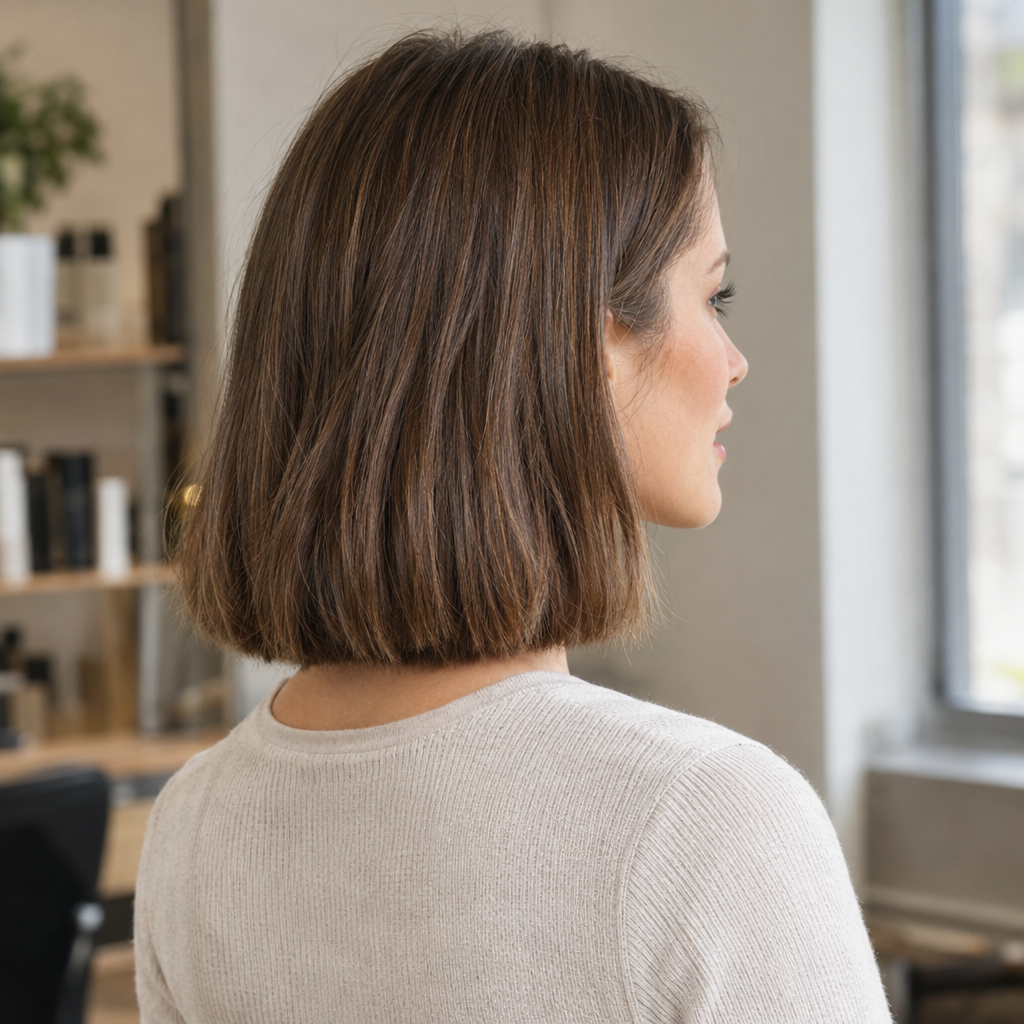
The defining feature is the perimeter, meaning the visible outer edge where the hair ends. A blunt perimeter looks continuous and substantial rather than feathered or tapered.
Three details create the effect:
- A clear baseline: The ends form a recognizable outer line.
- Fullness at the edge: Enough hair reaches the perimeter to make it look solid.
- Limited visible layering: Internal adjustments may exist, but they do not dominate the silhouette.
A stylist may use one-length construction, with minimal elevation away from the hair’s natural fall. However, discreet shaping underneath can reduce bulk while preserving the blunt exterior.
Texture affects how the line appears. Straight hair can show a sharp edge, waves soften it, curls create a rounded outline, and coils produce a compact, sculptural silhouette. The perimeter does not need to look ruler-straight to be blunt.
Blunt cut, bob, long bob, and one-length cut are different
A blunt cut is not automatically a bob. The terms describe different aspects of a haircut.
| Term | What it describes | Can it have a blunt edge? |
|---|---|---|
| Blunt perimeter | A strong, continuous outer edge | Yes, by definition |
| One-length cut | A construction method in which lengths meet at a common perimeter | Usually |
| Bob | A shorter length category, generally ending above the shoulders | Yes |
| Long bob | A longer variation around the shoulders or collarbone | Yes |
| Graduated cut | Shorter sections underneath with longer hair above | Yes, with built-up weight |
Layering distributes different lengths through the shape. Graduation builds weight through progressively longer sections. A cut can contain discreet internal layers and still look blunt at the bottom.
How length changes the finished shape
Choose a dry-length landmark rather than requesting only a short or medium cut.
- Jaw or chin: Creates a compact, prominent line. Natural parting and front growth direction become especially noticeable.
- Around the shoulders: Keeps a substantial edge, but contact with clothing can push the ends outward.
- At the collarbone: Provides more tying-back flexibility while retaining a defined perimeter.
- Below the shoulders: Creates a dense lower edge if enough hair reaches the selected length. Moving the perimeter slightly higher can help if the longest ends look transparent.
For curls and coils, the requested landmark should describe where the hair will sit when dry rather than where it reaches while wet or stretched.
Check how your hair falls before choosing a length
Use this simple assessment before collecting reference photos:
- Let clean, dry hair settle in your usual part.
- Leave it untucked so the front falls naturally.
- Stand against a contrasting background to see the end density clearly.
- Check the front, sides, and back.
- Note shrinkage, shoulder contact, and sections that spring higher than others.
- Look for an upward-growing neckline or cowlick that could interrupt a very short baseline.
- Consider how often you air-dry, blow-dry, straighten, or wear your hair tied back.
If you are comparing several silhouettes, Facefy’s Hairstyle Finder can help you explore hairstyle options. Treat a preview as visual direction rather than a prediction of exact texture, movement, or density.
Blunt cuts by texture and density
Density describes how many strands grow across the scalp. Strand thickness describes the diameter of each strand. Fine hair can still have high density, so the terms are not interchangeable.
| Hair characteristics | Likely appearance | Optional salon adjustment |
|---|---|---|
| Low-density straight hair | Crisp edge with a fuller-looking baseline | Preserve perimeter weight and avoid extensive thinning |
| Low-density wavy hair | Softer edge with natural variation between bends | Refine the perimeter dry without stretching the waves |
| Low-density curly or coily hair | Light, rounded, or compact outline | Allow for shrinkage and limit internal removal if fullness is the goal |
| Medium-density straight hair | Clear, substantial baseline | Use shallow point cutting only if a softer finish is preferred |
| Medium-density wavy hair | Structured shape with visible movement | Add limited interior layering if more movement is wanted, while checking that it does not weaken the edge |
| Medium-density curly or coily hair | Full, rounded silhouette | Consider a small amount of interior layering, then assess visibility in the natural dry state |
| High-density straight or wavy hair | Strong edge with weight concentrated near the bottom | Use limited undercutting or hidden interior layers, noting that either can complicate grow-out |
| High-density curly or coily hair | Bold outer shape with substantial lower volume | Keep the perimeter intact and add optional interior layers only where less compactness is desired; check how they show when the hair is tied up |
These are tendencies, not suitability rules. Different areas of the same head may have different densities, curl patterns, or growth directions.
Details that can change an otherwise even line
Curl shrinkage
Wet or stretched hair may sit much lower than it does naturally. Agree on the intended dry endpoint and ask how uneven shrinkage between sections will be handled.
A lifting neckline
Hair that grows upward or sideways may separate at a short baseline. Retaining a little more length or refining the area in its natural direction can create better visual balance.
Sparse-looking long ends
Keeping every possible inch can weaken the outline. Identify where the ends begin to look continuous, then decide whether that point offers a better balance between length and fullness.
Shoulder flipping
An outward bend may result from physical contact rather than an uneven cut. Moving the perimeter above or below the main contact point can reduce the flip, or it can be incorporated into the intended style.
How to remove weight without losing the blunt outline
Different techniques create different tradeoffs:
- Subtle internal layering: Redistributes weight beneath the surface. Ask where the shortest layers will sit and whether they will show during movement or when the hair is tied back.
- Limited undercutting: Uses shorter hidden sections to reduce bulk or encourage the outer hair to turn under. Too much can remove support from the perimeter.
- Restrained point cutting: Softens the edge with shallow cuts into the ends. Deep or repeated point cutting can make the baseline look wispy.
- Localized front shaping: Changes the area around the face without layering the entire haircut.
Technique names vary between salons. Saying “keep the bottom full but reduce some weight underneath” is clearer than asking for thinning without identifying where it should happen.
Choosing face-framing pieces
Face-framing layers are shorter front sections designed to direct attention toward particular features or add movement around the face. They should be selected according to the desired emphasis, facial outline, texture, and dry endpoint.
For example, cheek-level pieces can draw attention toward the cheek area and create more visible movement around the front. Longer connected pieces retain more length and fullness below that point. On curly or coily hair, a piece cut near the cheek while wet may spring considerably higher when dry.
If you are unsure how your overall outline appears, Facefy’s Face Shape Detector can provide an estimated visual category. Use that estimate as one reference alongside your natural texture, preferred styling routine, and the features you personally want to emphasize.
What to ask for at the salon
Use a request that covers five decisions:
“I want the perimeter to fall at [landmark] when my hair is dry. I prefer a [sharp or softly broken] edge, with [no visible layers or discreet internal weight removal]. I would like [no face framing or front pieces beginning at this landmark]. Please check the final balance in my natural dry texture.”
Clarify each point:
- Length: Name a precise landmark, such as the center of the jaw, just above the shoulder, or the collarbone.
- Edge: Choose graphic and sharp or slightly softened without becoming wispy.
- Internal shape: Separate visible layering from hidden weight adjustment.
- Front pieces: State their intended dry endpoint and whether they should connect to the perimeter.
- Finishing method: Ask whether wet cutting, dry refinement, or a combination suits your texture.
Bring front, side, and back references when possible. Point out the perimeter, volume placement, and movement you like instead of relying on the haircut name alone.
Styling and maintaining a blunt cut
A polished blowout makes small differences in the baseline more noticeable, while air-dried waves and curls spread the ends across a wider vertical area.
For waves, a lightweight mousse or flexible-hold foam can support definition without making finer strands collapse. For curls or coils, a light curl cream or gel can improve clumping and definition. Start with a modest amount so the product does not weigh down the perimeter or restrict movement.
For a smooth finish, direct airflow down the hair and use heat protection according to the product instructions. Avoid repeated hot-tool passes over the ends solely to force a perfectly straight line.
Rather than relying on a universal trim schedule, look for practical cues:
- The baseline starts appearing uneven.
- The ends lose their visually dense edge.
- The length reaches the shoulders and begins flipping unexpectedly.
- Daily styling requires noticeably more effort.
Trimming can remove compromised ends, but it does not address the cause of persistent breakage, unusual shedding, or scalp discomfort.
How to interpret reference photos and digital previews
Camera angle, head position, lighting, extensions, products, and heat styling can all change how sharp or full a blunt cut appears. A background that matches the hair color may conceal gaps, while a contrasting background can emphasize them.
Compare several references showing different angles and finishes. Use them to identify preferences such as dry length, perimeter strength, front-piece placement, and overall volume. Exact movement and density will still depend on your own hair.
Common questions about blunt cuts
Is a blunt cut the same as a bob?
No. A bob describes a length category, while blunt describes the perimeter. A bob can be layered, and long hair can have a blunt edge.
Does a blunt cut make fine hair thicker?
It can make the ends appear fuller because more hair reaches the perimeter. It does not increase strand thickness or hair growth.
Can thick, curly, or coily hair have a blunt cut?
Yes. The outer line can be preserved while optional internal layering adjusts movement or volume. Shrinkage and dry balance should be considered during the consultation.
Can a blunt cut include face-framing pieces?
Yes. Specify where the pieces should sit when dry and whether they should remain separate or connect gradually to the perimeter.
How can the edge be softened?
Shallow point cutting or light dry refinement can reduce sharpness without creating obvious layers. Ask for a softer finish while keeping the bottom visibly full.