Canthal Tilt: Meaning, Types, and How to Check Yours
Learn what canthal tilt means, how to identify positive, neutral, or negative tilt, why photos mislead, and when eyelid changes need care.
Canthal tilt is the angle of the line connecting the medial canthus, or inner eye corner, to the lateral canthus, or outer eye corner, compared with a horizontal reference. A higher outer corner indicates positive tilt, approximately level corners indicate neutral tilt, and a lower outer corner indicates negative tilt.
These are descriptions of normal anatomical variation, not objective measures of attractiveness. Head position, camera angle, expression, and natural differences between the eyes can all affect how that angle looks in a photo.
What canthal tilt measures
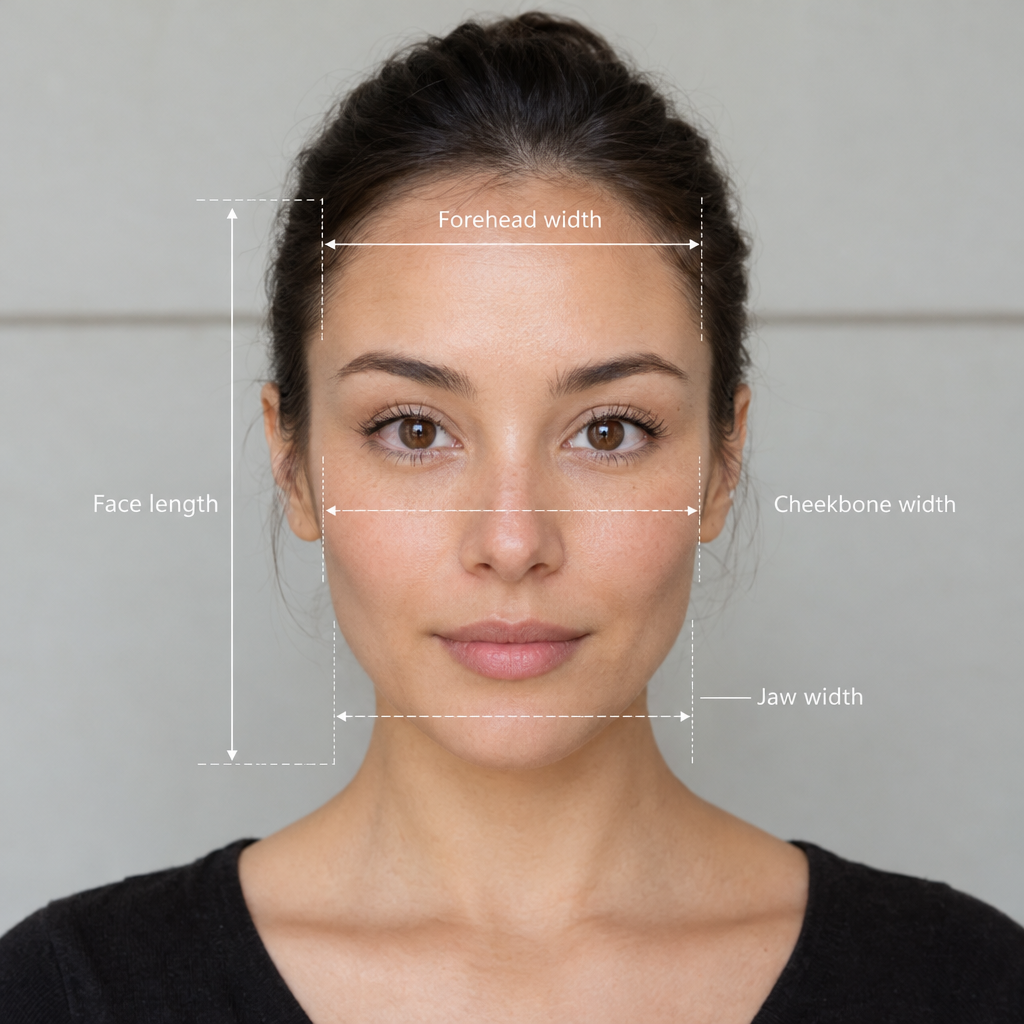
A canthus is a corner where the upper and lower eyelids meet. The medial canthus sits nearest the nose; the lateral canthus sits farther from it.
To describe canthal tilt, imagine a straight line connecting those two points across the eye opening, also called the palpebral fissure. Compare that line with a level horizontal reference. You are comparing the endpoints, not tracing the curve of either eyelid.
The simplified diagram below shows positive tilt for an eye whose inner corner is on the left:
                         ● ②
                      ╱
                   ╱
                ╱ ③
             ╱
① ● · · · · · · · · · · · · ④
Diagram key:
- Medial canthus: the inner corner, nearest the nose.
- Lateral canthus: the outer corner, shown higher here.
- Connecting line: the straight line between the canthi.
- Horizontal reference: the level dotted line through the inner corner.
The diagram is schematic, not a suggested ideal angle. A line drawn on a photograph gives a photo-based estimate, not a standardized clinical measurement.
Positive, neutral, and negative canthal tilt compared
| Positive tilt | Neutral tilt | Negative tilt |
|---|---|---|
| Outer corner higher | Corners approximately level | Outer corner lower |
| Line rises outward | Line appears horizontal | Line falls outward |
“Neutral” does not require mathematical precision. If a small difference disappears when you change photos or you cannot confidently locate the corners, “approximately level” is more useful than assigning an exact angle.
There are no universal degree cutoffs that make a casual photo assessment definitive. Landmark selection, head alignment, image quality, and the measurement method all affect the estimate.
None of these categories determines attractiveness, health, masculinity, femininity, or personal worth.
How to check canthal tilt from a photo
The aim is to see the actual eye corners clearly, without pose or styling supplying a misleading direction.
A five-step photo self-check
-
Choose a less distorted view. Use the rear camera or a non-wide-angle view where practical. Avoid an arm’s-length close-up if you can position the camera farther away and crop afterward. Distance matters more than simply switching cameras.
-
Place the camera at eye level. Support the phone rather than holding it noticeably above or below your face. Use even, frontal lighting that leaves both eye corners visible.
-
Face the camera directly. Keep your nose pointed toward the lens without turning your face or projecting your chin. Move hair away from the eyes. Remove liner or lashes if they obscure where the eyelids actually meet.
-
Keep your head level and expression relaxed. Look straight ahead without widening your eyes, squinting, raising your brows, or deliberately pulling the outer corners upward. In the photo, locate the inner and outer canthus of each eye, then compare their heights against a horizontal guide.
-
Compare two separately taken photos. Reset your position before taking the second image. Assess each eye separately. If the same broad pattern appears in both suitable photos, that is usually enough for an informal description. If the result changes, leave it uncertain rather than repeatedly measuring.
Decision rule: Use “positive,” “approximately level,” or “negative” only when the corners are visible and the pattern is consistent. Use “unclear from these photos” when alignment or visibility is questionable.
Before uploading a facial photo to any analysis service, review how images are stored, used, and deleted. Use your own image or obtain the other person’s permission.
Canthal tilt is not the same as eye shape or eyelid type
The eye area has several independent features. A person can have almond-shaped eyes with negative tilt, round eyes with positive tilt, or hooded eyelids with approximately level corners.
| Trait | What to observe | Common confusion |
|---|---|---|
| Canthal tilt | Relative height of the inner and outer eye corners | Eyeliner wing direction |
| Overall eye shape | Elongation, roundness, and corner taper | Assuming tilt alone defines shape |
| Eyelid hooding | Skin overlapping the crease | Treating it as the same as a monolid |
| Brow angle | Direction of the eyebrow | Treating it as the eye-corner angle |
| Outer-eyelid position | Whether the outer lower-lid edge rests against the eye or turns outward | Treating lid-margin contact as the relative height of the canthi |
Almond and round describe the overall visible eye opening. Neither label tells you the angle between the corners by itself.
Hooding describes overlying skin that partly or substantially conceals the eyelid crease. Crease visibility is separate from tilt. An epicanthic fold, a fold of skin near the inner corner, is also a distinct feature. It may make the inner landmark harder to see, but it does not define the outer corner’s height.
Upturned and downturned often describe the overall impression of the eye area. They may reflect canthal tilt, but people also use them in response to eyelid contour, lashes, brows, and makeup. A lifted-looking liner wing does not necessarily mean the anatomical outer corner is higher.
Outer-eyelid position is another separate observation. Eyelid-margin contact refers to whether the lower-lid edge rests against the surface of the eye as expected or appears to turn away from it. This concerns the position of the lid margin, not simply whether one canthus is higher than the other. A selfie cannot establish whether an apparent change represents an eyelid condition.
An eye-shape analysis can help describe the broader outline, but it is not a substitute for comparing the two canthi.
Why the angle can look different in photos
Head roll changes the reference
Tilting your head toward one shoulder rotates the entire eye-corner arrangement relative to the image frame. If you treat the frame as a reliable anatomical reference, you can mistake that rotation for a difference in tilt.
The schematic below shows the same four canthi before and after the complete two-eye arrangement rotates clockwise around one shared center. Reading from left to right in the level view, the points represent the left outer corner, left inner corner, right inner corner, and right outer corner.
Level head

●────●       ●────●

Same alignment after clockwise head roll

●
 ╲───●
          ●
           ╲───●
In the lower view, all four points and the space between the eyes have rotated together. The geometry within the pair has not changed.
There is an important distinction: head roll does not usually make both eyes more positive in the same way. Because each eye’s outer corner lies on a different side of the face, a clockwise roll makes the screen-left eye appear more positive and the screen-right eye more negative relative to the frame.
For a purely geometric example, rotating two initially horizontal eye-corner lines clockwise by 5° creates an apparent +5° tilt for one eye and -5° for the other when the sign is measured from each inner corner toward its outer corner. These numbers illustrate image rotation, not anatomical thresholds.
Other sources of misleading impressions
- Camera height and face rotation: Looking up, down, or sideways changes the projection of the eye area. One corner may also become less visible.
- Distance and lens perspective: A close camera exaggerates perspective differences. A wide-angle view often encourages shooting too close.
- Cropping and rotation: Cropping alone does not change the angle, but it can remove the head and room cues that reveal a tilted image. Rotating the image does change its angle against the frame.
- Image quality: Blur, compression, and heavy smoothing can make the true endpoint difficult to locate.
- Gaze and expression: Squinting, smiling, looking sideways, or widening the eyes changes eyelid contours and tension, which can alter the visual impression.
- Makeup and shadows: Eyeliner, false lashes, brow direction, hair, and directional lighting can conceal or visually extend the outer corner.
Mirroring reverses left and right; it does not physically change your eyes. It can still change what you notice because one orientation may be more familiar.
A different-looking photo is therefore not, by itself, evidence that your eyelid anatomy has changed.
How to interpret different tilt in each eye
The two eyes do not have to share exactly the same angle. Small, stable differences can be part of ordinary facial variation.
Use this interpretation rule:
- Describe each eye separately. For example: “One appears approximately level; the other appears slightly positive.”
- Check an unmirrored view. Keep track of your actual left and right eye rather than relying on their screen positions.
- Confirm the pattern in a second independently taken photo. Look for the same result with a level head and relaxed expression.
- Consider presentation differences. Head roll, uneven smiling, directional lighting, or different makeup placement can exaggerate a contrast.
Visible asymmetry alone does not establish a medical problem or explain the cause of the difference. A new change or accompanying symptoms matters more than a small difference in an otherwise comfortable, stable eye area.
If you want an estimated visual result after this self-check, Facefy’s Canthal Tilt Test is a relevant next step. Treat its AI-generated assessment as informational, not as a clinical measurement or an attractiveness judgment. The same photo limitations still apply.
Canthal tilt and attractiveness claims
The relative height of two anatomical landmarks can be described or measured. Whether someone finds that arrangement attractive is a different question.
Preferences vary among individuals, cultures, online communities, and styling contexts. The rest of the face, expression, movement, and personal familiarity also affect perception. No single eye angle captures those factors.
Claims that positive tilt is universally ideal, neutral tilt is inadequate, or negative tilt indicates poor health confuse description with judgment.
Use the terminology if it helps you understand a feature or choose makeup. Avoid treating it as a score to improve. Edited celebrity pictures, posed comparison grids, and repeated measurements offer little useful guidance about how you look in everyday life.
What can change the visual impression and what can change anatomy
Visual styling
Styling changes what attracts attention around the eyes. It does not reposition the canthi.
For a more upward-directed impression, you might:
- Keep an eyeliner extension short and angle it slightly upward.
- Blend outer-corner eyeshadow outward and upward.
- Place lash emphasis just above or slightly inward from the outer corner, rather than extending it downward.
- Choose brow styling or glasses with an upward-directed outer line.
To emphasize your natural contour, follow the existing outer-lid direction instead. Check makeup with your eyes open and relaxed, since a wing that looks smooth on a closed eyelid may fold differently when you look ahead.
These are optional visual effects, not corrections.
Temporary image effects
Head pose, lighting, shooting distance, lens choice, retouching, and filters can alter how the eye area appears in an image. Cropping can change the surrounding context.
These effects do not change anatomy. An edited or deliberately angled picture is also unsuitable for estimating your natural tilt.
Facial exercises, massage, tape, and skincare should not be presented as ways to permanently reposition the canthi. Tape may temporarily pull nearby skin, but it can irritate the delicate eye area and is not an anatomical treatment.
Medical procedures
Procedures around the outer eye corner may alter eyelid support or position:
- Canthopexy generally aims to support or tighten structures near the lateral canthus. The exact approach depends on the clinical situation.
- Canthoplasty involves reconstruction or repositioning around the lateral canthus, with techniques tailored to the eyelid’s anatomy and the reason for surgery.
These are medical interventions, not simple beauty adjustments. Possible complications include irritation, scarring, asymmetry, eyelid-position problems, and difficulty closing the eye.
Anyone considering a procedure needs an examination and individualized discussion with an appropriately qualified oculoplastic professional. A photo angle or online category cannot establish whether surgery is appropriate. The American Society of Ophthalmic Plastic and Reconstructive Surgery provides information about this specialty.
When an eyelid change needs professional attention
A longstanding eye-corner arrangement without symptoms is different from a sudden change in eyelid position.
Seek professional assessment for:
- Sudden or new eyelid-position changes.
- Recent injury or trauma around the eye.
- Difficulty closing the eye fully.
- Persistent irritation or pain.
- New outward turning of the eyelid margin.
- Blurred vision, double vision, or other visual symptoms.
Sudden vision loss, severe eye pain, or a significant eye injury requires urgent medical attention.
An eye-care professional can examine the eyelid, eye surface, and vision together. An oculoplastic clinician may be appropriate for eyelid support or positioning concerns.
Do not try to diagnose an outward-turning eyelid or a new droop from a selfie. Appearance analysis cannot diagnose eyelid, nerve, eye-surface, or vision conditions.
Canthal tilt glossary
- Canthus: Either corner where the upper and lower eyelids meet.
- Medial canthus: The inner corner nearest the nose.
- Lateral canthus: The outer corner farther from the nose.
- Palpebral fissure: The opening between the upper and lower eyelids.
- Eyelid margin: The edge of the eyelid beside the eye surface, including the lash-bearing edge.
- Canthal tilt: The orientation of the line between the medial and lateral canthi relative to a horizontal reference.
- Facial asymmetry: A visible left-right difference between corresponding features. A visual difference does not establish why it exists. A facial symmetry comparison can organize observations, but it cannot diagnose their cause.
Related resources
- Eye outline: Elongation, roundness, and taper help you explore your overall eye shape.
- Proportional analysis: Defined landmarks and consistent images help you understand facial proportions. Proportions are not universal beauty standards.
Common questions about canthal tilt
Is neutral canthal tilt the same as no tilt?
In everyday descriptions, yes. It means the inner and outer corners appear approximately level within the limits of the image or assessment. It does not require an exact measurement of 0°.
Can camera angle change how canthal tilt looks?
Yes. Camera height, face rotation, head roll, shooting distance, and perspective can change the apparent angle or make the corners harder to identify. A straight-on, eye-level photo reduces these problems but does not eliminate all uncertainty.
Can each eye have a different canthal tilt?
Yes. Assess each eye separately and confirm the impression in two suitable photos. A difference visible only in one tilted selfie may reflect the photograph rather than anatomy.
Can makeup make eyes appear more upturned?
Yes. Liner direction, eyeshadow placement, and lash emphasis can direct attention upward. They change the visual impression without moving the anatomical eye corners.
Can exercises change canthal tilt?
There is no sound basis for presenting facial exercises as a way to permanently reposition the canthi. Changes in expression or eyelid tension may alter a photo’s appearance, but that is not the same as changing the underlying attachment or support structures.
What is the difference between canthopexy and canthoplasty?
Canthopexy generally supports or tightens structures near the outer eye corner. Canthoplasty involves reconstruction or repositioning in that area. Techniques and terminology can overlap, so the useful clinical question is what tissue would be altered, why, and with what risks.
For ordinary self-description, a broad, consistent observation is enough. Canthal tilt is one feature of the eye area, not a verdict on the whole face.