Blowout Taper Haircut: Variations, Barber Requests, and Styling
Learn what defines a blowout taper, compare low, mid, and high versions, and get practical barber, styling, and maintenance guidance.
A blowout taper keeps noticeable length, lift, and movement on top while gradually shortening the hair at the sideburns and neckline. The edges can stay softly tapered or go down to skin. Skin exposure is optional, not part of the definition.
The result depends on four choices: how high the taper reaches, how much length stays on top, your natural texture, and how you style it. For a softer outline, keep the transition low and preserve side fullness. For stronger contrast, choose a higher transition or shorter edges.
What defines a blowout taper?
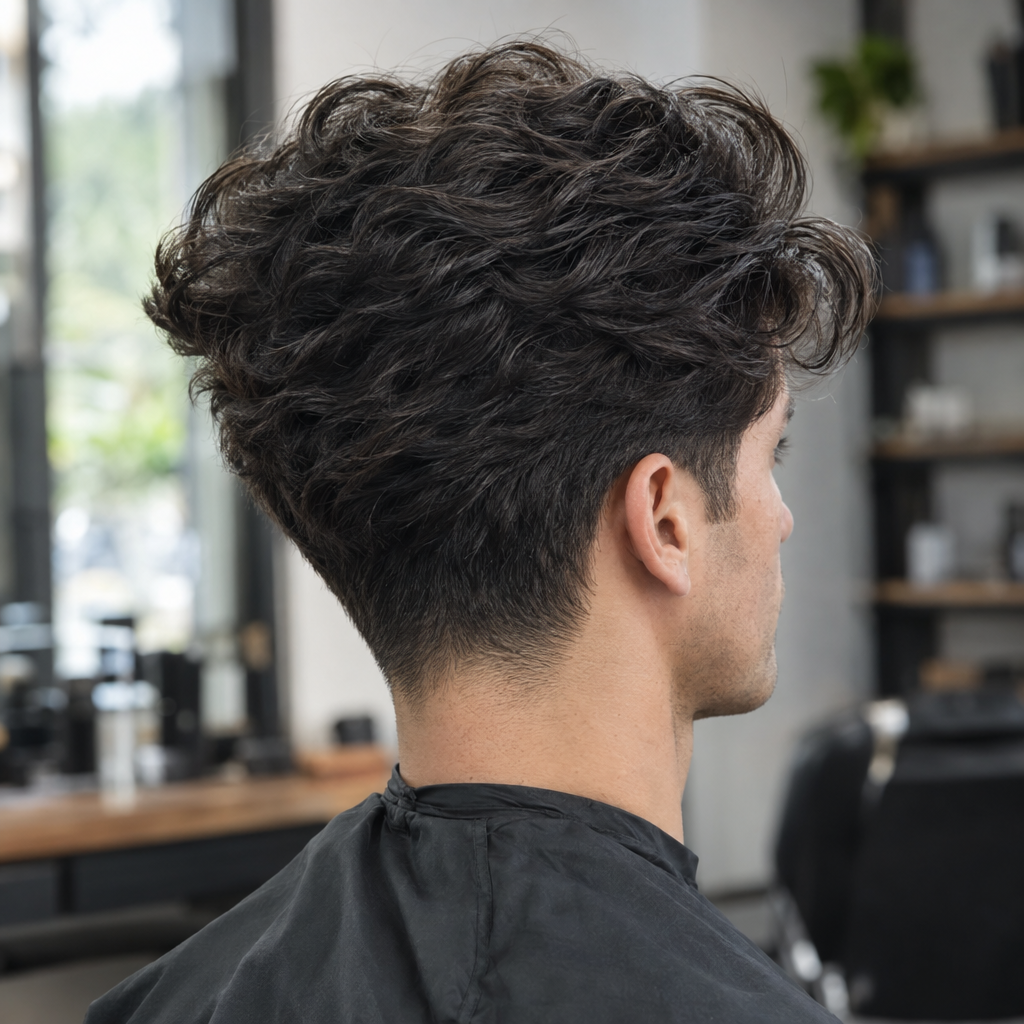
Look for three visible components:
- Retained length and volume on top: Enough hair remains to create a lifted, rounded, swept, or textured silhouette.
- Gradual shortening at the sideburns: The hair blends into a shorter edge rather than ending in an abrupt step.
- Gradual shortening at the neckline: The lower edge becomes progressively shorter while the hair above retains more fullness.
The cut and the finish are different things. The taper establishes the outline, while drying and styling create much of the lift. Naturally textured hair may produce that volume without a conventional brush-and-dryer routine.
The following styles overlap, but each name emphasizes a different part of the finished look.
| Style | Where shortening occurs | Top silhouette | Typical styling effort |
|---|---|---|---|
| Classic taper | Primarily at the sideburns and neckline, usually with fuller sides | Flexible; volume is optional | Often modest, depending on the retained top length |
| Taper fade | Temples and neckline can blend extremely short, sometimes to skin | Can accompany a compact top or a lifted blowout top | Low with a short top; higher when drying longer hair for height |
| Blowout taper | Sideburns and neckline beneath a fuller top | Deliberately lifted, full, rounded, or textured | Natural texture may air-dry well; sculpted height requires more work |
A blowout top can accompany a taper fade, so these are not mutually exclusive categories. Barber terminology also varies. Describing the transition height, shortest length, retained fullness, and top shape is more reliable than relying on the name alone.
Low, mid, and high blowout taper variations
Taper height describes how far the short-to-long transition reaches. It does not simply describe how short the bottom becomes.
| Variation | Transition area | Overall effect | Grow-out visibility |
|---|---|---|---|
| Low | Lower sideburns and nape | Fuller sides and quieter contrast | Usually subtle with a soft edge |
| Mid | Higher toward the temples | Clearer separation between the top and sides | More visible as the blend fills in |
| High | Upper temple and upper-side area | Less side weight and stronger contrast | Most noticeable when the bottom is skin-exposed |
Use these descriptions as starting points rather than fixed boundaries. Before cutting, ask your barber to show where the shortest section and the top of the blend will sit. You can also use Facefy’s Hair Style Try-On to preview haircut options and compare taper heights, shorter sides, and top volume.
Low blowout taper
A low version keeps the transition near the lower sideburn and lower ear area, usually with a low neckline taper. It retains more fullness around the upper sides and creates a less dramatic contrast.
This variation can work well if you want the top to look full without making the sides appear especially narrow. A soft finish also tends to lose definition gradually as it grows.
Mid blowout taper
A mid transition removes more weight around the temple area. It creates clearer separation between the lifted top and the shorter edges while retaining some upper-side fullness.
This is a useful middle ground if a low taper feels too understated but a high taper would remove more side weight than you want.
High blowout taper
A high version takes the transition farther up the sides. It produces stronger contrast and can make the top appear more prominent, but it also leaves less side fullness.
Regrowth is usually more visible when the edge goes to skin. A high transition may also need more deliberate top styling to keep the silhouette balanced.
Height and skin exposure are separate decisions. A low version can go to skin, while a high version can retain short hair at the edges. Higher does not automatically mean a full fade around the entire head.
How much top length do you need?
Roughly 5 to 10 cm, or 2 to 4 inches, is a useful working range for a visibly lifted blowout effect. It is not a minimum requirement for every texture or variation.
Very short hair can still have tapered edges, but it usually creates a compact outline rather than a dramatic elevated top. Extra length is not automatically better. On some hair, additional length adds weight that makes lift harder to maintain.
Consider these variables alongside length:
- Shrinkage: Tighter curls and coils can look substantially shorter when dry. Agree on the intended dry silhouette, not only the stretched length.
- Density: Lower-density hair may benefit from retaining weight instead of receiving extensive thinning.
- Growth direction: Forward-growing hair may resist an upright or swept-back finish.
- Existing layering: Shorter internal sections can support movement, but excessive removal may leave the surface or ends looking sparse.
- Upper-side weight: Preserving some fullness above the taper can support a rounded top. Removing it creates a narrower outline.
For a shorter variation, ask for modest lift with enough surface length to separate the hair. You can preserve the full-top, neat-edge contrast without aiming for maximum height.
Will a blowout taper suit your hair and routine?
Start by observing how your hair behaves after washing and drying without heavy styling products.
Straight hair often needs directed drying for sustained lift. Hair with a natural wave can create a looser, less structured finish. Curly and coily textures may already provide volume, making shape and dry-length control more important than adding height. Your face shape can also influence how different taper heights and top volumes frame your features. Facefy’s Face Shape Detector can provide a photo-based estimate to help you explore proportions before discussing your preferred haircut with a barber.
Your routine matters just as much as your texture:
- For minimal morning effort: Choose a shape that follows your natural growth pattern and keep the edge contrast soft.
- If you are willing to use a dryer: Consider a more deliberate lifted front, rounded top, or swept-back finish.
- If you prefer less visible scalp: Retain short hair at the bottom of the taper instead of taking it to skin.
- For a restrained school or workplace look: Choose a low transition with a softly tapered edge.
- If maximum fullness is the priority: Preserve enough upper-side weight to support the top rather than narrowing the sides excessively.
Before-appointment self-check
- Check the current top length. Can it lift or separate now, or does it need more growth?
- Choose the transition height. Mark the approximate stopping point on a side-view reference image.
- Decide on edge exposure. Tell your barber whether visible skin at the sideburns and nape is acceptable.
- Set a realistic styling budget. Be honest about air-drying versus daily brush-and-dryer work.
- Save front, side, and back references. Include the neckline, not only the front and top.
Reference images communicate preferences, not guaranteed outcomes. Lighting, product, styling, hair density, and growth direction can change the apparent height and fullness. Look for examples with hair that behaves similarly to yours.
How to ask your barber for a blowout taper
Give your barber five clear decisions instead of only naming the style:
- Taper transition height
- Top length
- Texture and finish
- Shortest edge length
- Neckline shape
A five-decision request template
“I’d like a blowout taper with a [low, mid, or high] transition, keeping approximately [length] on top, measured [dry or stretched, where relevant]. I want a [natural or lightly textured, or heavily textured] finish, [softly tapered or skin-exposed] edges, and a **[natural tapered, rounded, or squared] neckline.”
Be careful with the word “textured.” Natural texture describes how your hair already behaves. Cut-in texture refers to weight removed with scissors or a razor. Styled separation comes from drying and product. Asking for a textured finish should not automatically authorize aggressive thinning.
Softer, lower-contrast request
“Keep the taper low at the sideburns and nape, with no skin showing. Leave around 7 cm on top and enough weight through the upper sides for a rounded shape. Keep the surface natural and the neckline softly tapered.”
More defined, higher-contrast request
“Take the temple transition higher and blend the bottom to skin, but retain about 8 cm on top. I want visible lift and separation without thinning the ends too much. Keep the neckline tapered rather than blocked.”
A rounded or squared neckline describes the outline, but a sharply blocked bottom edge looks different from a fully tapered finish. Ask how your preferred outline will blend into the nape.
Before cutting, ask:
- “How much top length will you remove?”
- “Where will the shortest section end?”
- “Where will the blend meet the fuller hair?”
- “How much upper-side weight will remain?”
- “Can this shape work with my usual drying routine?”
Guard numbers can help describe the shortest length, but they should not be the whole request. Clipper systems, lever settings, and blending techniques vary.
How to style a blowout taper at home
For a lifted, blow-dried finish:
- Start with damp hair. Blot gently with a towel rather than rubbing aggressively.
- Apply one light pre-styler if needed. Use heat protection according to the product directions when blow-drying.
- Establish direction at the roots. Lift sections upward or outward with your fingers or a brush while directing airflow along them.
- Build the overall shape first. Keep the dryer moving at a comfortable temperature instead of concentrating heat in one place.
- Add surface separation once dry. Work with small sections so you do not collapse the entire shape.
- Finish sparingly. Spread a small amount of product across your hands, apply lightly, and add more only if necessary.
For a lower-heat routine, use a diffuser or air-dry the hair in the intended shape. Gentle root clips can support lift while drying, while loose twists can organize coily texture. Neither method should pull tightly or cause discomfort.
A heat-free finish may look softer and less elevated than a brush blowout. That is a styling difference, not a failed result.
Troubleshooting common styling problems
- Flat roots: Begin lifting while the roots are still damp and reduce heavy product near the scalp.
- Frizz: Lower the airflow, avoid rough towel-drying, and touch textured hair less while it sets.
- Bulky sides: Ask whether weight needs redistributing at your next appointment. More product rarely corrects an unsuitable outline.
- Greasy or collapsed finish: Use less product next time. Wash out buildup rather than layering more product over it.
- Lift that falls quickly: Try drying smaller sections completely before moving on. Hair that remains damp at the roots can lose its shape.
Maintenance and grow-out
Treat edge maintenance and top reshaping as separate needs.
| Appointment | Planning range | Main purpose |
|---|---|---|
| Edge cleanup | About 2 to 4 weeks | Refresh the sideburns and neckline |
| Top reshaping | About 4 to 8 weeks | Restore balance, movement, and manageable length |
These are planning ranges, not fixed rules. Growth rate, preferred sharpness, budget, edge exposure, and styling habits may justify longer or shorter intervals.
A low, soft taper generally loses definition less abruptly than a higher or skin-exposed finish. If the top still sits well, refreshing only the edges may be enough.
Tell your barber when you want to preserve top length. “Clean up the edges and rebalance only what is necessary” is clearer than requesting the same amount off everywhere.
Check the result before leaving the chair
Use normal room lighting and look at the front, both sides, and the back. The goal is to catch visible issues without examining every hair.
Check the following:
- Does the transition begin at the height you discussed?
- Is the blend smooth, without an obvious dark line or step?
- Do both sideburn areas finish at a similar height?
- Is the neckline tapered or outlined as requested?
- Has enough top and upper-side fullness been preserved?
- Can the top move in the direction you plan to style it?
If you see a correctable blending issue, ask a specific question such as, “Can you soften this visible step without raising the taper?”
Fullness that has already been removed must grow back. Requests to preserve upper-side weight or top length belong in the consultation before cutting begins.
Common blowout taper mistakes to avoid
- Requesting a skin fade when you want soft edges: State the shortest acceptable finish explicitly.
- Removing too much top weight: Heavy texturing can undermine fullness, especially on lower-density hair.
- Choosing height without discussing exposure: A high transition and skin-exposed edges are separate choices.
- Using heavy product to create lift: Establish the shape through drying, then add a small amount of hold.
- Drying the roots flat: Downward airflow alone will not create an elevated silhouette.
- Bringing only a front-view reference: The side blend and neckline define much of this cut.
- Ignoring the natural growth pattern: A reference styled against its growth direction may require more daily effort on your hair.
- Expecting an exact copy: Texture, density, hairline, growth patterns, and styling technique affect the result.
Adjusting the style for straight, wavy, curly, and coily hair
Choose a suitable drying method and one lightweight product. A complicated product routine is not required.
| Texture | Drying approach | Lightweight product option |
|---|---|---|
| Straight | Directed airflow with a vent or round brush | Texture powder or matte cream |
| Wavy | Diffuser or controlled gentle airflow | Mousse or light styling cream |
| Curly | Low-airflow diffuser or air-drying | Lightweight curl cream or mousse |
| Coily | Air-drying, gentle stretching, or low-heat diffusing | Lightweight styling foam or conditioning foam |
Straight hair
Lift small sections at the roots while drying. A vent brush creates a looser finish, while a round brush can produce a more curved and controlled top. Apply texture powder sparingly to dry roots if additional grip is needed.
Wavy hair
Preserve the natural bends instead of brushing everything straight. A diffuser or gentle airflow can support volume without creating an overly polished finish. Sea salt spray can add grip, but skip it if it leaves the hair feeling dry or rough.
Curly hair
Apply one lightweight styler while the hair is damp, then diffuse gently or allow it to dry. Avoid repeatedly touching the hair as it sets if you want more defined texture. Discuss the intended dry length before cutting because shrinkage affects the final outline.
Coily hair
Decide whether you want a compact natural outline or a gently stretched finish. For light hold, apply a small amount of lightweight styling foam, then air-dry or diffuse using low heat and low airflow. Loose twists can also help establish direction before the hair is released and shaped.
One suitable styler can be enough. Heavy waxes, oils, and excess cream may reduce lift or make the finish feel coated, particularly when applied near the roots.
- Planning resource: Facefy’s Hairstyle Finder can help you explore blowout taper directions for different textures before your appointment. Treat the result as a visual discussion aid, since a preview cannot guarantee how a specific cut will behave on your hair.