Almond Eyes vs. Round Eyes: How to Tell the Difference
Compare almond and round eyes using five visual cues, a neutral-gaze self-check, and guidance for mixed or ambiguous features.
Almond eyes usually look horizontally elongated, with tapered inner and outer corners and an iris that touches or nearly touches both eyelids. Round eyes tend to have more vertical openness through the center, a more curved outline, and sometimes visible white above or below the iris.
The most useful distinction is overall outline, not one isolated feature. These categories have soft boundaries, so your eyes may combine almond and round traits rather than fit one label exactly.
Almond eyes vs. round eyes at a glance
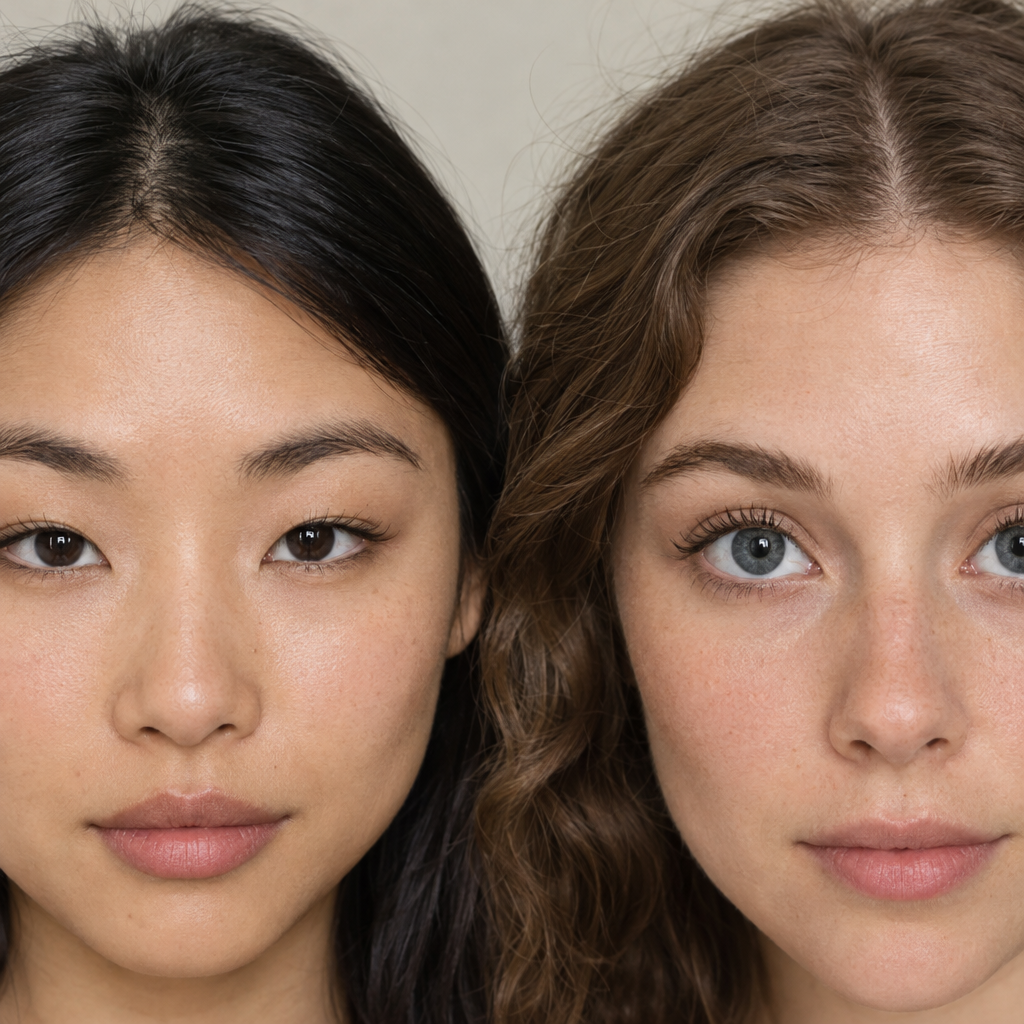
Compare these five cues together. The iris is the colored part of the eye; the sclera is the white surrounding it.
| Cue and limitation | Points toward almond | Points toward round |
|---|---|---|
| Horizontal elongation: angle and expression affect proportions | Longer width relative to center height | Less elongated, more open outline |
| Vertical opening: widening or squinting changes height | Narrower opening through the center | Greater height through the center |
| Inner and outer corner taper: cosmetics alter appearance | Both corners narrow noticeably | More continuously curved overall outline |
| Iris contact: gaze and lid position matter | Touches or nearly touches both lids | More separation from one lid |
| Visible sclera: several features affect white visibility | Little white above or below iris | White may appear above or below |
None of these cues is decisive alone:
- Horizontal elongation depends on viewing angle and expression. An angled photo can make the opening appear shorter or narrower.
- Vertical opening changes when you deliberately widen your eyes or squint.
- Corner taper can be emphasized by eyeliner or visually softened by lashes. Round eyes still have corners; the difference is how strongly the outline narrows toward them.
- Iris contact changes with gaze direction and eyelid position. It is not a fixed boundary between the two descriptions.
- Visible sclera depends on gaze, expression, eyelid anatomy, and how prominent the eyes appear. White below the iris does not automatically mean round eyes.
Almond and round are descriptive appearance terms, not biological categories or judgments of attractiveness.
A five-step check for your eye shape
Use a mirror or photographs taken in soft, even light. Keep your head level, your brows relaxed, and your gaze straight ahead. If you are using photos, begin by taking a neutral, straight-on photograph with the camera near eye level. Avoid eyeliner, false lashes, filters, or anything else that obscures the natural outline when possible.
1. Compare overall width with center height
Look straight ahead without deliberately opening your eyes wider. Compare the distance from inner to outer corner with the height of the opening through the center.
A noticeably stretched, horizontal outline points toward almond. A less elongated opening with greater central height points toward round. There is no universally accepted width-to-height cutoff, so you do not need to calculate a ratio.
2. Assess the corner taper
Follow the upper and lower edges toward each corner. Do they narrow into clearly tapered ends, or does the opening look broadly curved overall?
Judge the actual eye opening, not the end of an eyeliner wing or the longest outer lashes.
3. Check the center opening
Relax after a normal blink. Notice how vertically open the middle looks without raising your brows, widening your eyes, or squinting.
A relatively narrow center supports an almond description. A taller, more open center supports a round description.
4. Note iris contact and visible white
Observe whether the iris touches, nearly touches, or sits visibly away from the upper and lower lids.
Contact with both lids often supports almond features. A gap between the iris and one lid may support round features, but treat the visible white as supporting evidence, not a verdict.
5. Repeat with a second neutral image
Take a second relaxed, straight-on photograph and compare it with the first. Support the camera near eye level and step back rather than holding it close to your eyes. Keep your face centered, avoid tilting your head, and crop the image afterward if you need a closer view.
Base your description on the pattern across all five observations, not on whichever detail stands out most.
Stronger clues: overall outline and a consistent appearance across neutral-gaze views.
Weaker clues: scleral show alone, makeup effects, and a single selfie.
Stopping point: if the cues remain evenly split after these observations, stop checking. “Almond-leaning round” or “round-leaning almond” can be more useful than forcing a definitive label.
What mixed signals can mean
Conflicting cues often describe a genuine combination of features rather than an identification mistake.
- Tapered corners plus noticeable white below the iris: If the center also looks relatively open, “almond-leaning round” may capture both qualities. If the opening is consistently narrow and elongated, lower white alone should not outweigh that outline.
- A rounded center plus strong horizontal length: “Round-leaning almond” may fit when the eye remains elongated across neutral images but has a noticeably curved, open middle. Both observations can be accurate.
- One eye appearing more open than the other: Describe the difference directly, such as “both elongated, with one slightly rounder through the center.” Small left-to-right differences in lid position can occur naturally, while expression and camera position may exaggerate them.
If you’re curious about visible differences between the two sides of your face, Facefy’s Symmetry Checker offers a photo-based facial symmetry assessment. Its results are visual estimates influenced by lighting, expression, and camera angle, rather than precise measurements of individual eye shapes.
These blended labels have no standardized scoring system. A plain description such as “elongated with an open center” is often clearer than debating which word should come first.
Eye outline is different from eyelid type and eye position
Four separate dimensions help describe what you see:
- Outline: The visible contour of the eye opening, including horizontal length, center height, and corner taper. This is the dimension that almond and round describe.
- Eyelid crease or hooding: Whether an upper-lid crease is visible, partly covered by overlying skin, or not visibly defined. A monolid lacks a distinct visible crease; hooding can partially or largely obscure a crease. Neither determines the opening’s outline.
- Depth or prominence: Whether the eyes appear deeper beneath the surrounding brow area or more prominent. A side or three-quarter view can help distinguish this from the straight-on outline.
- Corner direction: Whether the outer corner sits higher than, level with, or lower than the inner corner. Upturned and downturned describe direction, not whether the opening is almond or round.
Someone can have almond-shaped hooded eyes, round hooded eyes, round deep-set eyes, or almond prominent eyes. These descriptions can coexist because they refer to different features.
If you would like a photo-based estimate after this self-check, the Eye Shape Detector offers an optional next step. Its AI-generated result is a visual estimate, not a clinical classification. Lighting, expression, camera angle, makeup, and image quality can affect the result.
Why your eyes may look different from one photo to another
A photograph captures a momentary opening, not an unchanging outline.
- Widened eyes: Increasing vertical openness can make an elongated eye appear rounder.
- Squinting: Reducing the center opening can make a rounder eye look more elongated.
- Looking upward or downward: Moving your gaze changes the relationship between the iris and eyelids, including where white becomes visible.
- Close-range wide-angle photography: Short camera distances can distort apparent proportions, especially when the face is off-center or turned relative to the camera.
- Eyeliner, lashes, and shadow: An outward wing can extend the apparent corner. Longer lashes over the center can emphasize vertical openness. Neither should be the main basis for identifying the natural outline.
Lighting also matters. Strong shadows can obscure the edge of the opening or make surrounding folds more noticeable.
Compare more than one relaxed, neutral image rather than trying to derive a precise measurement from a single selfie. If your description changes only when your expression or camera angle changes, give more weight to the consistent neutral view.
Common questions about almond and round eyes
Can eyes be both almond and round?
Yes. An eye opening can combine horizontal length and tapered corners with a relatively open, curved center. A blended description can reflect that combination more accurately than a strict either-or label.
Does white below the iris prove that eyes are round?
No. It is one clue affected by gaze, eyelid position, expression, and prominence. Consider it alongside the overall outline rather than using it as the deciding feature.
Can almond or round eyes be hooded?
Yes. Hooding describes skin covering part of the upper eyelid area, while almond and round describe the opening. Either outline can occur with hooding.
Can the left and right eye have slightly different shapes?
Yes. Small differences in openness or lid position are common and can look stronger in photos. You do not need to average both eyes into one exact category.
Do eye-shape labels reveal ethnicity, ancestry, personality, health, or attractiveness?
No. These labels describe visible features only. They cannot reliably establish ethnicity or ancestry, reveal personality, cannot assess health, or determine attractiveness.
What if my eye or eyelid appearance changes suddenly?
A sudden change belongs with a qualified healthcare professional rather than a cosmetic shape guide, especially with pain, swelling, double vision, new drooping, or other vision changes. Sudden vision loss or a new change accompanied by weakness, difficulty speaking, or a severe headache warrants emergency care.
For stable features, a useful description is enough. “Elongated with tapered corners” or “rounded through the center” can tell you more than a label that does not quite fit.