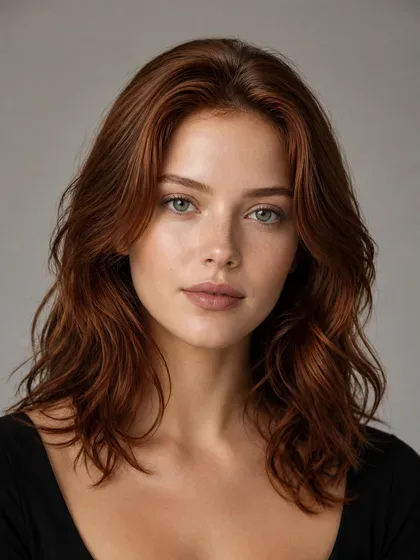
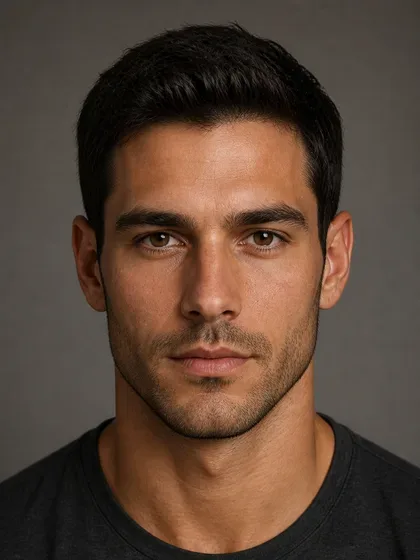
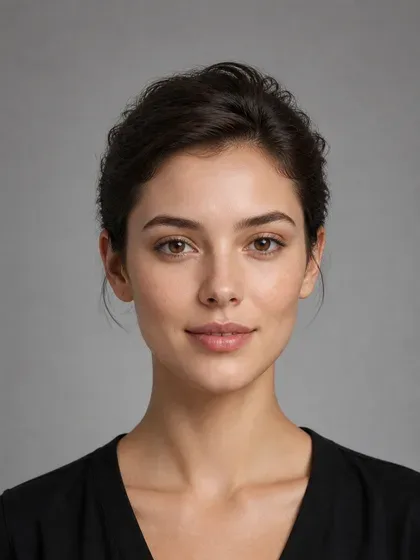
Oval Face Shape: Key Signs and a Simple Self-Check
Learn the signs of an oval face, use a simple four-step self-check, compare similar shapes, and understand mixed or borderline traits.
An oval face is usually longer than it is wide, with cheekbones that are often the widest area, a gently narrowing lower face, and a softly curved chin. These traits matter together. A slightly pointed chin or broad forehead does not determine the shape on its own.
Face-shape categories overlap. Your outline may fit an oval pattern clearly, or a blended description may capture it better. These labels are visual references, not precise anatomical classifications.
What an oval face looks like

Look for four connected features:
- More length than width: The face appears noticeably longer than wide, without the pronounced length associated with an oblong outline.
- Cheekbones slightly widest: The forehead and lower face are usually somewhat narrower than the cheekbone area.
- Gradual inward taper: The outline narrows smoothly from the cheekbones toward the chin rather than maintaining broad, angular corners.
- A softly curved chin: A rounded contour is common, although a subtle point can still fit the overall pattern.
The important distinction is gradual change. Cheekbones can be visible without creating a sharp contrast in width, and the chin can be narrow without making the entire lower face strongly pointed.
Overall length, cheekbone width, and lower-face taper carry more weight than eyebrow shape, eye shape, hair styling, or makeup. The latter can change the visual impression without defining the underlying outline.
Face shape does not establish health, personality, ethnicity, age, or attractiveness.
A four-step oval face self-check
Use a mirror or a clear, front-facing photo. Move hair away from your temples, face straight ahead, and relax your expression. Make sure you can see the forehead, both sides of the face, and the full chin.
1. Compare face length with width
Compare the distance from the central hairline to the bottom of the chin with the widest visible span across the cheekbones.
An oval pattern generally looks longer than wide, but not markedly stretched. If the dimensions look close, compare your outline with the round category. If length dominates strongly, compare it with oblong.
You can mark these distances on a photo if that helps. Approximate comparisons are enough, and there is no universal numerical cutoff that settles the category.
2. Find the widest area
Compare three horizontal spans:
- The forehead between the temples
- The face across the cheekbones
- The lower face across its widest corners
For an oval pattern, the cheekbones are often slightly widest. A much broader upper face or a strong contrast between prominent cheekbones and narrow temples may point toward another category.
Small differences are not decisive. If two areas look nearly equal, note that instead of forcing one to be the widest.
3. Follow the cheekbone-to-lower-face taper
Trace the outer outline downward from each cheekbone.
Look for a gentle inward slope toward the lower face. Broad corners suggest a more angular outline, while pronounced narrowing toward a small chin suggests a stronger taper than the typical oval pattern.
Assess the visible boundary, not a shadow beneath the cheekbones or a makeup contour line.
4. Check the chin contour
Look at the bottom curve separately from the width above it. Is it softly rounded, subtly pointed, sharply pointed, or broad and squared?
A soft curve or mild point can support an oval description. A sharply angular chin is less typical, but it should not override the other three observations.
Decision rule: Look for agreement across at least three observations, including the overall length and width pattern. This is a practical organizing method, not a validated scoring system. When the observations conflict, a mixed description is reasonable.
Oval, round, oblong, heart, or diamond?
Compare each shape using the same four observations. Differences are relative, so focus on the overall pattern rather than any single feature.
| Shape | Length versus width | Widest area | Cheekbone-to-lower-face taper | Chin contour |
|---|---|---|---|---|
| Oval | Noticeably longer than wide | Cheekbones, often slightly | Gentle, gradual narrowing | Soft curve or subtle point |
| Round | Length and width are closer | Cheeks or cheekbones | Limited narrowing, with rounded sides | Rounded |
| Oblong | Distinctly longer than wide | Several areas may be similar | Often limited narrowing | Rounded or broad |
| Heart | Often longer than wide | Forehead or upper face | More pronounced narrowing toward the chin | Tapered or pointed |
| Diamond | Usually longer than wide | Cheekbones, distinctly | Noticeable narrowing below the cheekbones | Narrow or pointed |
Oval versus diamond: Both can have cheekbones as the widest area. The difference is the contrast. Diamond outlines tend to have noticeably narrower temples and lower faces relative to the cheekbones. Oval outlines usually transition more gradually.
Oval versus heart: Look at where the width sits and how strongly the face narrows. An oval pattern usually has slightly wider cheekbones and a gentle taper. A heart pattern is more top-heavy, with a broader forehead or upper face and stronger narrowing toward the chin.
These are descriptive tendencies, not categories separated by exact measurements.
How to interpret mixed or borderline traits
Start with the overall pattern rather than the feature that catches your attention first.
For example, imagine a face that is longer than wide, has broad cheekbones, narrows through the lower face, and ends in a somewhat pointed chin. The most useful interpretation depends on where the width sits and how pronounced the narrowing appears:
- Oval remains reasonable if the cheekbones stay slightly widest and the outline narrows gradually. The chin is one variation within an otherwise oval outline.
- Oval-heart may be useful if the cheekbones and upper face appear similarly wide, while the taper becomes more noticeable near the chin.
- Heart becomes reasonable if the forehead or upper face appears widest and the outline narrows more clearly from that area toward a pointed chin.
The pointed chin alone does not decide between oval and heart. Its relationship to the forehead, cheekbones, and lower-face width matters more.
Similarly, a softly rounded outline with only a modest difference between length and width may sit between oval and round. If the observations point in different directions, describe those traits directly rather than repeatedly measuring small differences.
Naming conventions also vary between guides. A description such as “longer than wide, slightly broader at the cheekbones, with a gentle taper” may communicate your outline more clearly than a single label.
Why the outline may look different in a photo
A photo can help you see the outline, but several conditions can obscure it:
- Hair covering the temples can make the forehead appear narrower.
- A non-neutral expression, such as smiling or raising the eyebrows, can alter the visible cheek and lower-face contours.
- A close wide-angle photo can exaggerate areas nearest the camera and change apparent dimensions.
- An uneven crop can hide boundaries or make the overall outline harder to judge.
- A tilted or turned head can change apparent length and relative widths.
- Strong directional lighting can create shadows that make contours appear sharper.
Compare a mirror view with a couple of clear, level, front-facing photos if the first image is ambiguous. You do not need identical impressions in every picture. Look for the broad pattern that remains consistent.
An optional second opinion
If the self-check leaves you between categories, Facefy’s Face Shape Detector can provide an estimated result from a submitted photo. Use it as another reference point alongside your observations, not as a definitive classification.
- Use Facefy’s Face Shape Detector for an estimated second opinion.
Results can vary with hair coverage, expression, framing, camera position, and image quality. Face-shape labels remain visual and styling descriptors, not medical classifications.
Does a widow’s peak change the category?
A widow’s peak does not automatically indicate a heart-shaped outline. It describes the central hairline, while the broader category depends on the relationship between forehead width, cheekbone width, face length, and lower-face taper.
A high, uneven, or receding hairline can also make the hairline-to-chin distance harder to interpret. In that case, give more weight to the visible side contours and width relationships instead of treating the length measurement as decisive. The goal is a useful description of your outline, not a perfect label.