Monolid Eyes: Features, Variations, and How to Identify Them
Learn what monolid eyes are, how crease visibility varies, how to check your eyelids, and when a sudden change needs medical care.
Monolid eyes describe an upper-eyelid appearance in which little or no crease is visible above the lash line when the eyes are naturally open. This is a normal anatomical variation, not a flaw or diagnosis. Some eyelids have a faint, low, or partial crease rather than fitting neatly into a single category, and the two eyelids do not need to look identical.
Monolids occur across populations and cannot determine a person’s ethnicity or ancestry. To understand your own eyelids, look at crease visibility separately from the inner corner and the overall outline of the eye.
What does monolid mean?
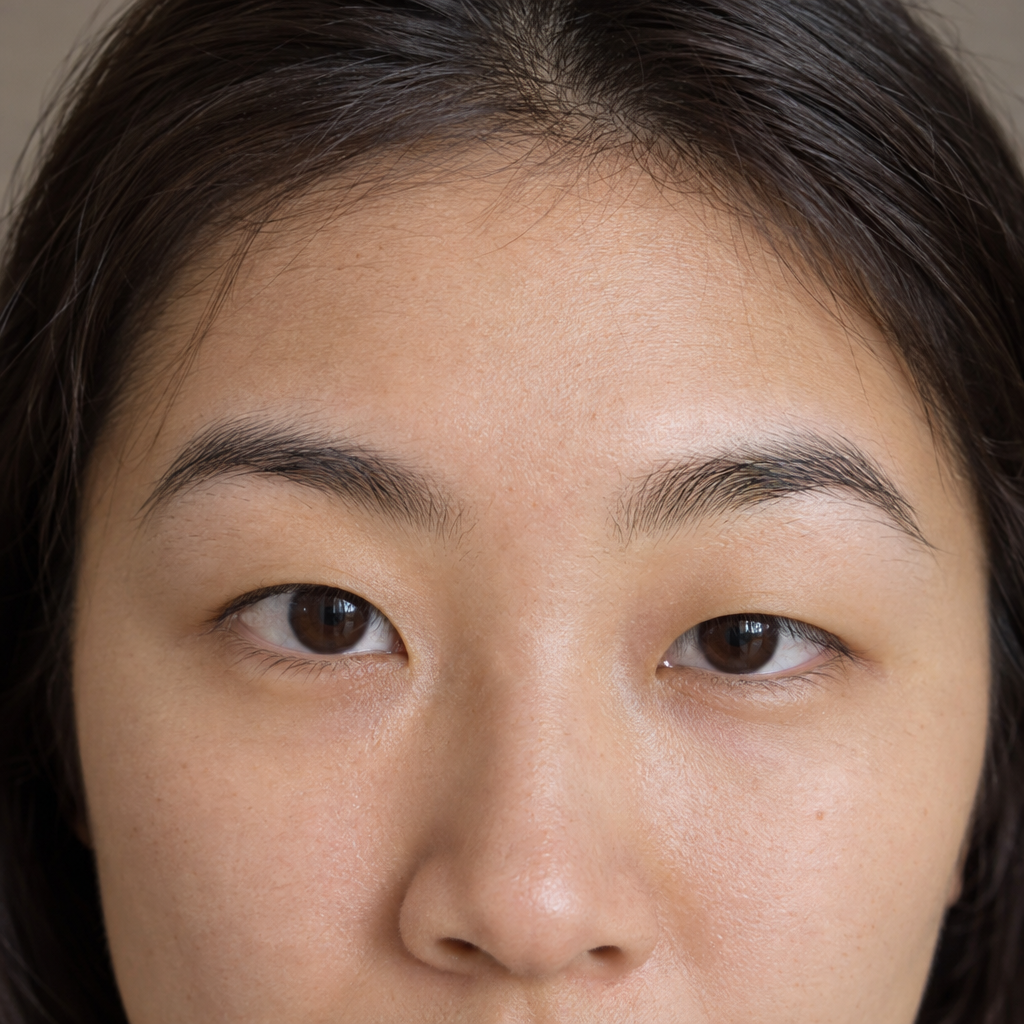
An eyelid crease is the fold above the upper lash line. The term monolid generally describes an eyelid on which that fold is absent or not prominent during a relaxed, forward gaze. The upper-lid area may look relatively smooth from the lashes toward the brow, although its fullness and contour vary.
“Monolid” is a descriptive term, not a rigid biological category. A faint or incomplete crease may appear when someone looks down but become difficult to see when they look forward.
A concealed crease does not always mean a monolid. An established crease can also be covered by overlying skin, often described as hooding. Visibility is a useful starting point, but it cannot explain every detail of eyelid structure on its own. If your eyelids fall between descriptions, “low crease” or “partly visible crease” may be more useful than forcing a label.
Three separate features that describe the eye area
Crease visibility, the inner-corner fold, and overall eye outline are separate observations that can occur in different combinations.
| Feature | What to observe |
|---|---|
| Eyelid crease visibility | Whether a fold appears above the upper lash line |
| Inner-corner fold | Whether skin covers part of the inner corner |
| Overall eye outline | Roundness, horizontal elongation, corner taper, and visible white around the iris |
- Eyelid crease visibility concerns whether a fold remains visible with the eyes naturally open. It does not tell you whether the eye opening is rounded or elongated.
- An epicanthic fold is a fold of skin covering part of the inner eye corner. It can occur with or without a monolid, so the two terms are not interchangeable.
- Overall eye outline describes features such as roundness, elongation, and corner taper. Outer-corner direction and how prominent or deep-set the eyes appear are additional dimensions. Neither is determined by the eyelid crease.
For example, one person might have monolids with an elongated opening, while another has monolids with a rounder opening. Either person may also have an inner-corner fold. These combinations do not establish personality, attractiveness, or ancestry.
A five-step way to observe your eyelid crease
Use a mirror in soft, even light. Strong overhead shadows can resemble a fold, while bright glare can make a subtle crease harder to see.
- Remove or disregard heavy eye makeup. Shadow, liner, and false lashes may obscure the natural lid contour. If you cannot see it clearly, leave the assessment for another time.
- Face forward. Keep your head upright rather than turning, tipping your chin down, or looking up at the mirror.
- Relax your brow. Let your forehead settle instead of lifting your eyebrows to expose more lid space.
- Keep both eyes naturally open. Avoid widening your eyes or squinting. Use your ordinary forward gaze.
- Assess each eyelid separately. Look for whether a crease remains visible above the lash line and whether it extends across the whole lid or only part of it.
One photograph is not definitive. A relaxed mirror view and another naturally posed image can provide context, but there is no need to keep checking until you find a perfect label.
How to interpret what you see
Monolid eyes and visible creases both have natural variations. The following descriptions can help you interpret your observations without forcing every eyelid into a strict category.
| Presentation | What you may notice | Useful description |
|---|---|---|
| No clear visible crease | Upper lid appears relatively smooth during a relaxed forward gaze | Consistent with a monolid appearance |
| Very low crease | Fold sits close to the lash line and may be easier to see when looking down | Low crease or monolid with a subtle crease |
| Partial or interrupted crease | Fold appears along only one section of the lid | Partial crease or transitional appearance |
| Clearly visible crease | Fold remains distinct across most of the lid when the eyes are naturally open | Visible upper-eyelid crease |
| Concealed established crease | A crease is present but overlying skin covers some or most of it | Hooding rather than an absent crease |
| Different crease visibility between eyes | One lid has a clearer or longer crease than the other | Describe each eyelid separately |
A very low crease may be easier to see when looking down. A partial crease might appear near the outer portion of the lid without continuing across it.
Differences between the two eyelids are also common. One may have little visible crease while the other has a more distinct fold. A longstanding difference without symptoms is different from a sudden change.
If you’re curious about broader differences between the left and right sides of your face, Facefy’s Symmetry Checker offers a photo-based visual assessment. It can provide an additional perspective on facial symmetry, but it does not determine eyelid anatomy or establish whether a difference is medically significant.
Why the crease can look different from one moment to another
Small changes in appearance do not automatically mean the underlying anatomy has changed. Several variables affect what you can see:
- Gaze direction: Looking down may reveal a crease concealed during a forward gaze.
- Brow raising: Lifting the brows changes the position of the skin above the eyes and can expose more upper-lid space.
- Head angle: Tipping or turning the head changes the viewing angle, skin overlap, and shadows.
- Temporary puffiness: Day-to-day swelling can make a shallow crease less distinct. Marked, painful, or persistent swelling requires a different response.
- Makeup and lash placement: A dark shadow line can imitate a crease, while thick liner or a false-lash band can cover one. Mascara and curled lashes may also change how much lid is visible.
A single photograph cannot reliably establish whether a crease is absent, low, or concealed. Observe your eyelids in a relaxed mirror view and consider what is usual for you before choosing a description.
Monolids, ethnicity, and ancestry
Monolids are more common in some East and Southeast Asian populations, but they are not exclusive to those populations. Not every East or Southeast Asian person has monolids, and people from other backgrounds can have them.
Eyelid appearance alone cannot establish ethnicity, heritage, or ancestry. It is more accurate to describe what is visible, such as “little visible upper-lid crease” or “a low crease on one side,” than to assign an ethnic label to the feature.
Makeup choices for limited visible lid space
Makeup is optional, and limited visible lid space does not require a corrective technique. If you want to experiment, base placement on what remains visible when your eyes are naturally open.
Map eyeshadow with your eyes open
Look straight into a mirror with your brow relaxed. Use a small amount of shadow to mark where you want color to remain visible, then lower your gaze to blend it.
Open your eyes again before adding more. If the color disappears, extend the blend slightly above the area concealed during your forward gaze. This is more useful than following a tutorial that assumes everyone has the same visible crease.
Build eyeliner thickness gradually
Start with a thin line close to the upper lashes. Check it with your eyes open and your forehead relaxed, then add width only where you want more definition.
If a thicker line takes up all the visible lid space, you can keep the inner section thin and add emphasis toward the outer section. A bold line is equally valid if that is the effect you prefer. The decision is about the result you want, not a universal rule for monolids.
Let products set before checking for transfer
Allow liner, shadow, or mascara to dry according to its instructions. Then blink normally and look for marks where the upper lid makes contact.
If transfer occurs, change one variable at a time. Use less product, adjust its placement, or choose a longer-wearing formula suitable for the eye area. Check with eyes both open and closed. The open view shows the everyday effect, while the closed view reveals gaps and blending edges.
Why one photo may not show your eyelids accurately
A photograph captures one expression from one viewpoint. It does not show how a crease behaves through ordinary movement.
Angled poses and downward gazes may reveal folds hidden in a forward-facing view. Closed or partly closed eyes show the lid surface differently from naturally open eyes. Heavy makeup, false lashes, filters, retouching, and strong shadows can also hide or exaggerate boundaries.
For a more useful comparison, choose:
- A relaxed, front-facing image with the camera near eye level.
- A second natural view showing a slightly different angle.
- Similar lighting and minimal obstruction around the lids.
Photo-based or AI classifications are estimated visual descriptions, not clinical findings or definitive labels. A result based on one image should not override the variation you can see naturally in a mirror.
When an eyelid change deserves medical attention
A longstanding monolid appearance without symptoms is generally a normal anatomical variation. Ordinary differences between eyelids do not, by themselves, mean something is wrong.
Seek prompt professional medical assessment for sudden drooping, pain, marked eyelid swelling, double vision or another new vision change, or new difficulty opening an eye. Difficulty opening the eye warrants assessment even when no injury has occurred. Marked swelling is also different from ordinary temporary puffiness that settles on its own.
Sudden vision loss, or an eyelid change accompanied by a severe headache, weakness, facial drooping, confusion, or difficulty speaking, warrants emergency care.
These precautions concern new or symptomatic changes, not monolids themselves. A clinician, rather than an appearance tool or online label, should assess symptoms.
Questions about monolid eyes
Can a monolid have a faint or partial crease?
Yes. Some eyelids described as monolids have a very low, incomplete, or faint crease that is visible only in certain positions. “Low crease” or “partial crease” may be a more precise description when the distinction is unclear.
Can one eyelid be monolid while the other has a visible crease?
Yes. Crease visibility can differ naturally between the two eyes. A stable difference without symptoms is not the same as a newly drooping or swollen eyelid.
Is an epicanthic fold the same as a monolid?
No. An epicanthic fold concerns skin at the inner eye corner, while a monolid concerns the upper-eyelid crease. Either feature can occur without the other.
Can monolids have different eye outlines?
Yes. Monolids can accompany rounded or elongated openings and different outer-corner orientations. Crease structure does not determine the entire appearance of the eye area.
Can fatigue or puffiness change how a crease looks?
Temporary puffiness, including puffiness you notice after poor sleep, can make a crease less visible. Fatigue can also change how widely you hold your eyes open. Neither observation alone establishes a permanent change in eyelid anatomy. Focus on what is usual for you, while treating new symptoms as a separate medical question.
Explore your overall eye outline
If you want a second perspective on features such as roundness, elongation, and corner taper, Facefy’s Eye Shape Detector can provide an estimated visual description from a photo. Treat the result as a flexible reference rather than a definitive anatomical classification.