Face Symmetry Test: How It Works and What Your Result Means
Learn how a face symmetry test works, take a consistent photo, interpret tool-specific results, and separate appearance from medical concerns.
A face symmetry test estimates visible differences between the left and right halves of your face in a photo. Depending on the tool, it may compare facial landmarks, measure their distance from an estimated center line, or create mirrored versions of each half of the face.
The result can describe apparent differences around the eyes, brows, mouth, and jaw. It cannot objectively measure attractiveness, diagnose a condition, or fully represent how your face looks in person. Treat it as an analysis of one image, not a verdict on your appearance.
What a face symmetry test measures
Bilateral facial symmetry means how closely corresponding facial features match across a central dividing line. Perfect matching is not the everyday norm. Mild differences in brow height, eye opening, cheek fullness, or jaw contour are common.
Two terms help explain the analysis:
- Facial landmarks: Identifiable points, such as eye corners, mouth corners, or the tip of the chin.
- Facial midline: An estimated vertical reference line through the center of the face. In a photograph, its placement depends partly on head position and how the tool identifies features.
An analysis may flag differences in position, apparent size, contour, or alignment. However, a darker cheek shadow is not necessarily a fuller cheek, and a higher-looking eyebrow may reflect expression rather than its resting position.
These observations cannot establish health, personality, genetic quality, attractiveness, or personal worth.
A perfectly mirrored composite can also look unfamiliar. Duplicating one half replaces the other half’s natural features, creating a different configuration rather than revealing a “correct” version of your face.
Symmetry, facial proportions, and attractiveness are different concepts
These terms answer different questions:
| Concept | Main question | Important limit |
|---|---|---|
| Symmetry | Do paired features match? | Pose changes the comparison |
| Proportions | How do dimensions relate? | No single ideal applies |
| Attractiveness | What does someone find appealing? | Preferences and context vary |
For example, facial ratios describe relationships such as face length relative to width. That is different from comparing the height of one eye with the other.
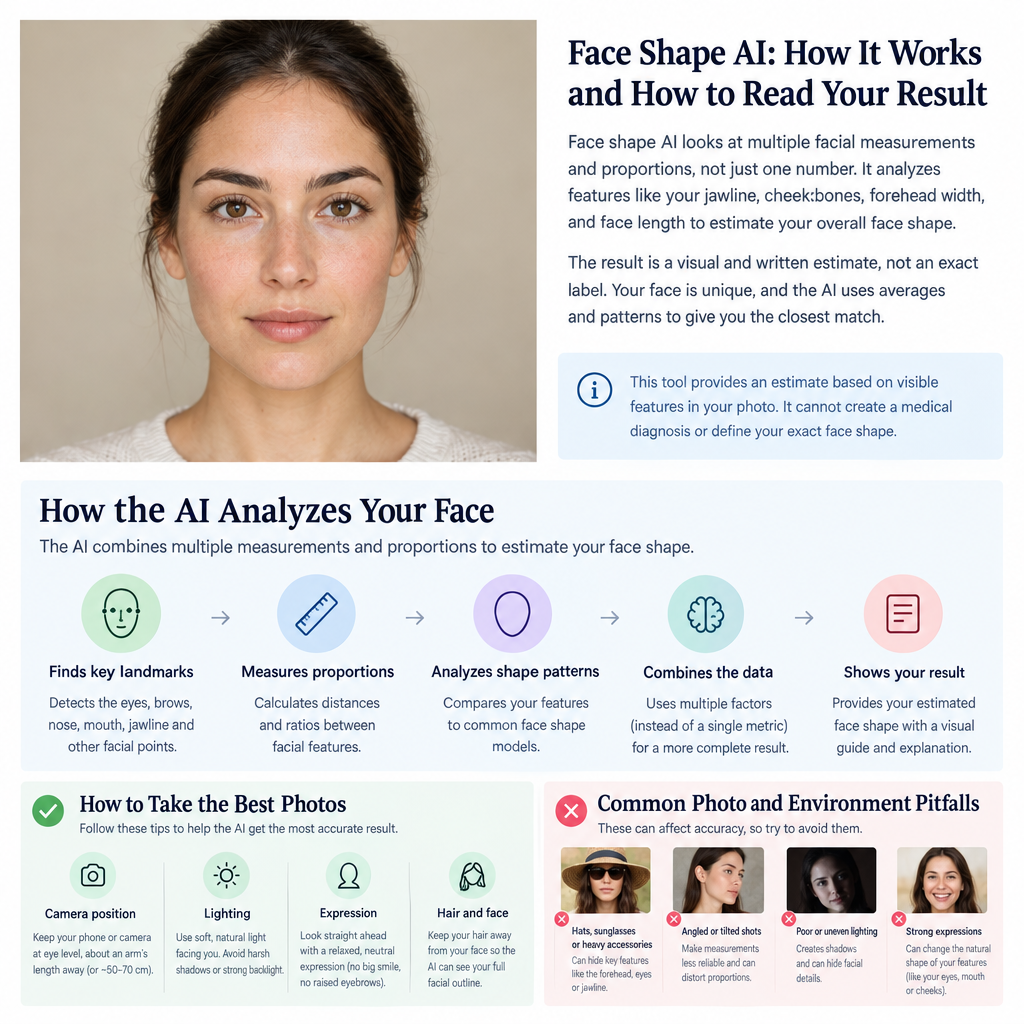
Likewise, face shape guidance considers overall length, forehead width, cheekbone width, and jaw contour together. Shape categories are approximate and can overlap. They do not depend on perfectly matched features.
Attractiveness involves personal preference, culture, expression, styling, and context. A face can have noticeable differences between corresponding features and still appear balanced or appealing. Matching more closely does not automatically mean looking better.
How face symmetry analysis can work
Facial-landmark comparison
This approach compares corresponding visible points, such as the outer eye corners or mouth corners. It may examine differences in their height, position, or alignment.
It answers: Where do paired points appear to differ?
Its usefulness depends on identifying those points correctly. Glasses, hair, shadows, or a squint can make that harder.
Facial-midline distance comparison
This approach estimates a center line and compares how far paired landmarks sit from it. For example, it might compare the horizontal distance from each eye corner to the estimated midline.
It answers: Do corresponding points appear equally far from the center?
A small head turn can alter these distances even when facial structure has not changed. The chosen midline also affects the result.
Mirrored-half visualization
This approach duplicates one half of a photograph to make a left-left composite, then repeats the process to make a right-right composite.
It answers: What would the image look like if each half were duplicated?
These composites also duplicate lighting, expression, and perspective differences. A face photographed with a slight turn may produce composites with noticeably different widths.
The three approaches provide different kinds of information. A particular tool may use one approach, a combination, or another method entirely. A visualization and a numerical score should not be treated as interchangeable evidence.
How to take a suitable photo for a face symmetry test
Use this six-point capture protocol to reduce avoidable photographic differences:
- Keep a neutral expression. Relax your forehead and mouth. Avoid raising a brow, squinting, or pressing your lips together unevenly.
- Place the camera at eye level. Support the phone or camera rather than angling it down from above or up from below.
- Center your face. Look directly toward the lens, not toward your own preview on the screen.
- Use soft, even frontal lighting. Face a window with indirect daylight or a diffuse light source. Avoid strong light from only one direction.
- Make the boundaries visible. Move hair away from the cheeks, jaw, and hairline. Keep the whole facial outline in the frame.
- Keep your head upright and straight ahead. Avoid an obvious sideways tilt, chin lift, or head turn. Do not force your posture to make features look matched.
Avoid holding the camera very close. If space allows, place it about 1–1.5 meters away and use a timer, keeping enough detail for the tool’s image requirements. This is a practical starting point, not a guarantee of accuracy. Moving farther away matters more than simply zooming while remaining close.
Use an unfiltered image without beauty adjustments or contour-altering portrait effects. Remove glasses if they obscure the eyes and you can comfortably do so.
Before uploading: Review the service’s current image-handling terms, including storage, deletion, and reuse. Use your own photo or one you have permission to upload.
How pose and camera conditions can create apparent asymmetry
A photograph turns a three-dimensional face into a flat image. Features nearer the camera can appear larger, especially at close selfie distances. A wide-angle camera often encourages close framing, but distance is a major source of perspective exaggeration.
Side lighting introduces another complication. It can deepen one eye socket, emphasize a nose edge, or make one cheek and jaw contour appear more defined. These are changes in visibility, not proof of structural differences.
Expression and styling matter too:
- A squint changes the visible eye opening.
- A raised brow changes forehead and eyebrow alignment.
- A smile moves the cheeks and mouth corners.
- Makeup changes contrast and the apparent edges of features.
- Hair, glasses, and facial hair can obscure landmarks or contours.
Two quick checks for head position
Check for roll by comparing pupil height. Imagine a horizontal line connecting the pupil centers. If it slopes, the head may be tilted sideways. This is a clue, not proof, because natural differences can also affect eye position. Use an upright background edge to help judge posture rather than tilting until the pupils match.
Check for rotation by comparing ear or cheek visibility. If substantially more of one ear or cheek is visible, the head may be turned. Hair coverage and natural ear differences can also explain this, so use the clue alongside nose direction and overall pose.
Mirroring affects familiarity as well. A mirrored preview may look more familiar because it resembles your usual reflection. An unmirrored photograph can therefore feel unusual without being less accurate. Neither view is a complete anatomical record.
How to read differences around each facial feature
Inspect the original photograph before accepting a highlighted difference as a stable feature. This troubleshooting table pairs common observations with possible photographic explanations.
| Feature and apparent difference | Possible confounder | What to check |
|---|---|---|
| Brows: one sits higher | Eyebrow movement | Relax forehead muscles |
| Eyes: one looks smaller | Squinting or glare | Relax gaze; soften lighting |
| Nose: appears off-center | Head rotation | Compare ear visibility |
| Mouth: corners look uneven | Uneven smile | Relax lips and cheeks |
| Cheeks: fullness looks different | Side lighting | Use even frontal light |
| Chin: appears unusually prominent | Low camera position | Move camera to eye level |
| Jaw: contour looks different | Hair obstruction or rotation | Clear hair; face forward |
These are possible confounders, not explanations for every difference. A feature that looks similar across consistently captured photos may reflect a familiar aspect of your appearance, but photographs still cannot establish its anatomical cause.
Some boundaries are especially difficult to identify. Soft tissue can make the jaw edge less distinct, a beard can replace the visible jaw contour with a hair outline, and a partly covered hairline can change the apparent facial boundary.
What a face symmetry score means
There is no universal good face symmetry score across tools. A percentage is a summary on one service’s scale, not a percentage of beauty, health, or anatomical perfection.
Scores can depend on:
- Selected landmarks: Which visible points are included or excluded.
- Normalization method: How measurements are adjusted for image size or face size.
- Weighting: Whether some features influence the result more than others.
- Image conditions: Pose, lighting, expression, crop, and visibility.
- Score scale: How measured differences become a number or category.
For those reasons, do not directly compare scores from different services. Two tools may give different numbers without either number having a universal interpretation.
If you want an optional photo-based estimate, Facefy’s Face Symmetry Checker can help you explore visible facial differences using a suitable image. Read any estimated result alongside the original photo rather than treating the number as a complete description.
A useful interpretation framework is:
- A difference appears only in a tilted or shadowed image: Improve the photo setup before drawing conclusions.
- A difference remains similar across matched photos: Treat it as a recurring visual observation, not a diagnosis.
- The score changes but the face looks much the same: Avoid assigning meaning to the numerical change alone.
Use three photos to check whether the result is stable
A short repeatability check can show whether an output is sensitive to small changes between captures.
- Take three separate photos. Keep the camera position, distance, lighting, expression, and framing the same. Do not use three copies of one image.
- Use the same service for all three. Mixing platforms adds differences in scoring methods.
- Compare the outputs. Look for recurring feature-level observations, not just an average score.
- Classify noticeable changes as photo-sensitive. If the highlighted area switches or the overall interpretation shifts between images, do not treat it as a stable description of your face.
There is no universal numerical cutoff for a meaningful change because score scales differ. A practical warning sign is a result that repeatedly describes a feature differently despite a matched setup.
Consistency does not prove anatomical accuracy. It only shows that the output is relatively repeatable under those conditions.
Stop after this three-photo check rather than chasing a preferred number. If a specific photographic question remains, a separate comparison should change only one variable, such as lighting, while keeping everything else fixed.
Appearance differences and medical changes require different responses
Familiar, long-standing differences are often part of normal appearance variation. Gradual changes without other symptoms may be a nonurgent concern, but new or unexplained changes deserve discussion with an appropriate healthcare professional, especially if accompanied by pain or problems with movement or bite.
An online image analysis cannot diagnose stroke, nerve problems, jaw conditions, dental issues, or other medical causes. It should not determine whether you need cosmetic or medical treatment.
Sudden facial drooping or weakness requires urgent medical evaluation, not another online test. Call your local emergency number, especially if it occurs with numbness, speech difficulty, confusion, a severe headache, vision changes, or weakness elsewhere. Do not wait for additional symptoms or an image result.
Common questions about face symmetry tests
Are face symmetry tests accurate?
They may describe visible differences in a submitted image, but accuracy depends on the method, feature detection, and photo setup. A repeatable result under controlled conditions is not the same as a validated measurement of three-dimensional anatomy.
Is a mirror or a photo more accurate?
A mirror gives you a familiar reversed view with movement and depth cues. A photo freezes one expression and perspective. A well-positioned camera can provide a useful comparison image, but neither view alone is definitive.
Does a symmetrical face mean someone is more attractive?
No. Symmetry is one visible characteristic, not a complete measure of appeal. Personal preferences, expression, styling, and social context all contribute to how someone is perceived.