Attractive Test: How to Use It and Understand Your Result
Learn how an AI attractive test works, choose a suitable photo, understand score changes, and interpret the result without overreading it.
An attractive test provides an AI-generated appearance assessment based on the photo you submit. It cannot objectively measure beauty or predict how other people will perceive you. Treat the result as informational or entertaining, and expect it to change with lighting, angle, expression, camera distance, and image quality.
The useful distinction is between what is visible in your photo and how a model interprets it. A score combines those layers. It is not a fixed measurement of your attractiveness.
What an attractive test can and cannot tell you
An AI attractiveness assessment processes information from an image and produces an estimated appearance result. Some systems may consider apparent symmetry, facial proportions, expression, or other visible characteristics. Whether they explicitly measure these features, and how much weight each receives, depends on the individual system. When its methods are not documented, you cannot know exactly which characteristics influenced the result.
| Layer | Example | What it tells you |
|---|---|---|
| Observable image information | Pose, shadows, expression, visible proportions | How your face appears in that particular photo |
| Model interpretation | An appearance rating or descriptive feedback | How the system assessed the submitted image |
| Unsupported conclusions | Health, personality, compatibility, universal attractiveness | Nothing reliable about these qualities |
Attractiveness preferences vary among individuals, cultures, and situations. Real-life impressions also involve movement, expression, voice, familiarity, and interaction. A single still image cannot capture all of that information.
An appearance score is not a medical, psychological, clinical, or diagnostic assessment. It cannot establish personal worth, social value, or how attractive every person will find you.
How to take the attractive test
Before using Facefy’s Attractiveness Test, start with a recent, representative photo. Choose an image that looks like you normally do rather than an unusually posed, heavily filtered, or highly edited portrait.
Before uploading, read the service’s current information about image retention, reuse, sharing, and deletion. Do not assume that facial photos are immediately deleted or excluded from other uses.
Run the Attractiveness Test
- Upload your chosen image. Follow the tool’s photo requirements and submit the assessment.
- Read the result in context. The feedback describes how the system interpreted that image, not your appearance under every condition.
- Decide when to stop. Use one representative photo or the limited three-photo comparison below. Repeatedly testing images until you receive a preferred number does not make the result more meaningful.
Use this five-point photo suitability check
Before submitting a photo, check these five things:
- Your face is clearly visible. Move hair away from facial boundaries where comfortable. If glasses create glare, adjust the light or camera position slightly. You do not need to remove glasses you normally wear.
- The camera is near eye level. Avoid a noticeably overhead or low viewpoint. Keep your head in a comfortable position rather than lifting or lowering your chin to meet the lens.
- Light falls evenly across your face. Face a window with soft, indirect light, or use a diffuse light in front of you. Avoid a bright window behind you or a strong lamp on only one side.
- Your expression feels natural. Relax your jaw and eyebrows. A neutral expression is useful for a baseline, but it should not require uncomfortable effort.
- The image is clear and unwarped. Avoid face-reshaping filters, heavy smoothing, and stretched images. Check that facial edges remain clear rather than blurred by compression.
Adapt the setup to you, not the other way around. Facial differences, mobility limitations, or accessibility needs may make standard positioning advice unsuitable. Move the camera or lighting when possible, and use a comfortable, representative position. Do not force a pose that feels uncomfortable or unlike your normal appearance.
These steps reduce avoidable image problems. They do not make a subjective rating objective or guarantee that a model handles every face equally well.
Why the result can change between photos
A photograph represents three-dimensional features on a flat surface. Your face can remain unchanged while its visible proportions, shadows, and outlines shift from one image to another.
| Variable | Visible effect | More consistent alternative |
|---|---|---|
| Close camera distance | Features nearest the lens appear relatively larger | Step back and avoid an extreme close-up |
| High or low camera | Forehead-to-chin proportions appear different | Keep the camera near eye level |
| Side lighting | Shadows and skin texture appear stronger on one side | Use soft frontal light |
| Facial expression | The eyes, cheeks, mouth, and jaw outline shift | Use the same relaxed expression |
| Tight crop | Facial boundaries or useful context disappear | Include the whole face |
| Heavy compression | Edges and fine details become blurred | Use the original clear file |
| Head rotation | One side appears narrower than the other | Face forward for the baseline photo |
| Hair or makeup changes | Silhouette, contrast, and visible contours shift | Keep presentation similar when comparing photos |
Camera distance and lens perspective
Close-range selfie distortion is mainly a distance issue. A wide-angle camera often encourages you to hold the phone close. At that distance, the nose and other features nearest the lens can appear larger relative to the ears and sides of the face.
Changing lenses without changing the camera position does not, by itself, remove that perspective effect. Stepping farther from the camera and reframing the image usually creates a less exaggerated perspective.
Camera angle and head position
An overhead camera shows different facial surfaces and proportions than a camera positioned below the face. Turning your head also moves one side farther from the lens, which can create apparent imbalance even when your facial structure has not changed.
For a consistent baseline, place the camera around eye level and look toward it without deliberately raising or lowering your chin.
Expression and presentation
Expressions can substantially change an image. Smiling lifts the cheeks and changes the mouth outline. Squinting narrows the visible eye openings. Tensing the jaw can alter the lower-face contour.
Hair, glasses, makeup, and facial hair can also affect visible boundaries, contrast, and shadows. None of these presentations is inherently wrong. They simply provide different visual information for the system to interpret.
Try a three-photo stability check
A small controlled comparison can show how sensitive the result is to changes in expression and pose. It does not prove that any score is objectively accurate.
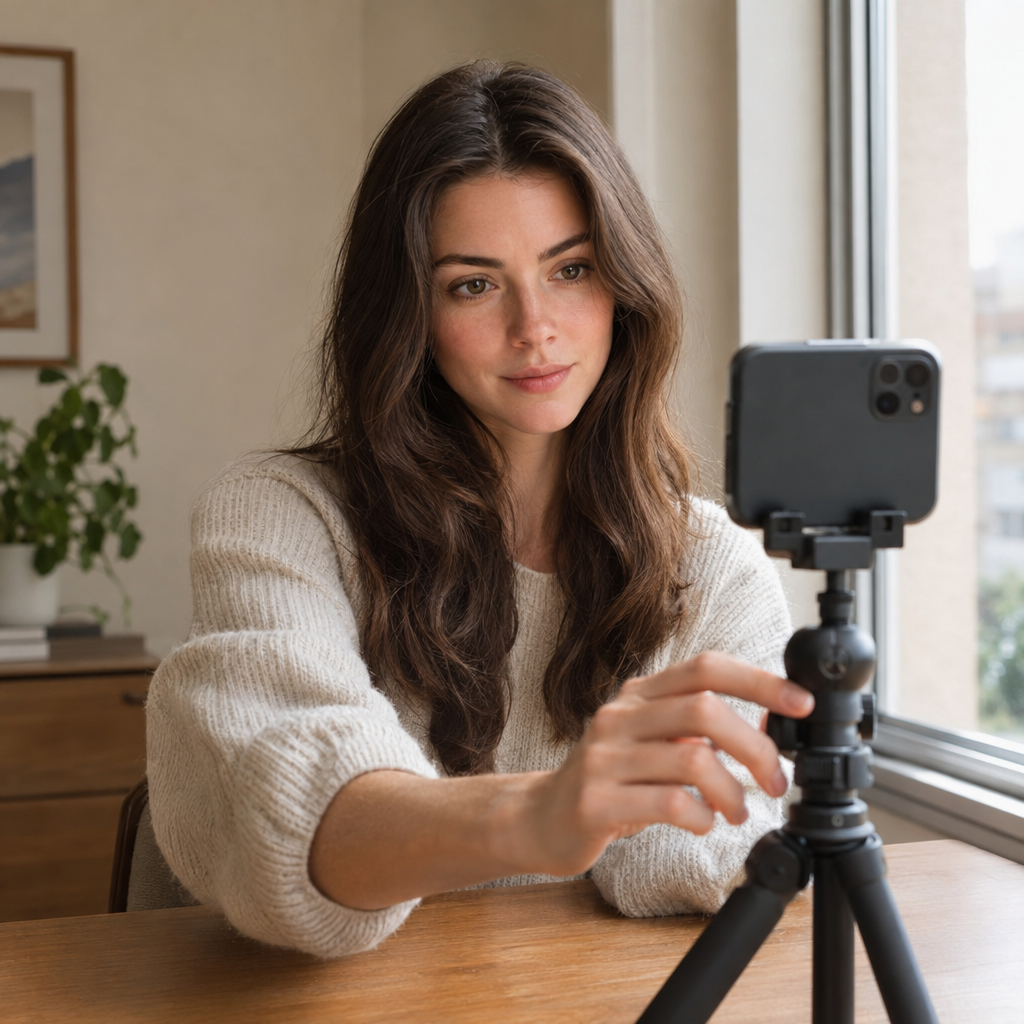
Before taking the photos, use the same camera and lens setting for all three images. Support the phone or camera on a tripod, shelf, or other fixed surface so its position does not move. A timer or remote shutter can help you maintain a natural posture without reaching toward the device.
Take these three photos:
- Neutral and front-facing: use even light, a comfortable expression, and an eye-level camera.
- Naturally smiling and front-facing: keep the light, distance, framing, camera position, and lens setting unchanged.
- Slightly angled: return to a relaxed expression and turn your head a little while keeping both eyes visible. Maintain the same distance and image quality.
Keep hair, makeup, glasses, and image processing consistent where practical. This makes it easier to examine expression and angle without introducing several other changes at once.
Compare the pattern rather than selecting only the highest number:
- Similar results: The output appears relatively stable across this small photo set. This does not establish objective accuracy.
- A noticeably different smiling result: The result suggests sensitivity to the expression change under these conditions.
- A noticeably different angled result: The result suggests sensitivity to the change in pose and perspective under these conditions.
- Large differences throughout: The output may be highly sensitive to image conditions or other parts of the system’s processing.
There is no universal numerical threshold for a meaningful difference because tools use different scales and scoring methods. Variation shows that the submitted image affects the output. It does not reveal the exact reason for every change.
Stop after the planned comparison. If the exercise makes you more self-critical rather than better informed, there is no benefit in continuing.
How to interpret an attractiveness score responsibly
Start by asking whether the submitted photo was suitable. A result from a blurred, heavily filtered, tightly cropped, or unusually angled image may say more about the input than it does about your typical appearance.
Next, avoid assigning importance to small numerical differences. Suppose one suitable photo receives 6.8 and another receives 7.0. That difference does not establish that you became more attractive, that one expression is objectively better, or that other people would rank the photos in the same order. It may reflect photo conditions, model sensitivity, rounding, or other undisclosed factors.
Look for broad patterns across the limited set instead:
- If the scores remain similar, the system appears relatively consistent for those photos.
- If one controlled change repeatedly affects the output, the system may be responding to that presentation difference.
- If similar photos produce very different results, the assessment may not be stable enough to support detailed interpretation.
Even a repeated pattern describes the model’s behavior with those images. It does not create a universal rule about attractiveness.
Do not compare scores from different tools as though they share a common scale. Two services can both use a ten-point rating while relying on different image processing, criteria, reference data, and score distributions. A 7 from one service is not necessarily equivalent to a 7 from another.
Model limitations may also affect results. Training data may not represent every demographic group, facial difference, age range, or style of presentation equally well. Unless a provider explains and evaluates these issues, a score alone cannot tell you how well the system performs for a particular person.
Attractiveness analysis and facial symmetry are not the same
A facial symmetry assessment focuses narrowly on apparent left-to-right balance. An attractiveness assessment adds subjective interpretation and may use other criteria that are not disclosed.
Symmetry is one visible characteristic, not a formula for beauty. A face does not need perfectly matching sides to be attractive, and a symmetrical image cannot predict personal attraction.
Photo conditions matter here too. Head rotation, uneven lighting, hair placement, and an asymmetric expression can change apparent balance without indicating a change in facial structure. If your question is specifically about symmetry, focus on that narrower observation rather than using it to explain an entire appearance score.
Common questions about attractive tests
Are AI attractiveness tests accurate?
They may produce consistent outputs under similar conditions, but consistency is not the same as accuracy. There is no universal attractiveness value against which every score can be checked. Results are better understood as model-generated assessments of submitted images.
Can an AI test predict whether other people will find me attractive?
Not reliably. Individual preferences vary, and real-life responses depend on more than the visible features in one photograph. Expression, movement, personality, voice, familiarity, and social context can all shape perception.
What photo should I use?
Choose a recent, clear image that looks representative of you. Use an unobstructed view of your face, an eye-level camera, even frontal light, a natural expression, and no reshaping filter or obvious image warping.
Why do different tools give different scores?
Tools may use different criteria, training data, image processing methods, and scoring scales. Those details are often undisclosed, so matching numbers from different services should not be assumed to mean the same thing.
Does facial symmetry determine attractiveness?
No. Symmetry describes one aspect of visible appearance. It does not determine attraction on its own, and apparent symmetry can change with pose, expression, lighting, and camera position.
Can makeup, hair, or glasses affect the result?
Yes. These elements can change visible contrast, facial boundaries, shadows, and the amount of the face that the system can process. This does not mean you need to remove them. Use a presentation that feels representative, and keep it consistent if you are comparing photos.
Is it safe to upload a face photo?
That depends on the service’s practices and your comfort with them. Check its current rules for image retention, reuse, sharing, and deletion before uploading. Use your own photo or obtain permission from anyone pictured. If the information is unclear or the terms make you uncomfortable, skip the upload.
Keep the result in perspective
An attractive test can show how one AI system interprets a particular photograph. It cannot settle a subjective question or capture how you appear in motion, in conversation, or across different contexts.
Use a representative photo, control obvious photographic variables, and treat small score changes cautiously. If a controlled comparison changes the output, the result suggests sensitivity to that photographic change under these conditions. It does not establish a fixed judgment about your appearance or your value as a person.