Face Rating AI: What It Measures and Why Scores Change
Learn what face rating AI analyzes, why scores vary between photos, how to take a consistent picture, and how to protect your privacy.
Face rating AI analyzes visible patterns in a photo and may return an estimated appearance score, feature observations, symmetry feedback, or proportion analysis. It cannot objectively determine attractiveness, health, personality, identity, or personal worth. Treat the result as limited appearance feedback or entertainment, not a verdict.
A rating depends on both the submitted image and the system interpreting it. Lighting, camera distance, expression, styling, demographic representation in training data, and the tool’s scoring criteria can all affect the result, even when the person photographed has barely changed.
What face rating AI actually analyzes
Face rating tools use computer vision to interpret information in a photograph. Depending on the service, the output may include a number, descriptive comments, or estimates of visible facial relationships. Not every tool provides all these outputs or uses the same methods.
Some systems locate facial landmarks, meaning reference points such as the eye corners, nose tip, or mouth corners. They may compare distances between these points.
A normalized measurement expresses one distance relative to another. For example:
Relative mouth width = mouth width in the image ÷ face width in the image
This helps distinguish proportions from raw image size. A larger photo contains more pixels, but that alone should not mean a wider mouth relative to the face. Normalization does not remove the effects of head rotation, perspective, or unclear boundaries.
Keep three layers separate:
| Layer | Example | What it establishes |
|---|---|---|
| Image observation | Apparent eye spacing | A photo-based relationship |
| Model interpretation | Higher appearance score | The system’s assessment |
| Human preference | Finding someone attractive | A subjective response |
A system may respond to apparent symmetry, relative proportions, face outline, expression, framing, or image quality. Describing these properties is different from proving that one arrangement is universally attractive. Personal taste, culture, context, and interaction also shape attraction.
Demographic representation in a model’s training data may affect how it responds to different faces. Some appearance systems also attempt demographic classification, but that is separate from an attractiveness assessment and may be inaccurate. A rating is not evidence of ethnicity, gender identity, sexuality, intelligence, health, or personality.
The three types of input that can influence a rating
Separating facial traits from presentation and photography makes a result easier to understand.
| Relatively stable visible traits | Changeable presentation choices | Capture conditions |
|---|---|---|
| Relative facial proportions | Hairstyle and bangs | Camera angle and distance |
| General jaw contour | Makeup | Lighting and partial shadow |
| Apparent cheekbone position | Glasses | Lens choice and crop |
| Spacing between features | Facial hair | Resolution and compression |
| Overall face outline | Head coverings | Expression and head position |
“Relatively stable” does not mean these traits look identical in every picture. A jaw contour can appear different under side lighting, smiling can change cheek contours, and hair can conceal the forehead boundary.
Performance may also be uneven across faces, demographic groups, and image conditions. An inconsistent output should not automatically be interpreted as a real change in appearance.
Why the same face can receive different scores
A face rating evaluates a particular image through a particular system, not an unchanging property of the person.
Camera distance changes perspective
In a close selfie, features nearest the camera can appear larger relative to features farther away. The nose may look more prominent while the ears and sides of the face appear smaller.
Wide-angle phone cameras often encourage this close framing. Stepping back changes the perspective. Zooming while staying very close does not undo it.
Lighting changes visible contours
Side lighting can emphasize one cheek and place the other in shadow. A system may interpret this uneven visibility as a difference in contour or apparent symmetry.
Soft frontal lighting usually makes both sides easier to see, although no lighting setup reveals every aspect of a three-dimensional face.
Expression and styling change what is visible
A smile changes mouth width, cheek shape, and the visible eye opening. Head rotation changes apparent spacing between features. Bangs, beard coverage, makeup, and glasses glare can obscure or emphasize boundaries.
Cropping and compression matter too. A tightly cropped chin or blurred eye corner gives the system less usable information.
The service itself can change
Different tools may use different models, image-processing steps, scoring rules, and scales. Results can also change over time if a service updates its system. Some systems may produce varying outputs even for the same input.
A changed score can therefore reflect photographic sensitivity or a different scoring method rather than a meaningful change in appearance.
How to take a suitable face rating photo
The aim is a clear, representative image, not the photograph most likely to earn a high score.
- Clean the lens and stabilize the camera. Use a stand or steady surface if possible. Avoid motion blur and dim conditions that obscure details.
- Place the camera at eye level. Face it directly, keeping your head level rather than lifting, lowering, or rotating your chin.
- Step back from the camera. For a phone, roughly 1 to 1.5 metres can be a practical starting point if the room and camera allow. Frame afterward with modest zoom or a light crop while preserving detail.
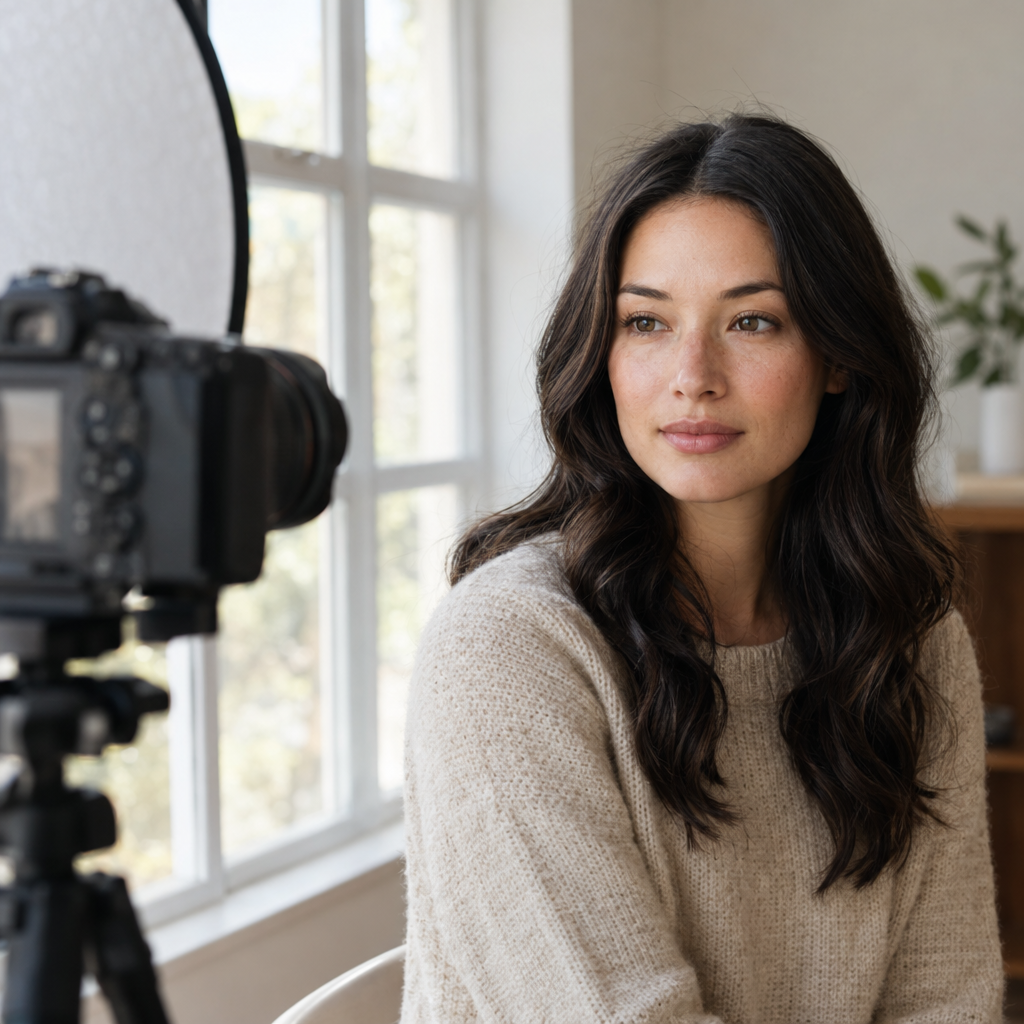
- Use soft, even front lighting. Face a window without direct sun, or use a diffuse light near the camera. Avoid strong side shadows and overhead highlights.
- Keep the full face in frame. Leave space around the forehead, chin, and sides. Move hair or accessories only if they obscure boundaries you want to examine.
- Use a relaxed expression. Look toward the lens without deliberately widening your eyes, tightening your jaw, or pushing your chin forward.
- Turn off appearance-altering effects. Disable beauty filters, face reshaping, artificial skin smoothing, and portrait effects where possible.
- Check the saved image. Make sure it is clear, well exposed, and not cropped through important features.
Follow any image requirements provided by the service. Even a carefully prepared photograph remains a flat view of a three-dimensional face, not a complete record of how you look in motion or from other angles.
Run a three-photo repeatability check
If you want to understand how sensitive a rating is to small photographic changes, keep the comparison limited to three images.
Use the same device, room, background, camera position, distance, and framing:
- Baseline: Take a straight-on photo with even lighting and a relaxed, neutral expression.
- Expression comparison: Keep the setup unchanged and use a small, natural smile.
- Lighting comparison: Return to the baseline expression and make one small lighting adjustment, such as slightly shifting a diffuse lamp.
Keep lighting fixed for the first two images. Only the third should introduce the lighting change.
Use the same service and scoring method for all three. Record the minimum score, maximum score, and spread:
Spread = highest result − lowest result
For example, hypothetical scores of 6.2, 7.1, and 6.5 have a spread of 0.9 on that service’s scale. That does not mean attractiveness changed by 0.9 points. It shows that the outputs differed across those images.
There is no universal threshold for a “large” spread. If the tool reacts strongly to these small changes, its result is sensitive to the submitted photo. Similar scores indicate consistency under those conditions, not proof of accuracy.
Strictly speaking, changing expression or lighting examines sensitivity rather than pure repeatability. You do not need repeated rounds of uploads to understand the practical lesson.
Compare difficult photo conditions one variable at a time
If a particular condition makes a result confusing, isolate it rather than changing your whole appearance.
- Glasses glare: Keep your glasses on and adjust the light enough to reduce reflections. Leave your head position and framing unchanged.
- Facial hair: Hair coverage can obscure the jaw or mouth boundary. If comparing existing photos with different coverage, use similarly framed and lit images. There is no need to shave for a rating.
- Heavy makeup: If you choose to compare makeup looks, keep hairstyle, expression, camera settings, and lighting consistent. Contrast and drawn contours may influence the output.
- Bangs: Move them aside only if they cover a relevant boundary, then keep the same pose for the comparison.
- Head tilt: Compare a level head with a slight tilt while holding the camera still. A tilted image can change apparent alignment.
- Partial shadow: Remove the shadow without simultaneously changing expression or camera distance.
- Head coverings: These may conceal parts of the face outline. Keep them as you normally wear them if that is your preference, and recognize that covered boundaries cannot be directly observed.
Some comparisons cannot perfectly isolate one variable. Moving a light to remove glare also changes illumination, for example. Treat the result as a clue, not a precise explanation of the model’s behavior.
Choose only a comparison relevant to your question. Working through every possible variation adds little practical value.
How to interpret a face rating responsibly
Start with any specific observation, not the total number.
1. Identify what the result actually describes
“Uneven lighting across the face” is an image observation. “Less attractive” is a broad interpretation.
If a service provides only a score, you cannot reliably infer which features caused it. Avoid inventing an explanation for an opaque result.
2. Look for consistency across the three photos
Does the same observation appear in all three? A comment about apparent asymmetry that disappears under even lighting may be responding to shadows rather than a stable feature.
Consistency makes an observation worth considering, but it does not prove that the system interpreted it correctly.
3. Classify the likely cause
Ask whether the comment concerns:
- A visible trait: Approximate proportions or general face outline.
- A presentation choice: Hairstyle, makeup, glasses, or facial hair.
- A capture condition: Lighting, expression, angle, or crop.
This distinction suggests a useful next step. Better lighting may help a portrait, while a different haircut may support a styling preference. Neither requires treating the rating as a beauty standard.
For face-shape exploration, consider several cues together: face length, forehead width, cheekbone width, and jaw contour. Shape categories are flexible descriptions and often overlap.
4. Reject unsupported conclusions
Disregard claims about health, personality, identity, desirability, or personal worth. A numerical result is an estimate tied to one image and one system.
For readers who want an AI-generated appearance assessment after preparing a consistent photo, Facefy’s Rate My Face tool offers a relevant option for exploring image-based feedback. Its results should be treated as subjective assessments rather than objective measurements of attractiveness.
Why scores from different tools cannot be compared
A 7 out of 10 from one service and a 74 out of 100 from another are not necessarily equivalent ratings.
Converting both to percentages only changes their number format. It does not align:
- What the endpoints mean.
- Which visible features receive more weight.
- How images are cropped or processed.
- Which image requirements apply.
- What the output labels represent.
Do not average these scores or assume that the higher result is more accurate. For understanding photo sensitivity, comparisons are more informative within the same tool and scoring method.
A focused question can also be more useful than a broad rating. Relative facial measurements describe proportions in an image. Symmetry describes apparent left-to-right correspondence. Neither provides a complete measure of appearance or a universal standard of attractiveness.
Five privacy questions to ask before uploading a face photo
A face photo can be sensitive personal data. Read the service’s current privacy policy rather than assuming an upload is temporary, private, or processed only on your device.
Ask:
- How long is the image retained? Look for information about original uploads and generated results.
- Can the image and related account data be deleted? Check how deletion is requested and whether any exceptions apply.
- Can images or generated data be reused? Look for terms covering model training and product improvement.
- Are third parties involved? Consider external processing, storage, and sharing.
- Does every identifiable person shown consent? Do not upload someone else’s photo without permission.
Use additional caution with images of minors. Choose a photo without bystanders or unnecessary identifying details in the background. If the policy leaves you uncomfortable or unclear about data use, you can choose not to upload.
Use the feedback without chasing a higher score
Give the exercise a specific purpose, such as choosing clearer portrait lighting, comparing a fringe, or understanding why two photographs look different.
Persistent, understandable observations may support decisions about framing, hairstyle, grooming, or makeup placement. A score increase alone does not establish that a styling change objectively improved attractiveness.
Avoid comparing your score with other people’s results or treating small differences as meaningful. Set a stopping point, such as one limited photo comparison, rather than continuing until a preferred number appears.
If checking starts affecting your mood or encourages repeated reassurance-seeking, step away. No automated score defines your relationships, opportunities, or value.
Common questions about AI face ratings
Is face rating AI accurate?
It may describe some visible patterns in a particular image, but there is no universal objective accuracy standard for attractiveness. Reliable measurement of a visible distance is different from a valid judgment about beauty. Consistent scores alone do not establish accuracy.
Can makeup, facial hair, or hairstyle change a result?
Yes. They can change visible contrast, facial boundaries, coverage, and framing. A changed result shows that the system responded differently to the image, not that one look is universally preferable.
Can a face rating tool identify face shape?
Some tools provide shape-related observations. A dedicated shape-analysis tool may be more suitable for that specific question, but its result is still an estimate. Camera perspective, hairline visibility, facial hair, and overlapping shape categories all affect interpretation.
Do symmetry and facial proportions determine attractiveness?
No. They describe aspects of visible geometry, not universal preferences. Attraction also involves expression, movement, personal taste, context, and interaction that a single photograph cannot capture.
Should I use a filtered photo?
Not if your goal is to understand how the system responds to your unedited photograph. Filters may alter proportions, texture, contrast, or contours. Use a clear, unfiltered image, then treat any result as limited feedback about that picture rather than a final answer about you.