Different Eye Shapes: A Five-Dimension Identification Guide
Identify different eye shapes using five clear dimensions: outline, eyelid structure, corner direction, spacing, and depth with practical tips.
Different eye shapes are best described across five separate dimensions: outline, eyelid structure, corner direction, spacing, and depth. Instead of choosing one label for your eyes, you can use one description from each dimension.
For example, your eyes might have an almond outline, hooded lids, slightly upturned corners, average spacing, and a deep-set appearance. Those descriptions do not conflict because each refers to a different visual characteristic.
Eye-shape labels can help you understand your features or adapt makeup placement, but they are not rigid anatomical categories. Mixed features and small differences between your left and right eyes are normal.
The five dimensions at a glance
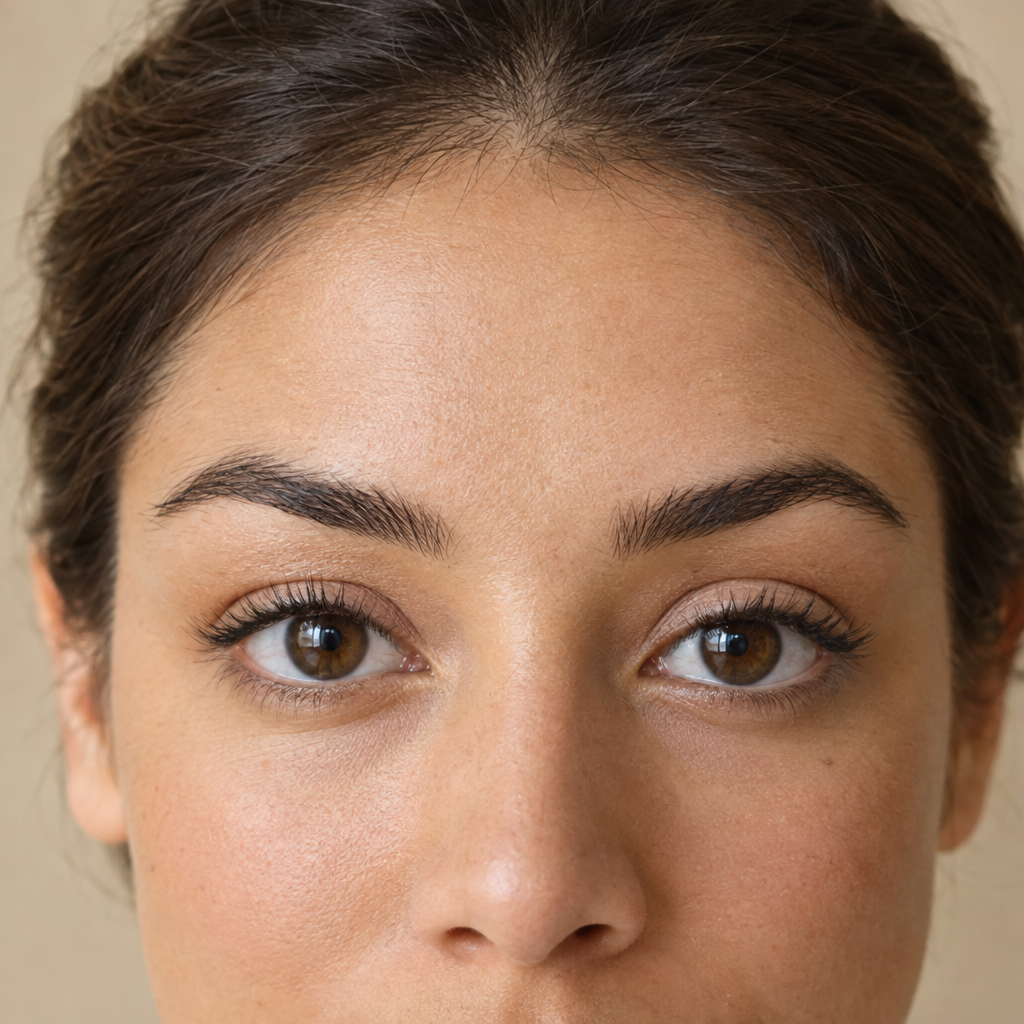
Lists of different eye shapes often place terms such as “almond,” “hooded,” and “wide-set” in one category. This can make it seem as though you must choose between them. In practice, these terms describe separate characteristics.
| Dimension | What to observe | Common descriptions |
|---|---|---|
| Outline | Shape of the visible opening | Almond, round, intermediate |
| Eyelid structure | Crease and visible lid skin | Monolid, hooded, visible crease |
| Corner direction | Inner corner height compared with outer corner height | Upturned, level, downturned |
| Spacing | Gap between the inner corners | Close-set, average-set, wide-set |
| Depth | Position relative to surrounding contours | Deep-set, intermediate, prominent |
Several labels can apply at once:
- Almond + hooded + upturned: a tapered opening, a partly covered lid crease, and outer corners that appear slightly higher.
- Round + visible crease + deep-set: a rounder opening, an observable crease, and eyes that sit beneath a noticeable brow bone.
- Monolid + level corners + wide-set: no readily discernible upper-lid crease, similar inner and outer corner heights, and a comparatively wider gap between the eyes.
None of these combinations ranks above another. They are neutral descriptions of visible features.
Eye outline: almond, round, and shapes in between
Outline means the visible opening between the upper and lower lids. Look at the whole opening rather than deciding from one isolated feature.
An almond-looking outline usually appears horizontally elongated, with distinct tapering toward the inner and outer corners. A rounder-looking outline has a more open central curve and relatively greater visible height.
Use several cues together:
- Horizontal elongation: Does the opening look long and narrow or more rounded?
- Central opening: How open does the middle appear with a relaxed gaze?
- Corner taper: Do the ends narrow distinctly?
- Iris contact: Do the lids meet or partly cover the top and bottom of the colored iris?
- Visible white: Is there white showing between the iris and either lid?
The sclera is the white outer part of the eye. Visible white above or below the iris can contribute to a rounder appearance, but it is not a deciding feature by itself. Looking upward, widening your eyes, squinting, or changing expression can alter how much white shows.
If your eyes have tapered corners but a fairly open center, “almond-leaning with a rounded center” may describe them more accurately than either label alone. Intermediate and blended descriptions are useful when the visual cues do not point consistently toward one category.
Eyelid structure: monolids, hooded lids, and visible creases
Eyelid structure concerns the upper-lid crease and the skin visible between that crease and the eyelashes. It does not determine the outline of the eye opening.
- Monolid: No distinct crease is readily discernible during a relaxed forward gaze or a gentle downward gaze. Lid fullness and contour can still vary considerably.
- Hooded lid: A crease is present, but skin above it overlaps the fold and partly or largely covers the mobile lid when the eye is open.
- Visible crease: The crease remains readily observable with the eyes naturally open and the brows relaxed.
An unseen crease during a forward gaze does not automatically indicate a monolid. To distinguish a concealed crease from no discernible crease, look gently downward without closing your eyes. If a crease becomes visible during this check but is covered again when you look forward, hooding is the more fitting description. If no distinct crease is readily visible in either position, monolid may be the more useful everyday label.
Return to a relaxed forward gaze to judge how much lid skin is normally visible. Raising your eyebrows can temporarily expose more lid space and make the structure appear different.
Partial hooding is common. The outer portion of a crease may be covered while the inner portion remains visible. One eye may also show more overlap than the other.
An epicanthic fold is a fold of skin near the inner corner of the eye. It is a separate feature, not another name for a monolid.
These structures occur across populations. A cosmetic description cannot establish ancestry, health, personality, or attractiveness.
Corner direction: upturned, level, and downturned eyes
Corner direction compares the relative height of the points where the upper and lower lids meet at the inner and outer corners. These meeting points are also called the medial and lateral canthi.
Compare the actual corners, not the eyebrow tail, longest eyelash, or the end of an eyeliner wing.
With your head upright and gaze straight ahead:
- Upturned: The outer corner appears higher than the inner corner.
- Level: The corners appear at approximately the same height.
- Downturned: The outer corner appears lower than the inner corner.
Judge each eye separately. One eye may look nearly level while the other appears slightly upturned or downturned.
Head tilt and camera rotation can change the apparent direction. Expression, lashes, and makeup can also obscure the corners. Do not rotate a photograph solely to make both eyes appear level because doing so may conceal a natural difference.
An exact angle is unnecessary for an everyday description. “Slightly upturned,” “nearly level,” or “slightly downturned” is usually more useful than trying to calculate a precise measurement. There is no corner direction you need to aim for.
Eye spacing: close-set, average-set, and wide-set
Spacing describes the gap between the eyes, not the outline of either eye.
Use the visible width of one eye, measured from its inner corner to its outer corner, as a rough reference:
| Gap between inner corners | Possible description |
|---|---|
| Visibly under one eye width | Close-set |
| Around one eye width | Average-set |
| Visibly over one eye width | Wide-set |
This is a descriptive reference, not a beauty rule or precise anatomical standard. “Average-set” is conventional styling language here. It does not prove that a measurement matches a statistical population average.
Keep the reference points consistent. Compare corner to corner, excluding eyelashes and eyeliner. If your eyes differ slightly in width, consider both rather than selecting whichever measurement produces a preferred label.
A turned face, a very close selfie, or lens perspective can distort the comparison. Borderline results are better described as “around one eye width” than assigned a firm category.
Eye depth: deep-set and prominent appearances
Depth describes how the eyes appear to sit relative to the brow bone and surrounding contours.
Deep-set eyes appear positioned farther beneath a noticeable brow bone. Prominent eyes appear to project more visibly relative to the surrounding eye area. Many people fall between these descriptions.
A straight-on view may not show depth clearly. A gentle three-quarter view in soft, even light can provide more context, but shadows alone are not evidence of deeper placement. Strong overhead or side lighting can make the brow area appear more pronounced.
Brow shape, dark eye makeup, expression, camera angle, and lens perspective can also change the impression of depth. Visual depth classification is subjective, not a medical assessment. A naturally prominent appearance should not be confused with a new or sudden change in eye position.
How to identify your eyes in five steps
Start with a mirror in soft, indirect daylight. Keep your head upright, look straight ahead, relax your brows, and let your eyes open naturally without deliberately widening or narrowing them. Minimal makeup makes the lid boundaries and corners easier to see.
1. Describe the outline
Look at horizontal elongation, central opening, and corner taper together. Note any visible white above or below the iris, but do not let that single cue decide the result.
Choose one of these flexible descriptions:
- Almond-leaning
- Round-leaning
- Intermediate
- Tapered with a rounded center
2. Inspect the open-eye crease
Observe whether a crease is distinct and how much mobile lid remains visible. Record monolid, visible crease, partial hooding, or more extensive hooding as appropriate.
If no crease is visible straight ahead, look gently downward. A crease that appears during the downward check but becomes covered when you return to a forward gaze suggests hooding rather than no discernible crease. Avoid raising your eyebrows during either check.
3. Compare corner height
Imagine a horizontal line extending from the inner corner of each eye. Does that eye’s outer corner appear above, near, or below the line?
Ignore eyelashes, eyeliner, and the direction of the eyebrow. Record each eye separately if their corner positions differ.
4. Estimate spacing
Compare the gap between the inner corners with one visible eye width. Record the result as under, around, or over one eye width. Keep this as an approximate observation rather than a precise measurement.
5. Observe the relationship to the brow bone
Look straight ahead, then use a gentle three-quarter view if needed. Describe the eyes as deep-set, intermediate, prominent, or uncertain rather than relying on one shadow or photograph.
Write one short description for each dimension. For example:
Round-leaning outline; partial outer hooding; nearly level corners; around one eye width apart; depth unclear.
“Unclear” is a useful result. You do not need to resolve every dimension or force a borderline feature into one category.
Check your result in more than one view
Compare your relaxed mirror view with at least one straight-on photograph taken at roughly eye level. Use a comfortable camera distance rather than a very close selfie, keep the camera upright, and avoid filters.
Ask three questions:
- Do the same outline and crease features appear in both views?
- Are the actual corners visible, without liner or lashes concealing them?
- Can a difference be explained by gaze, expression, lighting, or head position?
Avoid deciding from a tilted selfie, strong side light, a squint, a dramatic expression, or heavily lined eyes. Remove false lashes or account for them if they cover the crease or corners.
If the views disagree, keep the description broad. The aim is to notice consistent features, not repeatedly measure tiny differences or compare your eyes with an ideal.
Mixed features, asymmetry, and changes worth checking
Your left and right eyes do not need to look identical. One may have more hooding, a clearer crease, a rounder center, or a slightly different outer-corner position.
Mixed cases often benefit from more specific wording:
- “Partial outer hooding” describes where the overlap occurs.
- “Crease visible with relaxed brows, less visible when smiling” captures expression-dependent variation.
- “Slightly more rounded on the left” acknowledges a difference without forcing matching labels.
- “Almond-leaning with a wider central opening” combines two outline observations.
Your usual appearance can also vary over time without changing your underlying eye structure. Temporary puffiness may make a crease less visible or cause one eyelid to appear fuller. It should not determine a lasting category.
Gradual age-related changes in eyelid skin and surrounding tissues can alter crease visibility and make hooding more noticeable. These changes vary from person to person, so an eye description that fit several years ago may not describe the current appearance as closely.
Keep appearance descriptions separate from healthcare. Sudden or significant changes in eyelid position, swelling, asymmetry, discomfort, or vision should be discussed with an appropriate healthcare professional rather than interpreted through an appearance tool. Sudden vision loss or severe eye pain requires urgent medical attention. Cosmetic labels cannot diagnose a condition.
Makeup choices based on the effect you want
You do not need a perfectly settled label to choose makeup. Start with the effect you enjoy, then adapt the placement to the lid space visible when your eyes are open.
| Desired effect | Starting technique |
|---|---|
| Emphasize a crease | Place shadow at the crease, or slightly above it if the fold hides the color |
| Extend the outer corner | Begin with a thin liner extension following the outer lid, then lengthen gradually |
| Create a rounder impression | Concentrate liner, mascara, or brightness near the center of the eye |
| Show natural lid structure | Use thinner liner and less-dense lashes |
To emphasize a crease
Look straight ahead while placing a soft shadow. Apply the color at the crease, or slightly above it if the natural fold hides the shadow when your eyes are open. Blend the edge lightly before adding more depth.
This placement can be more reliable than following a fold with your eye closed, especially when part of the mobile lid becomes concealed in a relaxed gaze.
To extend the outer corner
Start with a short, narrow extension of liner or shadow. Follow the direction you want visually rather than assuming the eyebrow tail must determine the angle.
Check the result with a relaxed gaze before making the line longer or thicker. Drawing only with the eye closed can produce an extension that changes direction once the lid folds naturally.
To create a rounder effect
Keep more definition near the center of the upper lash line instead of extending it far beyond the outer corner. A small amount of central lid brightness or mascara concentrated on the middle lashes can reinforce the effect.
You can keep the outer corners softly defined so the central emphasis remains visible without creating a sharp boundary.
To keep lid structure visible
Use a thin line close to the lashes and choose less-dense false lashes if you wear them. Heavy liner can cover much of a small visible lid area, while a finer application leaves more of the natural contour visible.
These techniques are creative options, not corrections. Keep, combine, modify, or ignore them according to your preferences.
Common questions about different eye shapes
Can someone have more than one eye-shape label?
Yes. Outline, eyelid structure, corner direction, spacing, and depth describe separate characteristics. “Almond, hooded, and slightly upturned” is a compatible combination, not a contradiction.
Are hooded eyes an outline?
No. Hooding describes how upper-lid skin overlaps the crease or mobile lid. It can accompany almond, round, or intermediate outlines.
What is the difference between eye outline and eye position?
Outline refers to the visible opening between the upper and lower lids. Position may refer to how far apart the eyes sit or how they relate to the brow bone and surrounding contours. Corner direction is another separate observation.
Why do my two eyes look slightly different?
Natural asymmetry, expression, uneven lighting, and temporary puffiness can all contribute. A longstanding small difference is different from a sudden change, particularly one accompanied by discomfort or altered vision.
Can eye features change with age?
Their appearance can change gradually as eyelid skin and surrounding tissues change. Creases may become more or less visible, and hooding may become more noticeable. Everyday styling labels are not fixed anatomical diagnoses.
Does visible white mean I have round eyes?
Not by itself. Visible white above or below the iris can support a rounder-looking outline, but gaze direction, expression, and lid position also affect how much sclera is visible. Consider elongation, central opening, corner taper, and iris contact together.
Can a photo or tool classify my eyes with certainty?
No. A photo captures one view under particular conditions, and familiar labels have flexible boundaries. The most useful description is one that fits your relaxed appearance across ordinary views, even if it includes words such as “mixed,” “slightly,” or “in between.”
Explore your eye shape from a photo
Facefy’s Eye Shape Detector can offer an additional photo-based estimate. Treat its result as a visual interpretation, not a definitive classification. Lighting, pose, expression, makeup, and image quality can affect what it appears to show.