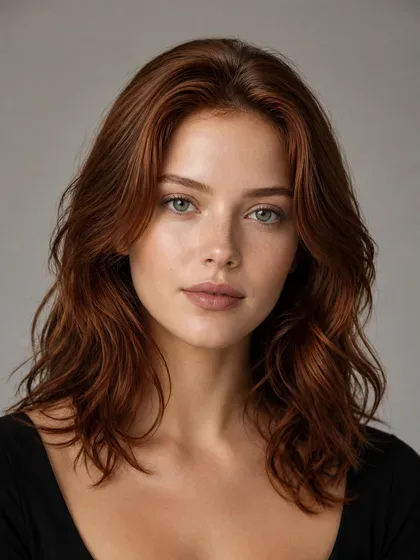
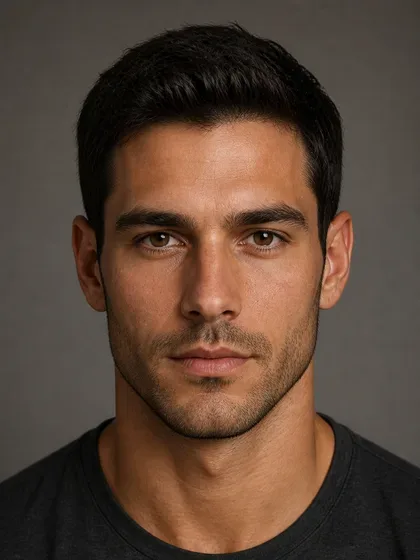
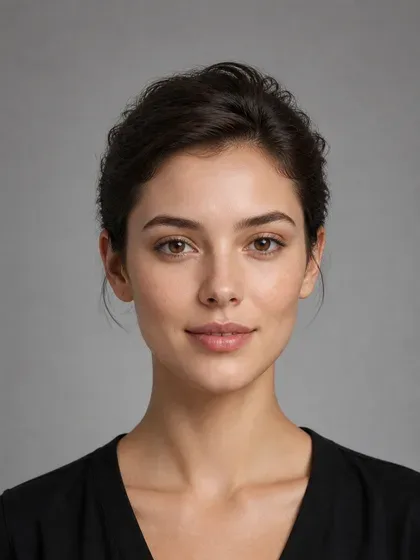
Face Shape Calculator: How to Measure and Read Your Result
Learn how a face shape calculator works, take four consistent measurements, interpret mixed results, and use your estimate for styling.
A face shape calculator compares your face length, forehead width, cheekbone width, and jaw width, often alongside jaw and chin contours, to estimate a likely shape: oval, round, square, oblong, heart, diamond, or triangle.
The result is flexible styling guidance, not a permanent or objective classification. Many faces combine traits from more than one category.
For a useful estimate, take a clear, straight-on photo, compare several proportions together, and allow for a mixed result. A slightly longer face or a broader jaw alone does not determine your shape.
What a face shape calculator can tell you
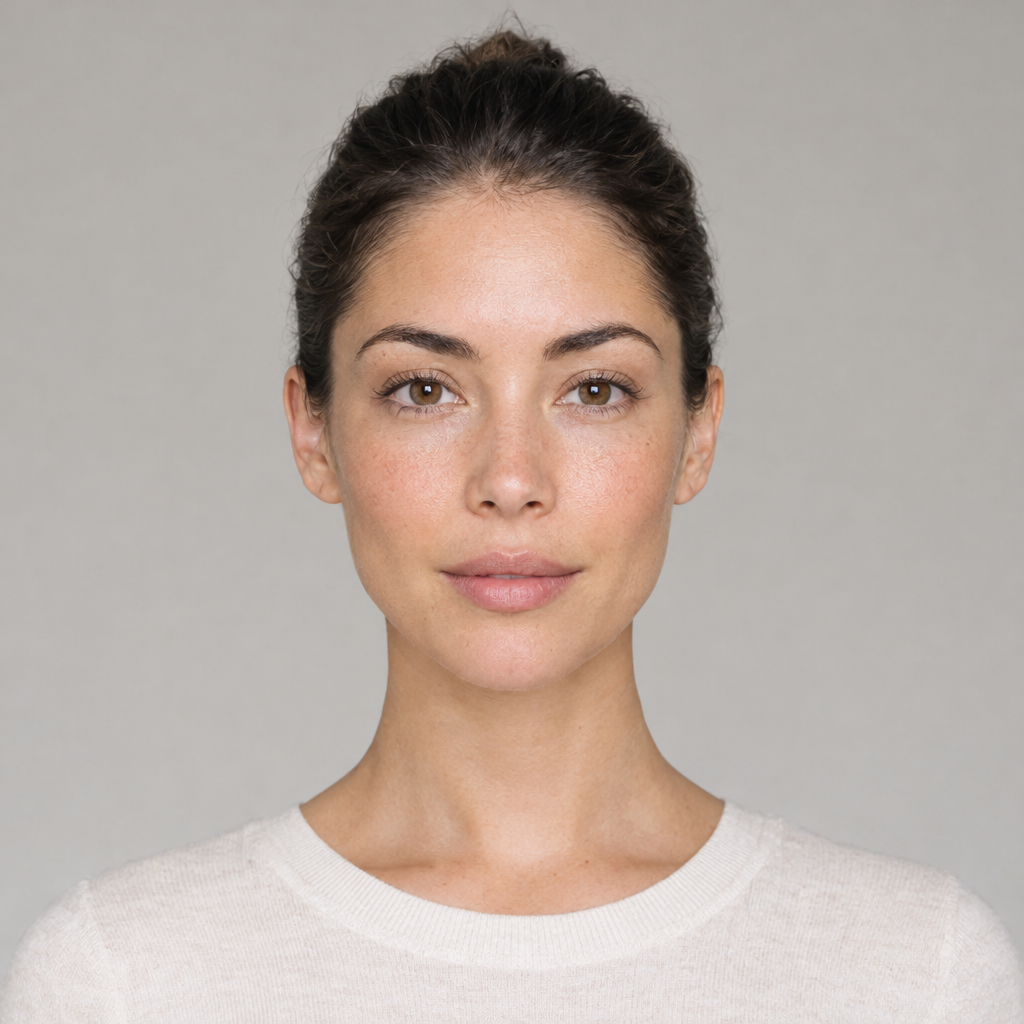
A calculator helps answer practical questions such as “Is my face noticeably longer than it is wide?” and “Is my forehead, cheek area, or jaw the broadest region?”
There are two common approaches:
- Photo-based tools estimate visible proportions and contours from an uploaded image. Camera position, lighting, hair, and expression can influence the result.
- Manual calculators compare measurements you enter yourself. Measuring one straight-on photo is usually easier to repeat than measuring a moving reflection or wrapping a tape around facial curves.
Neither approach captures your full three-dimensional facial structure. Face shape categories are descriptive shortcuts, not medical assessments, identity checks, or measures of attractiveness. Two people with the same category can look quite different.
The most useful result may be a description rather than a single label, such as “longer than wide, with prominent cheek width and a softly rounded jaw.”
How to take photos that produce a more consistent estimate
A suitable photo makes the facial outline visible without exaggerating one region.
- Position the camera near eye level. Keep your head upright rather than tilting your chin upward or downward.
- Look directly forward. Relax your mouth and jaw. A broad smile can change the visible cheek and lower-face outline.
- Move hair away from the boundaries. Reveal the forehead, cheek edges, and jaw. Avoid pulling hair so tightly that it changes your expression.
- Use soft, even frontal lighting. Face a window with indirect daylight, or use a diffuse light near the camera. Strong side lighting can obscure a cheek or jaw edge.
- Step back from a close selfie position. A camera very near your face makes nearer features appear larger relative to more distant ones. This can exaggerate central features and alter apparent proportions. There is no single ideal distance for every camera, but a supported camera taken from farther away is generally more useful than a close handheld selfie.
- Include the complete face. Keep the upper boundary and chin visible, with space around the outline. Avoid filters, face reshaping, and uneven crops.
Moving the camera farther away changes perspective. Simply zooming into a close selfie afterward does not undo that perspective.
Use a three-photo consistency check
Take a small set of reference images:
- Photo 1: A front-facing image with a neutral expression.
- Photo 2: Reset the camera position, then recreate the same eye-level setup.
- Photo 3: Use different soft, neutral lighting while keeping your pose and framing similar.
If all three suggest the same broad pattern, that is a useful starting point. If the category changes, keep the two strongest possibilities and review camera height, head angle, distance, expression, crop, and lighting.
This is a check for photo sensitivity, not a reason to keep taking pictures until you get a preferred label.
How to measure your face in four steps
Use one straight-on image for all four measurements. You can measure in pixels on screen or use a ruler on a printed photo. The units matter less than keeping the image scale and endpoints consistent.
Measure straight across the image, not along the curved surface of the face.
1. Measure face length
Measure from the center of the hairline to the lowest point of the chin.
If your hairline is receding, irregular, hidden, or difficult to identify, choose a consistent visible upper-face boundary and record exactly where you placed it. Reusing that substitute endpoint can make measurements from your own photos more repeatable.
Repeatability is not the same as comparability. A ratio based on a substitute endpoint should not be treated as equivalent to a calculator input defined specifically from the hairline to the chin. If you use a different boundary, interpret the result within your own set of photos rather than comparing it directly with thresholds based on another method.
Do not substitute the top of your hairstyle for the hairline.
2. Measure forehead width
Measure across the broadest visible part of the forehead, using corresponding points at the outer edges.
Keep the line level. Do not include hair volume or use the eyebrows as the forehead’s outer boundaries.
3. Measure cheekbone width
Measure across the widest visible cheek area, keeping the line horizontal.
Use the facial outline rather than a highlight, shadow, or contour-makeup edge. A photograph shows the surface over the cheekbones, not a direct measurement of the bones themselves.
4. Measure jaw width
Measure between corresponding points where the jaw is widest, usually around the visible lower-jaw corners.
Use a straight horizontal span. Do not trace from one jaw corner around the chin to the other, and do not mix this method with calculators that request a different jaw measurement.
Once you have all four values, compare:
- Face length with the widest horizontal measurement.
- Forehead width with cheekbone width.
- Jaw width with forehead and cheekbone widths.
- The measured widths with the visible jaw contour and chin shape.
For example, measurements of 180 units long and 140 units wide give a length-to-width ratio of about 1.29. That describes relative length, but it does not establish an oval or oblong shape by itself.
Face shape comparison guide
Use the following patterns as matching cues. Compare the complete pattern rather than choosing a label from one measurement or feature.
| Face shape | Overall length | Widest region | Jaw contour | Chin shape |
|---|---|---|---|---|
| Oval | Longer than wide, without pronounced elongation | Often the cheekbones, with relatively balanced widths | Softly curved and gradually narrowing | Rounded or gently tapered |
| Round | Relatively close to overall width | Usually the cheek area | Curved, with less pronounced corners | Rounded rather than strongly tapered |
| Square | Relatively close to overall width | Forehead, cheeks, and jaw broadly aligned | More angular, with visible jaw corners | Broad, sometimes with a flatter outline |
| Oblong | Noticeably longer than wide | Horizontal widths often relatively similar | Often straighter, with limited taper | Rounded or broad |
| Heart | Variable, but often longer than wide | Forehead or upper face | Narrows toward the chin | Tapered, sometimes pointed |
| Diamond | Usually longer than wide | Cheekbones, beyond the forehead and jaw | Narrows below the cheeks | Tapered or pointed |
| Triangle | Variable and not the main distinguishing cue | Jaw, with a narrower forehead | Broad through the lower face | Broad or softly rounded |
These are practical patterns, not universally standardized numerical definitions. A calculator may use different category boundaries, and some systems use “pear” for a jaw-dominant triangle shape.
Practical ambiguity rule: when to call a result mixed
If the two widest horizontal measurements differ by roughly 5% or less, treat them as effectively close for this comparison. If the other cues do not clearly distinguish a category, describe the result as mixed or borderline.
This is a practical decision aid, not a scientific standard or a measure of calculator accuracy.
To calculate the difference:
Difference percentage = (larger width − smaller width) ÷ larger width × 100
For example, a cheekbone width of 140 units and a forehead width of 135 units differ by about 3.6%. It would be unhelpful to make a firm heart-versus-diamond distinction based only on that small gap.
Use this tie-breaker sequence:
- Compare length with overall width. Does the face look relatively compact or noticeably elongated?
- Identify the widest region. Is one area clearly broader, or are the widths close?
- Review jaw contour and chin shape. Are the corners angular or curved? Is the chin broad, rounded, or tapered?
If those cues point in different directions, keep two possibilities:
- Oval-oblong: A softly curved outline with enough length to sit between categories.
- Round-square: Similar length and width, with some jaw angularity.
- Heart-diamond: A tapered lower face with forehead and cheekbone widths too close to separate confidently.
A mixed description is often more useful for styling than a precise-sounding label.
Hypothetical measurement example
Suppose a photo produces these measurements:
- Face length: 180 units
- Forehead width: 136 units
- Cheekbone width: 140 units
- Jaw width: 118 units
- Jaw contour: gradually narrowing
- Chin: tapered
The observable pattern is a face that is longer than wide, with similar forehead and cheek widths and a narrower lower face. Those traits could support an oval interpretation if the outline narrows gently and the cheekbones do not stand out clearly from the forehead.
A heart interpretation becomes more plausible if the upper forehead appears distinctly broad relative to the lower jaw. A diamond interpretation would require clearer cheekbone prominence, with the cheeks visibly wider than both the forehead and jaw. Here, the 4-unit difference between the forehead and cheeks is too small to establish that on its own.
The most defensible result would therefore describe the visible traits first and retain oval, heart, or diamond as possibilities until the outline provides a stronger distinguishing cue.
Edge cases that can change the result
Widow’s peaks and receding hairlines
A widow’s peak changes the shape of the hairline, but it does not automatically make the face heart-shaped. Compare the actual forehead width with the cheeks and jaw.
A receding or unclear hairline makes face length harder to interpret. Use the same upper boundary consistently when comparing your own photos, and give more weight to horizontal widths and the lower-face outline. Do not compare a ratio based on that substitute boundary directly with a calculator that defines face length from the natural hairline to the chin.
Facial hair that covers the jaw
A beard can add apparent width, length, or angularity. If your goal is to estimate the underlying face shape, use a suitable clean-shaven reference photo if one is available. Otherwise, acknowledge that the jaw boundary is partly hidden.
For grooming decisions, the current beard outline may matter more than the category underneath it.
Natural differences in the facial outline
Small differences between the two sides of a face can affect where measurement points appear. Keep your head centered, use corresponding endpoints, and avoid letting a minor variation determine the whole result.
Changing facial fullness and presentation
Changes in facial fullness can soften or reveal cheek and jaw contours while the broad proportional pattern remains similar. Aging and hairline changes can also affect the visible outline.
Hair volume, makeup, facial hair, expression, head angle, lighting, and crop can change the impression immediately, even when facial structure has not changed.
Commonly overlapping categories
- Oval versus oblong: Focus on the degree of length relative to width. Both can have rounded contours, but oblong appears more elongated.
- Round versus square: Focus on jaw contour. Similar length and width can occur in both, but square patterns have more angular corners.
- Heart versus diamond: Compare forehead and cheekbone width. Heart patterns are broader toward the upper face, while diamond patterns are widest at the cheeks.
If the distinguishing cue is hidden or only marginally different, retain the blended description.
How to use your result for hairstyles, glasses, makeup, and grooming
A shape estimate describes your starting point. It does not decide what you should wear.
1. Choose what you want to emphasize
Start with a preference rather than a correction:
- Draw attention to your eyes.
- Highlight your cheekbones.
- Emphasize a defined jaw.
- Create more visible width or height through styling.
- Showcase your natural hair texture.
You do not have to make every face look oval or minimize whichever feature defines your category.
2. Compare two or three options
Choose alternatives that differ in one useful way:
| Styling choice | Compare | Notice |
|---|---|---|
| Hairstyles | Crown height versus side volume | Overall silhouette |
| Glasses | Rounded versus angular frames | Contrast and eye emphasis |
| Makeup | Higher versus central blush placement | Where attention gathers |
| Facial hair | Fuller sides versus a longer chin area | Lower-face outline |
These are comparison ideas, not shape-based prescriptions. For example, crown volume can add apparent height, while side volume can add apparent width. Either effect may suit your preference.
3. Judge the complete look
Consider hair texture, density, color, styling time, frame scale, facial hair, and personal style. For glasses, bridge fit, comfort, and whether the frames sit securely matter more than a category recommendation.
A hairstyle that suits your preferred silhouette may still require more maintenance than you want. A frame that contrasts with your face shape may be less appealing to you than one that echoes its curves.
Do not reject an option solely because a guide calls it unsuitable. Compare how it actually looks and feels.
Privacy and responsible photo use
Before uploading a facial photo:
- Review the service’s privacy policy and image-retention terms.
- Check whether deletion options are available and how images may be used.
- Use another person’s photo only with their clear consent.
- Choose an image without unnecessary background details or other identifiable people.
- Keep enough framing to show your own full facial outline.
Common questions about face shape calculators
Why do different calculators give different results?
Tools may use different measurement methods, category definitions, or ways of interpreting contours. Image quality and capture conditions also matter. If one says oval and another says oblong, compare relative length rather than assuming one label must be definitively correct.
Can my face shape change?
Its appearance can change with facial fullness, aging, hairlines, facial hair, and styling. A new category does not necessarily indicate a substantial structural change, especially if the photos were taken differently.
How can I distinguish oval from oblong?
Compare face length with overall width while keeping the hairline boundary consistent. Oval generally looks longer than wide without pronounced elongation, while oblong looks noticeably longer. There is no universal ratio that reliably separates every face.
How can I distinguish round from square?
Look at the jaw contour rather than width alone. Both may have relatively similar length and width. A curved lower outline suggests round, while more pronounced jaw corners suggest square. A round-square blend is also reasonable.
How can I distinguish heart from diamond?
Compare the forehead with the cheekbones. A broader forehead or upper face suggests heart, while clearly wider cheekbones with a narrower forehead suggest diamond. When those widths are close, use the mixed-result rule.
Is one face shape better for hairstyles, glasses, or makeup?
No category is inherently better. Shape can help you predict visual effects, but fit, texture, comfort, and preference determine whether an option works for you. Keep the estimate as a useful description, not a limit on your choices.
Related resources
Try the Face Shape Detector
If you would rather begin with a photo-based estimate, use the Face Shape Detector to explore a likely category. Compare the result with your visible proportions, allow for mixed traits, and review the service’s privacy terms before uploading a photo.